

Unpacking "Being": A Journey into Metaphysical Foundations
The concept of Being stands as one of the most fundamental and elusive inquiries in all of Metaphysics. Far from a simple dictionary definition, "Being" in philosophy refers to the very nature of existence, what it means for something to be. It delves into the underlying Principle that governs all reality, exploring questions of substance, existence, and the relationship between the One and Many. This supporting article unpacks the rich historical tapestry of this concept, drawing insights from the Great Books of the Western World to illuminate why understanding "Being" is crucial for comprehending ourselves and the cosmos.
The Genesis of Inquiry: What Does it Mean "To Be"?
From the earliest philosophical stirrings, thinkers have grappled with the profound question of Being. It's not merely asking if something exists, but how it exists, what its essence is, and why there is something rather than nothing. This primal inquiry forms the bedrock of Metaphysics, the branch of philosophy concerned with the fundamental nature of reality, including the first causes and principles of things.
Early Greek philosophers, often considered the pioneers of Western thought, laid the groundwork for this exploration:
- Parmenides famously argued for the unchanging, eternal, and indivisible nature of Being, positing that "what is, is, and what is not, is not." For him, change and multiplicity were illusions.
- Heraclitus, in stark contrast, emphasized the constant flux of all things, declaring that "you cannot step into the same river twice." Yet, even in his doctrine of change, there was an underlying Principle (the Logos) that governed this ceaseless transformation.
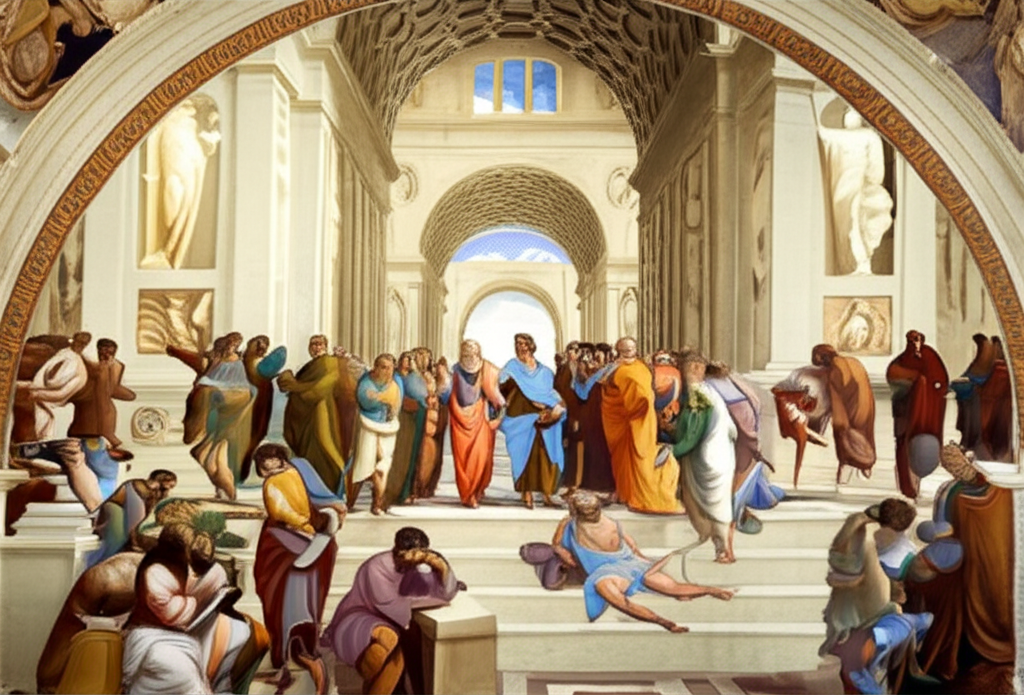
- Plato, influenced by both, sought to reconcile permanence and change through his theory of Forms. True Being, for Plato, resided in the immutable, perfect Forms (e.g., the Form of Beauty, the Form of Justice), while the sensible world was merely an imperfect reflection.
- Aristotle, Plato's student, brought the inquiry back to the empirical world, exploring Being in terms of substance, actuality, and potentiality. He sought to understand how individual things exist and change, emphasizing the concept of ousia (substance) as the primary mode of Being.
These foundational debates, deeply explored within the Great Books of the Western World, reveal that the concept of Being is anything but monolithic; it is a dynamic field of inquiry that has shaped millennia of philosophical thought.
The Problem of the One and Many
One of the most enduring challenges in understanding Being is the "Problem of the One and Many." This fundamental metaphysical puzzle asks: How can a multitude of diverse things exist, yet simultaneously be part of a unified reality? Or, conversely, if there is a fundamental unity (the One), how does it give rise to the apparent diversity (the Many) we perceive?
Consider these perspectives:
- Monism: Proposes that reality is fundamentally one. Parmenides is a classic example, where all apparent multiplicity is an illusion.
- Pluralism: Argues that reality consists of many ultimate entities. Empedocles, with his four roots (earth, air, fire, water), offers a form of pluralism.
- Dualism: A specific form of pluralism, typically positing two fundamental substances, such as mind and body (Descartes).
The One and Many problem isn't just an abstract intellectual exercise; it has profound implications for how we understand identity, change, and the very structure of the cosmos. If everything is truly one, then individual distinctions might be illusory. If everything is truly many, then what binds it all together into a coherent universe? This tension between unity and diversity is a recurring theme in the history of Metaphysics.
Being as Principle and Ground of Existence
The search for Being often converges with the search for a fundamental Principle or Archē (as the Pre-Socratics called it) – the ultimate source or explanation for all that exists. This Principle is not merely a cause in a linear sense, but rather the underlying ground or foundation from which all other things derive their existence and nature.
Philosophers have proposed various Principles:
| Philosopher/School | Proposed Principle(s) of Being | Description |
|---|---|---|
| Thales | Water | The primary substance from which all things originate and return. |
| Anaximander | The Apeiron (Boundless) | An indefinite, primordial substance that is eternal, ageless, and encompasses all the worlds. |
| Pythagoras | Number | The underlying order and harmony of the cosmos, dictating relationships and structures. |
| Plato | The Form of the Good | The ultimate source of all reality, knowledge, and value, illuminating all other Forms. |
| Aristotle | God/Unmoved Mover | The ultimate Principle of motion and change, a pure actuality that causes motion without being moved. |
The pursuit of these Principles is an attempt to find a stable, intelligible basis for reality amidst the apparent chaos and change of the world. It is the quest to understand the why and how of existence, moving beyond mere observation to penetrate the deeper layers of Being.
The Enduring Relevance of Being
Why does this ancient inquiry into Being still matter today? Because questions about existence, reality, and fundamental principles are timeless. Whether we are discussing quantum physics, artificial intelligence, or the nature of consciousness, we are, in essence, grappling with facets of Metaphysics and the concept of Being.
The frameworks developed by the great thinkers, from the Presocratics to Heidegger, provide us with invaluable tools to:
- Critically analyze our assumptions about reality: Are our perceptions accurate? Is there an objective reality beyond our subjective experience?
- Understand the limits and possibilities of knowledge: What can we truly know about Being?
- Formulate coherent worldviews: How do all the disparate elements of our experience fit together into a meaningful whole?
The metaphysical concept of Being is not a solved puzzle but an eternal invitation to ponder the deepest mysteries of existence. It compels us to ask not just what things are, but that they are, and what it means for them to truly be.
YouTube Video Suggestions:
-
📹 Related Video: What is Philosophy?
Video by: The School of Life
💡 Want different videos? Search YouTube for: ""Parmenides vs Heraclitus - Crash Course Philosophy""
2. ## 📹 Related Video: ARISTOTLE ON: The Nicomachean Ethics
Video by: The School of Life
💡 Want different videos? Search YouTube for: ""Aristotle Metaphysics Being as Being""