

The Fundamental Question: What Does It Mean to Be?
The metaphysical concept of Being stands as the bedrock of philosophical inquiry, a question so fundamental that its very articulation often feels like a journey into the abyss of thought. In essence, Being refers to the ultimate reality of existence itself – that which is, in contrast to that which is not. It’s the raw, unadulterated fact of existence, stripped of all particular qualities and attributes. For millennia, philosophers have grappled with this elusive concept, attempting to define, categorize, and understand the very Principle that underpins all phenomena. This article delves into the rich history and multifaceted interpretations of Being, drawing insights from the Great Books of the Western World to illuminate its profound significance in Metaphysics.
Metaphysics and the Primacy of Being
Metaphysics is often described as the branch of philosophy concerned with the fundamental nature of reality, including the relationship between mind and matter, between substance and attribute, and between potentiality and actuality. At its heart lies the question of Being. To ask "What is Being?" is to inquire into the most universal aspect of everything that exists. It’s not about what a particular thing is (a tree, a thought, a number), but that it is. This distinction between whatness (essence) and thatness (existence or Being) has been a persistent thread throughout philosophical history.
- The Scope of Inquiry:
- Ontology: The study of Being itself.
- Cosmology: The study of the universe as a whole, its origin, and structure.
- Theology: The study of God or ultimate divine reality.
These branches are deeply intertwined, as understanding the nature of Being often leads to conclusions about the nature of the cosmos and, for many thinkers, the divine.
Ancient Echoes: Parmenides, Plato, and Aristotle
The journey into Being begins in ancient Greece, where the earliest thinkers laid the groundwork for all subsequent discussions.
Parmenides: The Unchanging One
One of the most radical early positions was articulated by Parmenides of Elea. For Parmenides, Being is singular, eternal, unchanging, and indivisible. He famously declared, "It is; it is impossible for it not to be." Non-being, or nothingness, is inconceivable and inexpressible. Therefore, change, motion, and multiplicity are mere illusions of the senses. This powerful assertion presented the philosophical world with the profound problem of the One and Many: if Being is truly one and unchanging, how can we account for the diverse, changing world we experience?
- Key Parmenidean Tenets:
- Being is uncreated and indestructible.
- Being is a continuous, undifferentiated whole.
- Being is immobile and perfect.
Plato: Forms and Participation in Being
Plato, deeply influenced by Parmenides' insistence on the unchanging nature of true reality, sought to reconcile the One and Many through his theory of Forms. For Plato, true Being resides in the transcendent, eternal Forms (e.g., the Form of Beauty, the Form of Justice). Particular objects in the sensible world are mere shadows or imperfect copies that participate in these Forms. The highest of these Forms is the Form of the Good, which illuminates all other Forms and is, in a sense, the ultimate source of Being and intelligibility.
- Plato's Hierarchy of Being:
- Forms: True, eternal, unchanging reality (e.g., Justice Itself).
- Particulars: Imperfect, changing copies of Forms (e.g., a just act).
- Images/Shadows: Representations of particulars (e.g., a painting of a just act).
Aristotle: Being is Said in Many Ways
Aristotle, Plato's most famous student, offered a more immanent and nuanced approach. Rejecting the separate realm of Forms, Aristotle argued that Being is not a single, monolithic concept but is "said in many ways." He identified different categories of Being, with substance (ousia) being primary. A substance is an individual, concrete thing (e.g., a specific horse, a particular human). Other categories of Being (quantity, quality, relation, etc.) are dependent on substance.
Aristotle also introduced the crucial distinction between potentiality and actuality. A seed has the potentiality to become a tree, and a tree is the actuality of that potential. This framework allowed him to account for change and motion without denying the reality of Being. For Aristotle, the Principle of non-contradiction—that something cannot both be and not be at the same time in the same respect—is the most fundamental Principle of Being and thought.
Medieval Elaborations: Essence, Existence, and God as Pure Being
The medieval period saw a profound integration of Greek philosophy with Abrahamic theology, particularly through figures like St. Thomas Aquinas.
Aquinas: Essence, Existence, and the Actus Essendi
St. Thomas Aquinas, drawing heavily on Aristotle, distinguished between essence (what a thing is) and existence (that a thing is, its actus essendi or act of Being). In all created beings, essence and existence are distinct; a thing receives its existence. However, in God, essence and existence are identical. God is pure Being (ipsum esse subsistens), the ultimate Principle and source of all other existence. This concept established God as the necessary ground for all contingent Being.
Modern Interpretations: From Mind to Spirit
The modern era brought new perspectives, often shifting the focus from objective reality to subjective experience and the role of consciousness.
- René Descartes: With his famous dictum "Cogito, ergo sum" ("I think, therefore I am"), Descartes grounded Being in the undeniable fact of conscious self-awareness. The Being of the self (res cogitans) and extended matter (res extensa) became distinct substances.
- Baruch Spinoza: Spinoza posited a single, infinite substance—God or Nature—which is the only true Being. All particular things are merely modes or attributes of this one substance, manifesting its infinite essence. This monistic view dissolved the Cartesian dualism.
- Immanuel Kant: Kant critically examined the limits of human reason, arguing that we can only know phenomena (things as they appear to us), not noumena (things-in-themselves). Being, as a pure concept, is not a real predicate that adds anything to the essence of a thing. Instead, it is a transcendental condition for thought.
- G.W.F. Hegel: Hegel conceived of Being as an unfolding, dynamic process of Spirit or Absolute Idea. Being is not static but develops through dialectical stages, moving from pure, indeterminate Being to non-being, and then to becoming, ultimately realizing itself in the Absolute.
The Enduring Problem of the One and Many
The problem of the One and Many remains a central challenge in the metaphysical concept of Being. How can we reconcile the apparent unity of Being (as suggested by Parmenides or Spinoza) with the undeniable multiplicity and diversity of the world?
| Philosophical Approach | View on One and Many | Key Figures |
|---|---|---|
| Monism | Reality is fundamentally one; multiplicity is an illusion. | Parmenides, Spinoza |
| Dualism | Reality consists of two fundamental kinds of Being. | Plato (Forms & Particulars), Descartes (Mind & Body) |
| Pluralism | Reality is composed of many distinct kinds of Being. | Empedocles, Democritus, Leibniz (Monads) |
Each approach offers a different Principle for understanding the structure of reality, demonstrating the persistent difficulty in unifying our experience of diversity with a cohesive understanding of ultimate Being.
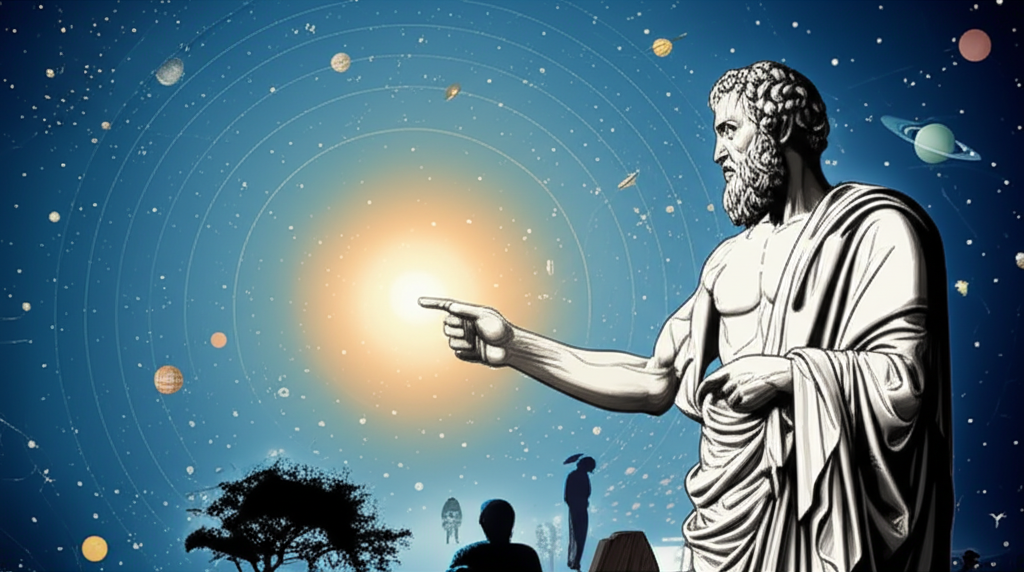
Why Does the Concept of Being Still Matter?
Beyond its historical and academic significance, grappling with the concept of Being forces us to confront the most profound questions about our own existence and the nature of reality. It underpins our understanding of truth, knowledge, ethics, and even the meaning of life. Every scientific discovery, every artistic creation, and every personal experience implicitly relies on the fact that something is, rather than nothing. The Principle of Being is not merely an abstract thought experiment; it is the silent foundation of all our endeavors.
Conclusion: The Unfolding Mystery
The metaphysical concept of Being is not a problem to be solved and discarded, but rather an ongoing inquiry, a perpetual unfolding of understanding. From Parmenides' assertion of a singular, unchanging reality to Aristotle's multifaceted categories, and from Aquinas's distinction between essence and existence to Hegel's dynamic Spirit, philosophers have continuously sought to grasp the elusive Principle of what it means to exist. The journey through the Great Books of the Western World reveals that while the answers may vary, the question of Being itself remains the most compelling and essential pursuit of human thought, forever inviting us to ponder the deepest mystery: Why is there something rather than nothing?
YouTube Video Suggestions:
-
📹 Related Video: ARISTOTLE ON: The Nicomachean Ethics
Video by: The School of Life
💡 Want different videos? Search YouTube for: ""Parmenides on Being and Non-Being Explained""
2. ## 📹 Related Video: ARISTOTLE ON: The Nicomachean Ethics
Video by: The School of Life
💡 Want different videos? Search YouTube for: ""Aristotle Metaphysics Substance Potentiality Actuality""