

The Metaphysical Concept of Being: Unpacking Existence
The concept of Being stands as one of the most fundamental and enduring inquiries within Metaphysics, the branch of philosophy dedicated to understanding the ultimate nature of reality. At its core, it asks: What does it mean for something to be? This seemingly simple question unravels into profound complexities, exploring the very ground of existence, the relationship between the One and Many, and the underlying Principle that governs all things. From ancient Greek philosophers grappling with permanence and change, to medieval thinkers linking existence to divinity, and modern existentialists pondering human reality, the quest to define Being is a journey into the heart of what is.
What is Being, Anyway? A Philosophical Quest
When we talk about Being, we're not just referring to the mere fact of existence in a casual sense. We're delving into the deepest philosophical waters, attempting to grasp the essence of what makes something real, rather than nothing. Metaphysics provides the arena for this exploration, pushing us to ask questions like: Is there a universal Being that underlies all particular beings? Are some forms of existence more "real" than others? And how do we reconcile the singular, unified concept of Being with the myriad, diverse things that exist in the world?
From Parmenides to Plato: The Ancient Foundations of Being
The journey into the concept of Being arguably begins in earnest with the pre-Socratic philosopher Parmenides. He famously argued that "Being is, and non-Being is not." For Parmenides, Being was singular, eternal, unchanging, and indivisible – a perfect, spherical One. Any appearance of change, motion, or multiplicity was, to him, an illusion of the senses. This radical monism presented philosophy with its first great challenge: how to account for the world of experience (the Many) if true Being is an unchanging One.
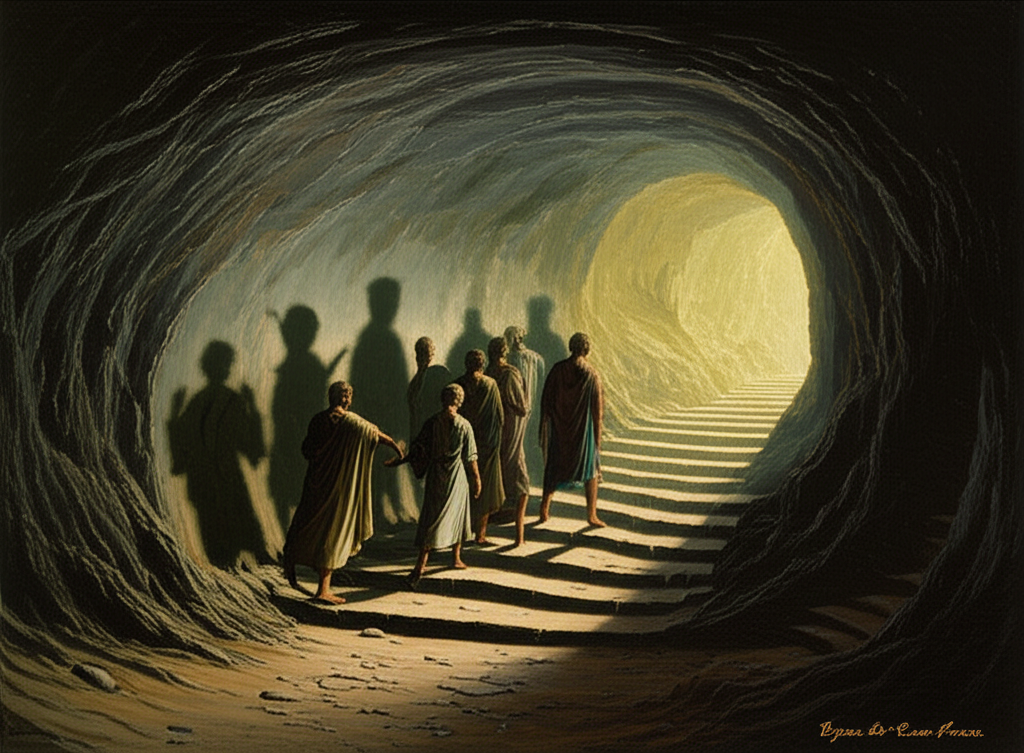
Plato, a titan among the thinkers featured in the Great Books of the Western World, sought to bridge this gap with his theory of Forms. For Plato, the true Being of things resided not in the shifting, imperfect world of sensory experience, but in a transcendent realm of eternal, immutable Forms or Ideas. A particular chair is a chair only insofar as it "participates" in the perfect Form of Chairness. Thus, for Plato, true Being was intelligible, not sensible, and the Principle of reality lay in these perfect, non-physical archetypes.
Aristotle's Systematic Approach to Being
Aristotle, Plato's most famous student, took a different, more empirical approach to Being. Rather than positing a separate realm of Forms, Aristotle grounded Being in the individual substances of the world around us. He famously declared that "Being is said in many ways." This means that while everything is, it doesn't is in the same way.
Aristotle introduced his Categories of Being, which describe the different ways things can be predicated of a subject. The most fundamental category is substance (ousia), which refers to the independent existence of a thing (e.g., a man, a horse). All other categories (quantity, quality, relation, place, time, position, state, action, affection) depend on substance.
He further explored Being through the concepts of:
- Potentiality and Actuality: A seed has the potential to be a tree, but it actually becomes a tree only through a process of development. This explained change without denying the underlying Being.
- Form and Matter: Every substance is a composite of matter (the "what it is made of") and form (the "what it is"). The form, for Aristotle, is the Principle of its Being, defining its essence.
- Being qua Being: Aristotle identified Metaphysics as the study of Being qua Being, meaning the study of existence itself, not just as a property of particular things, but in its most general and fundamental aspects.
The Problem of the One and the Many
The tension between the One and Many is a recurring theme in the history of Being. How can we understand the unity of existence while acknowledging the immense diversity of individual entities?
- Parmenides: Denied the Many in favor of the One.
- Plato: Posited a unified realm of Forms (the One) which individual things (the Many) participate in.
- Aristotle: Found unity in the shared concept of "substance" and the universal principles of being (like potentiality/actuality), even while affirming the reality of particular beings.
- Neoplatonism (Plotinus): Proposed an ultimate, ineffable One from which all other levels of Being emanate, gradually losing perfection as they descend, thus explaining the diversity of the Many from a singular Principle.
This fundamental problem forces us to consider whether there is a single, ultimate Principle or source from which all Being derives, or if Being is inherently pluralistic.
Modern Reflections: Essence, Existence, and the Ground of All Things
As philosophy progressed, particularly through the medieval period and into modernity, the concept of Being continued to evolve. Medieval scholasticism, influenced by Aristotle and Neoplatonism, grappled with the distinction between essence (what a thing is) and existence (that a thing is), often linking existence to God as the ultimate ground of Being. Thinkers like Thomas Aquinas explored Being in relation to the divine, seeing God as pure Actuality, whose essence is existence.
Later, existentialist philosophers like Heidegger and Sartre shifted the focus to human Being, or Dasein, emphasizing the unique way humans exist in the world, characterized by freedom, responsibility, and the awareness of one's own finitude. While their approaches differed significantly from the ancients, they were still fundamentally engaging with the core question of what it means to be.
Why Does This Matter to Us?
You might be asking, "Daniel, why should I care about the difference between 'Being qua Being' and the 'One and Many'?" And it's a fair question. But consider this: our understanding of Being shapes everything else.
- Our worldview: Do we believe in an ultimate, unifying Principle, or a fragmented, diverse reality?
- Our ethics: If humans have a particular mode of Being, what responsibilities does that entail?
- Our science: What constitutes a "real" entity worthy of scientific investigation?
The metaphysical concept of Being isn't just an abstract philosophical game; it's the bedrock upon which all other inquiries rest. It's the attempt to understand the very fabric of reality, and our place within it.
📹 Related Video: ARISTOTLE ON: The Nicomachean Ethics
Video by: The School of Life
💡 Want different videos? Search YouTube for: ""Parmenides on Being" and "Aristotle Metaphysics Overview""
Conclusion: The Enduring Quest for What Is
From the stark pronouncements of Parmenides to the intricate categories of Aristotle, and the transcendent Forms of Plato, the Great Books of the Western World reveal a sustained and profound engagement with the Metaphysical concept of Being. The question of what it means to be, how the One and Many relate, and what fundamental Principle underpins all existence, remains a vibrant and essential area of philosophical inquiry. It is a quest that continues to challenge our assumptions, deepen our understanding, and ultimately, help us grasp the profound mystery of reality itself.