

The Metaphysical Concept of Being: Unpacking Existence Itself
The concept of Being stands at the very heart of Metaphysics, serving as the foundational inquiry into what it means for anything to exist. This article delves into the profound philosophical exploration of Being, tracing its historical development through the "Great Books of the Western World" and examining the persistent questions it raises. From the ancient Greek dilemma of the One and Many to the search for ultimate Principles, we will unpack why understanding Being is not merely an academic exercise, but a fundamental quest to comprehend reality itself.
The Enduring Question of Being: An Introduction to Metaphysics
For millennia, philosophers have grappled with a question so fundamental it often eludes our immediate grasp: What is Being? It’s a query that precedes all others, underpinning our understanding of reality, knowledge, and even ourselves. Metaphysics, the branch of philosophy dedicated to exploring the fundamental nature of reality, provides the framework for this profound investigation. When we speak of Being, we are not merely asking if something exists, but what it is to exist, how it exists, and why it exists in the manner that it does. This isn't just about identifying things in the world; it's about the very is-ness of those things, the essence that makes them what they are.
Defining the Indefinable: What is "Being"?
At first glance, "Being" seems self-evident. We are, the world is, things exist. Yet, upon closer inspection, the term becomes elusive. Is Being a property that everything shares? Is it a universal category? Or is it something more profound, perhaps the ultimate reality from which all else derives?
Philosophers have offered various perspectives:
- Existence: The most common and immediate understanding – the fact that something is present in reality.
- Essence: What a thing is, its defining characteristics, independent of its particular existence.
- Substance: That which underlies properties and changes, the fundamental substratum of reality.
- Actuality: The state of being real or in existence, as opposed to potentiality.
The difficulty lies in that "Being" is not a genus like "animal" or "tree" that can be neatly categorized. It is a concept so pervasive that it resists conventional definition, often leading philosophers to describe it through its various manifestations or by contrasting it with Non-Being.
From Parmenides to Plato: Early Explorations of Being
The ancient Greeks laid much of the groundwork for our understanding of Being.
-
Parmenides of Elea (c. 5th century BCE), a pivotal figure in the "Great Books," famously argued that Being is One, eternal, unchanging, and indivisible. For Parmenides, change and plurality were mere illusions of the senses; only Being truly is. His radical monism presented a stark challenge to subsequent thinkers, forcing them to reconcile the apparent diversity and motion of the world with the logical demands of a singular, unchanging Being.
-
Heraclitus of Ephesus, in contrast, emphasized flux and change, famously stating, "No man ever steps in the same river twice, for it's not the same river and he's not the same man." This highlights the dynamic aspect of existence, a direct counterpoint to Parmenides' static Being.
-
Plato, profoundly influenced by both Parmenides and Heraclitus, sought to bridge this gap. In his theory of Forms, he posited a realm of perfect, eternal, and unchanging Forms (e.g., the Form of Beauty, the Form of Justice) that constitute true Being. The physical world we perceive, with its constant change and imperfection, merely participates in these Forms. Thus, for Plato, the true Principle of reality lies in these transcendent, intelligible Forms, offering a solution to the problem of the One and Many by positing many particular things that derive their Being from a singular, universal Form.
Aristotle's Categories and the Substance of Being
Aristotle, Plato's most famous student, offered a different, more empirical approach to Being. Instead of positing a separate realm of Forms, Aristotle argued that Being is found in the individual substances of the world around us. In his Categories, he systematically analyzed the different ways in which something is.
Aristotle's Categories of Being:
| Category | Description | Example |
|---|---|---|
| Substance | That which exists independently and underlies all other categories. | Socrates, a horse, a tree |
| Quantity | How much or how many. | Two feet tall, ten pounds |
| Quality | The characteristic or attribute of a substance. | White, wise, hot |
| Relation | How one thing stands in relation to another. | Larger than, father of, on the right |
| Place | Where something is located. | In the marketplace, at home |
| Time | When something occurs. | Yesterday, at noon |
| Position | The posture or arrangement of parts. | Sitting, lying down |
| Having | What a substance possesses. | Wearing shoes, armed |
| Acting | What a substance is doing. | Cutting, burning |
| Being Affected | What is being done to a substance. | Being cut, being burned |
For Aristotle, substance is the primary mode of Being. All other categories are accidents that depend on a substance for their existence. This grounded approach shifted the focus from transcendent Forms to the immanent reality of the physical world, emphasizing observation and logical analysis to understand the Principle of existence.
The Grand Conundrum: The One and the Many
The problem of the One and Many is perhaps the most enduring challenge in the Metaphysics of Being. It asks how individual, distinct things (the many) can exist and yet be part of a unified reality (the one), or how a single concept (like "humanity") can apply to countless individual instances.
- Parmenides's solution: Only the One truly is; the Many are illusion.
- Plato's solution: The Many participate in the One (Forms).
- Aristotle's solution: The One (universal concept) exists in the Many (individual substances).
- Later philosophers like Plotinus (Neoplatonism) posited a transcendent "One" from which all reality emanates, while medieval scholastics wrestled with the relationship between God as the ultimate Being and the created world.
This problem forces us to confront the very nature of identity and difference, unity and plurality, and remains a central theme in contemporary metaphysics. How can we speak of "Being" as a singular concept when the world presents itself as an overwhelming multiplicity of distinct entities?
Unveiling the Ultimate Principle
The quest for Being often leads to the search for an ultimate Principle – a fundamental ground, cause, or source from which all reality derives. This Principle is not just a being, but that which gives rise to all being.
- For some, this Principle is a divine entity, such as the God of monotheistic religions, who is pure Actuality and the source of all existence.
- For others, it might be a more abstract concept, like Spinoza's "Substance" (which is God or Nature), or Hegel's "Absolute Spirit."
- Modern scientific perspectives, while not strictly metaphysical, often seek a unified theory or fundamental laws that govern the universe, echoing this ancient philosophical drive to find an underlying order or Principle.
Understanding the Principle of Being is to understand the ultimate why and how of everything that exists. It's the attempt to grasp the foundational truth that makes all other truths possible.
The Contemporary Relevance of Metaphysics and Being
While the language may have evolved, the questions concerning Being remain profoundly relevant. In an age of scientific discovery, artificial intelligence, and virtual realities, we are continually forced to reconsider what it means to be.
- What is the Being of a digital entity?
- Does consciousness constitute a distinct mode of Being?
- How do we reconcile the subjective experience of Being with objective scientific descriptions?
These are not trivial questions. They shape our ethics, our understanding of personhood, and our place in the cosmos. The rigorous exploration of Being through Metaphysics continues to provide the intellectual tools necessary to navigate these complex contemporary challenges.
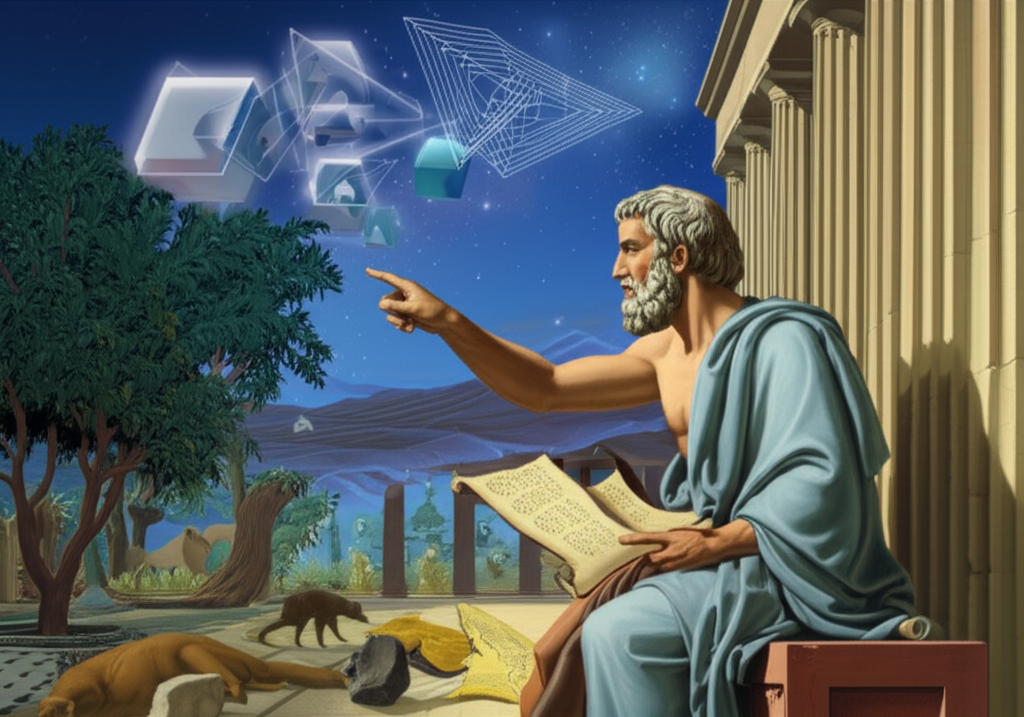
Conclusion: The Unending Journey into Being
The Metaphysical concept of Being is not a static definition but an ongoing philosophical journey. From the ancient Greeks' wrestling with the One and Many to the continuous search for an ultimate Principle, the question of what it means to be has driven human inquiry for millennia. By engaging with these profound questions, as preserved and explored in the "Great Books of the Western World," we gain not only a deeper understanding of philosophy's rich history but also a more nuanced perspective on our own existence and the fundamental nature of reality itself.
📹 Related Video: KANT ON: What is Enlightenment?
Video by: The School of Life
💡 Want different videos? Search YouTube for: ""What is Being in Metaphysics? An Introduction to Ontology""
📹 Related Video: KANT ON: What is Enlightenment?
Video by: The School of Life
💡 Want different videos? Search YouTube for: ""The Problem of the One and the Many Explained""