

The Unfolding Mystery: Exploring the Metaphysical Concept of Being
The concept of Being stands as the bedrock of Metaphysics, the branch of philosophy dedicated to understanding the fundamental nature of reality. Far from a simple dictionary definition, Being represents the ultimate Principle from which all existence, all phenomena, and all thought derive their possibility. This article delves into the rich, complex history of how philosophers, from the ancient Greeks to modern thinkers, have grappled with this elusive idea, examining its various interpretations and its crucial role in addressing profound questions like the One and Many.
What is Being? A Foundational Inquiry in Metaphysics
At its core, Metaphysics asks, "What is real?" and "What does it mean to exist?" The concept of Being is the direct answer to these questions, yet it remains one of philosophy's most challenging and debated subjects. It isn't merely about what exists, but the very act or condition of existing. For centuries, thinkers have recognized that before we can discuss the properties of things, or how they relate to each other, we must first confront the sheer fact that they are. This foundational Principle underpins all other philosophical inquiry.
The Elusive Nature of Being
Why is Being so difficult to grasp? Perhaps because it is so fundamental, so ubiquitous, that it defies direct categorization. To define Being is to attempt to place it within a larger category, but Being itself is the largest category—it encompasses everything. Any attempt to describe it invariably uses terms that presuppose its existence. This paradox has led philosophers to approach Being through various lenses: by examining its attributes, its relation to non-being, or its manifestations in particular entities.
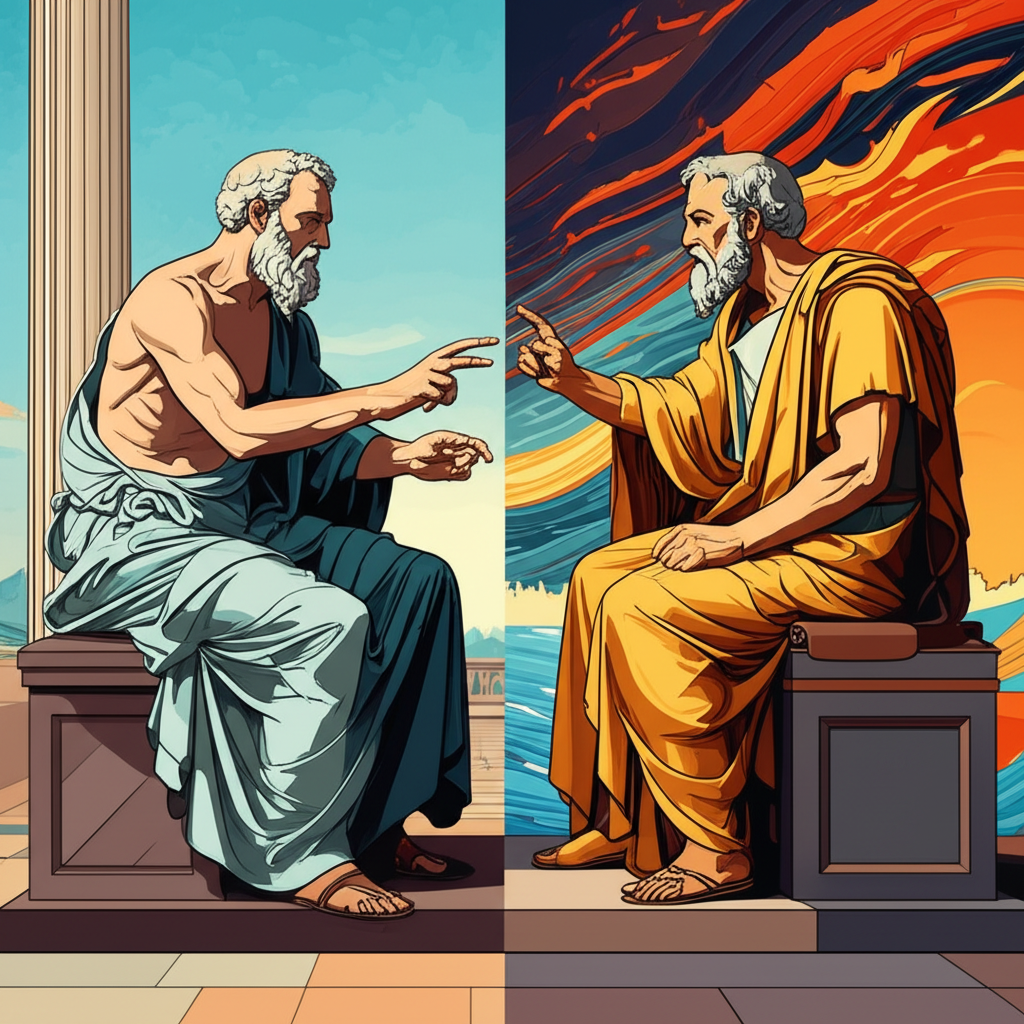 and a turbulent, flowing river (Heraclitus), symbolizing their opposing views on the nature of reality and Being.)
The Ancient Greeks and the Problem of the One and Many
The earliest systematic investigations into Being emerge from the pre-Socratic philosophers, who wrestled with the problem of the One and Many. How can reality appear as a multitude of changing things, yet possess an underlying unity?
- Parmenides of Elea: A pivotal figure, Parmenides argued that Being is eternal, unchangeable, indivisible, and perfect. Change, multiplicity, and motion are mere illusions of the senses. For Parmenides, "It is, and it is impossible for it not to be." Non-being is unthinkable and unsayable. His Principle was that Being is singular and absolute.
- Heraclitus of Ephesus: In stark contrast, Heraclitus famously declared, "No man ever steps in the same river twice, for it's not the same river and he's not the same man." For him, change (flux) was the fundamental reality, the Principle of all existence. Being was a process, a constant becoming.
These opposing views set the stage for much of Western philosophy, particularly for Plato.
Plato's Solution: The Forms and Participation
Plato, deeply influenced by both Parmenides' unchanging Being and Heraclitus' flux, sought to reconcile the One and Many. His solution was the theory of Forms:
- The Realm of Forms: A transcendent realm of perfect, eternal, and unchanging essences (Forms or Ideas) exists independently of the physical world. These Forms represent true Being. For instance, there is a Form of Beauty, a Form of Justice, and a Form of the Good.
- The Physical World: The world we perceive through our senses is a realm of change, multiplicity, and impermanence. Individual beautiful objects "participate" in the Form of Beauty, deriving their Being and intelligibility from it.
- Reconciling the Divide: Through participation, Plato explains how many individual things (the Many) can share in a single, universal essence (the One), thereby providing a metaphysical framework for understanding the nature of Being across different levels of reality.
Aristotle's Systematic Approach to Being
Aristotle, Plato's most famous student, took a different approach. While acknowledging the importance of universal principles, he insisted that Being is primarily found in individual, concrete substances.
- Categories of Being: Aristotle developed a comprehensive system for classifying the ways in which things can be said to "be." He identified ten categories, with Substance (ousia) as the primary form of Being.
- Substance: The fundamental "what it is" (e.g., a man, a horse).
- Quantity: How much (e.g., two cubits long).
- Quality: What kind (e.g., white, grammatical).
- Relation: How related (e.g., double, half).
- Place: Where (e.g., in the Lyceum).
- Time: When (e.g., yesterday, last year).
- Position: How situated (e.g., lying, sitting).
- Having: What it possesses (e.g., shod, armed).
- Action: What it does (e.g., cutting, burning).
- Passion: What is done to it (e.g., being cut, being burned).
For Aristotle, Being is not a single, undifferentiated concept but is said in many ways, all ultimately referring back to substance. He explored Being as actuality and potentiality, form and matter, providing a robust framework for understanding the Principle of existence in the world we inhabit.
Medieval Reflections: Being and the Divine
In the medieval period, particularly within Christian philosophy, the concept of Being became inextricably linked with God. Thinkers like Thomas Aquinas synthesized Aristotelian Metaphysics with Christian theology.
- God as Pure Act of Being (Ipsum Esse Subsistens): For Aquinas, God is not merely a being, but Being itself. God's essence is His existence; He is the ultimate Principle and cause of all other being. Creatures, by contrast, have being, but they are not Being itself. This distinction between essence and existence became a cornerstone of medieval thought on Being.
Modern Queries: From Self to Phenomenon
The modern era brought new perspectives on Being:
- Descartes and Subjective Being: René Descartes' famous "Cogito, ergo sum" ("I think, therefore I am") shifted the starting point of Metaphysics to the individual consciousness. The Being of the self, as a thinking thing, became the undeniable Principle from which all other knowledge could be derived.
- Kant and the Limits of Being: Immanuel Kant argued that Being is not a "real predicate" that adds anything to the concept of a thing. To say "God exists" adds nothing to the concept of God; it merely posits that the concept is instantiated. For Kant, our understanding of Being is structured by our own minds, limiting our access to things-in-themselves.
- Heidegger and the Question of Sein: Martin Heidegger, in the 20th century, famously challenged the entire Western philosophical tradition for having forgotten the "question of Being itself" (Sein), reducing it to a mere predicate or a supreme entity (God). He sought to re-examine Being through the analysis of human existence (Dasein), arguing that it is through our own temporal and finite Being that the meaning of Being as such can be disclosed.
The Enduring Significance of the Principle of Being
Despite the diverse and often conflicting interpretations, the Metaphysical concept of Being remains the most fundamental Principle in philosophy. It forces us to confront:
- Existence vs. Non-existence: Why is there something rather than nothing?
- Unity vs. Multiplicity: How do we reconcile the apparent diversity of the world with an underlying unity?
- Essence vs. Existence: What is the difference between what a thing is and the fact that it is?
- Appearance vs. Reality: What is truly real, beyond our perceptions?
Understanding Being is not about finding a simple definition, but about engaging with the deepest questions concerning reality, knowledge, and our place within the cosmos. It is the continuous unfolding of the mystery of existence itself.
Conclusion
From the ancient Greek struggle with the One and Many to Aristotle's systematic categories, medieval theology's divine Being, and modern philosophy's turn to subjectivity and the question of Sein, the concept of Being has been the ultimate Principle guiding Metaphysics. It is the grand inquiry into what it means for anything—or everything—to simply be. This enduring philosophical journey reminds us that the most fundamental questions are often the most profound and the most resistant to easy answers, continually inviting us to think more deeply about the very fabric of existence.
📹 Related Video: What is Philosophy?
Video by: The School of Life
💡 Want different videos? Search YouTube for: ""Parmenides vs Heraclitus - Philosophy Debate Explained""
📹 Related Video: ARISTOTLE ON: The Nicomachean Ethics
Video by: The School of Life
💡 Want different videos? Search YouTube for: ""Heidegger Being and Time Explained""