

The Unfolding Mystery of Being: A Metaphysical Inquiry
Summary: At the very heart of philosophy, Metaphysics grapples with the fundamental question of "what is." Central to this pursuit is the concept of Being – the very fact of existence. This article explores how philosophers, from antiquity to the modern era, have wrestled with defining Being, understanding its relationship to the One and Many, and identifying it as a foundational Principle of all reality, drawing heavily from the insights preserved in the Great Books of the Western World. We'll delve into the profound implications of asking not just what things are, but that they are at all.
Probing the Depths: What Does it Mean "To Be"?
For centuries, philosophers have embarked on a profound journey, seeking to understand the ultimate nature of reality. This quest, known as Metaphysics, delves into questions that lie beyond the empirical, exploring concepts such as substance, cause, time, space, and, most crucially, Being. To ask about Being is to ask about existence itself – not just the existence of specific things, but the underlying essence that allows anything to exist. It's a question that challenges our most basic assumptions, pushing us to consider the very fabric of reality.
The difficulty in defining Being lies in its ubiquity; it is present in everything and yet distinct from any particular thing. How can we speak of "is-ness" without reducing it to a specific "what-ness"? This fundamental inquiry has been a cornerstone of Western thought, shaping our understanding of the cosmos, humanity, and the divine.
Ancient Voices on the Nature of Being
The Great Books of the Western World provide an invaluable chronicle of humanity's attempts to grasp Being. Early Greek thinkers laid much of the groundwork.
Parmenides: The Unchanging One
One of the most radical early positions came from Parmenides of Elea. His central Principle was stark:
- What is, is; what is not, is not.
- He argued that Being is eternal, uncreated, indestructible, indivisible, and unchanging. There is no void, no empty space, and no motion, for these would imply non-being.
- For Parmenides, reality is a single, undifferentiated One. All change and multiplicity are mere illusions of the senses. This monolithic view presented a profound challenge to subsequent philosophers.
Plato's Forms: Bridging the One and Many
Plato, profoundly influenced by Parmenides' insistence on unchanging reality, sought to reconcile this with the evident multiplicity and change of the sensory world. He proposed his theory of Forms:
- The true Being of things resides not in the fleeting physical world but in an eternal, immutable realm of perfect Forms (e.g., the Form of Beauty, the Form of Justice, the Form of the Good).
- Individual beautiful things participate in the Form of Beauty, deriving their existence and nature from it.
- This allowed Plato to address the problem of the One and Many:
- The One: The perfect, singular Form.
- The Many: The multiple, imperfect instances in the physical world that reflect the Form.
- The Form of the Good, for Plato, was the ultimate Principle – the source of all Being and intelligibility.
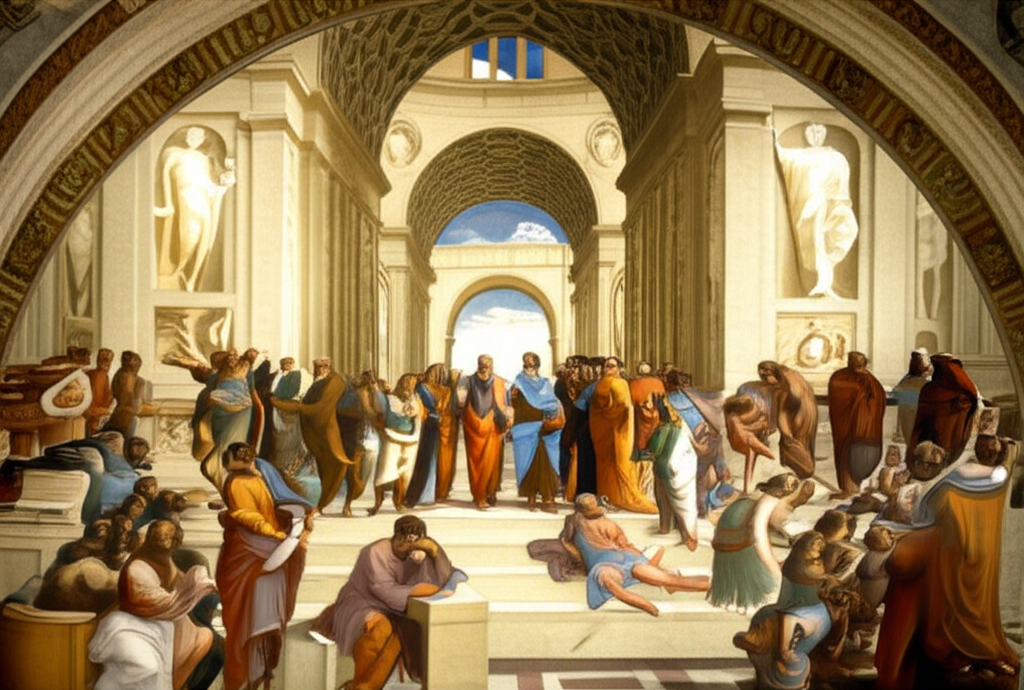
Aristotle: Substance as Primary Being
Aristotle, Plato's student, took a different approach, grounding Being more firmly in the empirical world. In his Metaphysics, he famously declared that "there is a science which investigates Being as Being and the attributes which belong to it in virtue of its own nature."
Aristotle's analysis of Being involved:
- Categories of Being: He identified ten ways in which something can be said to "be": substance, quantity, quality, relation, place, time, position, state, action, and affection. Of these, substance (ousia) is primary.
- Substance (Ousia): This is the fundamental Principle of individual existence – the "this" that underlies all attributes. A substance is what can exist independently, while qualities like "red" or "tall" depend on a substance to exist.
- Potentiality and Actuality: Aristotle explained change not as a transition from Being to Non-Being, but from potential Being to actual Being. A seed has the potential to be a tree; the tree is the actuality.
- The Unmoved Mover: For Aristotle, the ultimate cause and Principle of all motion and change in the cosmos is the Unmoved Mover, a pure actuality that is pure thought, which inspires the universe to move towards its own perfection. This Mover is pure Being without any potentiality.
The Enduring Challenge of the One and Many
The tension between the unity of Being and the multiplicity of existing things has been a persistent thread throughout philosophical history. How can reality be fundamentally one, yet manifest as an infinite array of diverse entities?
| Philosopher | Approach to One and Many | Key Concept |
|---|---|---|
| Parmenides | Denies multiplicity; reality is a single, undifferentiated One. | The One |
| Plato | Reconciles by positing eternal, singular Forms (the One) participated in by multiple particulars (the Many). | Forms, Participation |
| Aristotle | Locates Being primarily in individual substances (the Many), yet seeks universal principles and an ultimate Unmoved Mover (a kind of One). | Substance (Ousia), Unmoved Mover |
| Later Thinkers | Explored concepts like universals and particulars, modes of being, and degrees of existence. | Analogy of Being, Transcendental Unity |
Being as the Ultimate Principle
Across these diverse perspectives, a common theme emerges: the search for a foundational Principle from which all else derives its existence. Whether it's Parmenides' unwavering One, Plato's Form of the Good, or Aristotle's Unmoved Mover, philosophers have consistently sought an ultimate ground of Being. This Principle is often conceived as:
- Self-sufficient: It does not depend on anything else for its existence.
- Explanatory: It provides the ultimate reason why anything exists at all.
- Unchanging: It is the stable foundation amidst the flux of phenomena.
Understanding Being as a Principle moves us beyond mere description of what is, to an inquiry into the very source and reason for existence.
Conclusion: The Unending Quest for Being
The metaphysical concept of Being remains one of philosophy's most profound and elusive subjects. From the stark monism of Parmenides to the nuanced categories of Aristotle, and Plato's transcendent Forms, the Great Books of the Western World reveal a continuous, evolving conversation about what it means for something "to be." This journey into Metaphysics not only seeks to define the fundamental Principle of existence but also forces us to confront the intricate relationship between the One and Many – the unity of reality and its countless manifestations. The question of Being continues to challenge and inspire, reminding us that the most fundamental questions are often the hardest to answer, yet the most rewarding to pursue.
📹 Related Video: PLATO ON: The Allegory of the Cave
Video by: The School of Life
💡 Want different videos? Search YouTube for: ""Parmenides on Being" or "Plato's Theory of Forms Explained""
📹 Related Video: ARISTOTLE ON: The Nicomachean Ethics
Video by: The School of Life
💡 Want different videos? Search YouTube for: ""Aristotle Metaphysics Substance""