

Unveiling the Unseen: The Metaphysical Concept of Being
At the heart of all philosophical inquiry, beneath the myriad questions of ethics, knowledge, and logic, lies the most fundamental and elusive concept: Being. What does it mean for something to be? This isn't a trivial question; it's the very bedrock of Metaphysics, the branch of philosophy dedicated to understanding the ultimate nature of reality. From the pre-Socratics to contemporary thinkers, the relentless pursuit of understanding Being has shaped Western thought, challenging us to look beyond mere existence to the underlying Principle that makes all things possible. This article delves into the profound implications of Being, exploring its historical interpretations and the enduring problems it poses, particularly the intricate relationship between the One and Many.
The Elusive Nature of "Being"
To speak of "Being" is to attempt to grasp that which is common to everything that exists, yet distinct from any particular thing. It's not a being (like a chair or a star), but the very is-ness that allows chairs and stars to exist at all. Philosophers have grappled with this concept, recognizing its ubiquity yet its resistance to simple definition. If we define it by its properties, we risk reducing it to merely a being. If we define it too broadly, it becomes meaningless. This paradox has driven centuries of profound contemplation.
Historical Lenses on Being: A Journey Through the Great Books
The Great Books of the Western World offer a rich tapestry of approaches to the concept of Being. Each era and philosopher, in their unique way, has attempted to articulate this fundamental Principle.
Parmenides and the Indivisible One
Perhaps the most radical early articulation comes from Parmenides, who famously declared, "Being is, Non-Being is not." For Parmenides, Being is eternal, unchanging, indivisible, and perfect. Any talk of change, multiplicity, or generation implies non-being, which is unthinkable. This stark assertion introduced the problem of the One and Many: if Being is a singular, undifferentiated whole, how do we account for the apparent multiplicity and change in the world we experience? This foundational challenge set the stage for much of subsequent Western philosophy.
Plato's Forms: The True Being
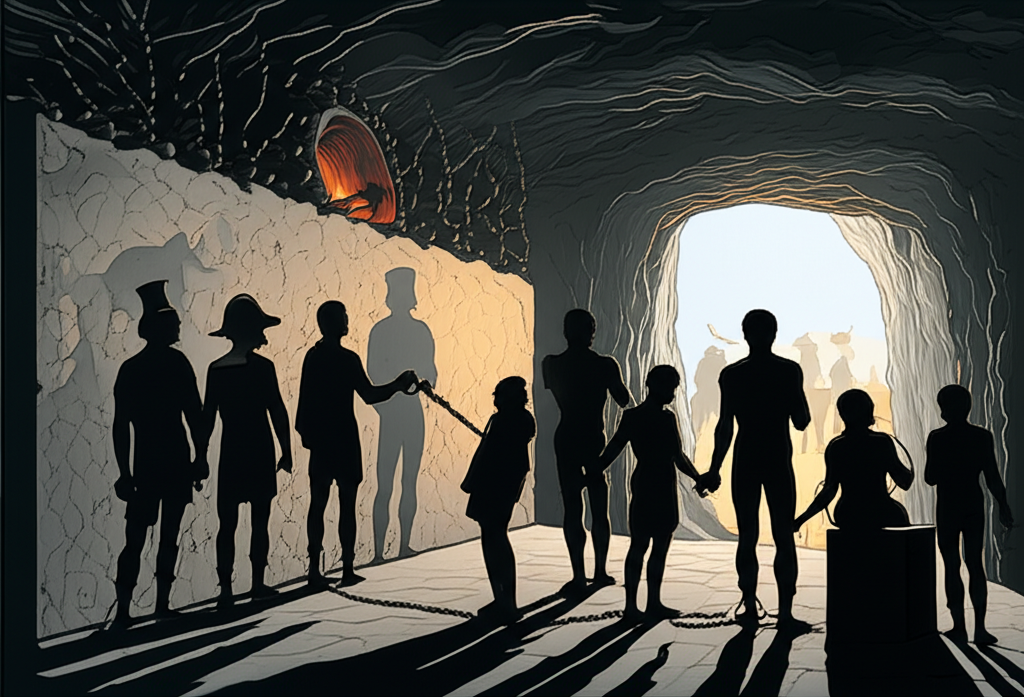
Plato, deeply influenced by Parmenides, sought to reconcile the changelessness of Being with the flux of experience. He posited the existence of Forms – perfect, eternal, and unchanging archetypes residing in an intelligible realm. For Plato, these Forms (e.g., the Form of Beauty, the Form of Justice) constitute true Being, while the objects we perceive in the sensory world are mere imperfect copies, participating in these Forms. The tangible world is thus a shadow of the real.
Aristotle's "Being Qua Being"
Aristotle, Plato's student, shifted the focus. While acknowledging universals, he argued that Being is primarily found in individual substances. His Metaphysics famously begins with the inquiry into "Being qua Being" – that is, Being precisely as Being, not as a specific kind of being. He developed a complex system of categories (substance, quantity, quality, relation, etc.) to describe the different ways things are. For Aristotle, the problem of the One and Many was addressed by understanding how universal forms are actualized in particular matter.
Medieval Scholasticism: Being and God
For medieval thinkers like Thomas Aquinas, the concept of Being became inextricably linked with the divine. God was seen as Ipsum Esse Subsistens – Subsistent Being Itself, the ultimate source and Principle of all existence. Created beings "participate" in God's Being, receiving their existence from Him. This framework provided a powerful theological grounding for the entire structure of reality.
Modern Philosophy: Subjectivity and Existence
With Descartes, the focus shifted inward. His famous "Cogito, ergo sum" ("I think, therefore I am") placed the certainty of individual consciousness at the core of existence. Later, Kant explored the conditions under which we can even know Being, arguing that our minds actively structure our experience of reality. In the 20th century, existentialists like Heidegger differentiated between Sein (Being itself) and Seiendes (beings, or entities), arguing that philosophy had forgotten the fundamental question of Being, reducing it to mere objects.
The Enduring Problem of the One and Many
Central to the metaphysical inquiry into Being is the persistent problem of the One and Many. How can a world teeming with diverse, individual entities be understood in relation to a singular, unifying Principle of existence?
- Monism: Some philosophies, like Parmenides', lean towards a singular, undifferentiated Being, seeing multiplicity as illusory.
- Dualism: Others, like Plato, propose two realms – one of perfect, unified Forms and another of multiple, imperfect particulars.
- Pluralism: Still others emphasize the irreducible multiplicity of beings, with no single, overarching Being.
The resolution, or perhaps the sustained contemplation, of this tension is what continues to drive much of Metaphysics. It forces us to ask: Is there an ultimate unity beneath all diversity? How do individual beings receive their "is-ness" from a common source, or do they each possess it intrinsically?
Being as the Ultimate Principle
Ultimately, the concept of Being functions as the most fundamental Principle in philosophy. It's the ground of all existence, the condition for anything to be true or false, real or imaginary. Without a coherent understanding of Being, our discussions of knowledge, ethics, and even aesthetics lack a stable foundation. It compels us to confront the deepest questions about reality:
- Why is there something rather than nothing?
- What is the essence of existence?
- How do we distinguish between what truly is and what merely appears to be?
These questions, born from the contemplation of Being, continue to challenge and inspire philosophers, inviting us to look beyond the surface of the world and ponder the very fabric of reality itself.
Further Exploration:
📹 Related Video: PLATO ON: The Allegory of the Cave
Video by: The School of Life
💡 Want different videos? Search YouTube for: ""Introduction to Metaphysics - The Nature of Reality""
📹 Related Video: ARISTOTLE ON: The Nicomachean Ethics
Video by: The School of Life
💡 Want different videos? Search YouTube for: ""Heidegger - What is Metaphysics?""