

The Mechanics of the Soul: Unraveling the Enigma of Inner Being
The concept of the soul has captivated humanity for millennia, serving as a cornerstone of philosophy, religion, and our very understanding of existence. But what if we were to approach this profound mystery not just with contemplation, but with a desire to understand its mechanics? This journey is a bold undertaking, moving beyond mere definition to explore the structure, function, and operational principles—if any—of that elusive inner essence we call the soul. From the ancient Greek philosophers to modern physics, the quest to grasp the soul’s inner workings reveals a fascinating interplay between mind, consciousness, and the very fabric of reality.
The Soul's Blueprint: A Historical Perspective
To speak of the "mechanics" of the soul is, in many ways, to ask "how does it work?" This question has been posed in myriad forms throughout the history of Western thought, often reflecting the dominant scientific and philosophical paradigms of the era. The Great Books of the Western World offer a rich tapestry of these inquiries.
Ancient Conceptions: Form, Function, and the Tripartite Self
For the ancient Greeks, the soul (psyche) was not merely a spiritual entity but often the very principle of life and motion.
-
Plato's Tripartite Soul: In works like The Republic and Phaedrus, Plato described the soul as having three distinct parts, each with its own "mechanics" or function:
- Reason (Logistikon): The rational part, seeking truth and guiding the other parts. Its function is to govern.
- Spirit (Thymoeides): The spirited or emotional part, associated with courage, honor, and indignation. Its function is to uphold reason's commands.
- Appetite (Epithymetikon): The desiring part, driven by bodily pleasures and desires. Its function is to provide the necessary drives for survival, but under the control of reason.
Plato envisioned a well-ordered soul as one where reason held sway, orchestrating the spirit and appetite in a harmonious fashion, much like a charioteer managing two horses.
-
Aristotle's Entelechy: In De Anima, Aristotle offered a more biological and less dualistic view. For him, the soul was the form of a natural body having life potentially within it—its entelechy. It is the principle that gives life, growth, sensation, and thought to a body. He identified different levels of soul:
- Nutritive Soul: Shared by plants, responsible for growth and reproduction.
- Sensitive Soul: Shared by animals, adding sensation and locomotion.
- Rational Soul: Unique to humans, encompassing thought and reason.
Aristotle's soul isn't a separate entity trapped in a body, but rather the very organization and activity of the living body itself. Its "mechanics" are intrinsically tied to the biological functions.
Medieval Synthesis: The Soul as Divine Imprint
With the rise of Christianity, particularly through figures like St. Augustine and St. Thomas Aquinas (drawing heavily on Aristotle), the soul gained further theological significance.
- Aquinas's Integration: Aquinas, in Summa Theologica, solidified the understanding of the soul as an immaterial, immortal substance, the form of the human body, but also capable of independent existence. The human soul, imbued with reason and will, was seen as a divine creation, reflecting God's image. Its mechanics involved not just vital functions, but also moral decision-making, intellectual cognition, and the pursuit of salvation.
Early Modern Dualism: The Soul as Thinking Substance
The scientific revolution and the emphasis on empirical observation brought new questions about the soul's relationship to the physical world.
- Descartes' Mind-Body Problem: René Descartes, a pivotal figure, famously posited a radical dualism. In Meditations on First Philosophy, he argued that the mind (which he largely equated with the soul) is a distinct, non-physical substance, whose essential attribute is thought (res cogitans). The body, in contrast, is an extended, physical substance (res extensa). The "mechanics" of the soul, for Descartes, were internal to its own thinking process, while its interaction with the physical body—specifically, through the pineal gland—became the infamous "mind-body problem." How could an immaterial soul exert influence over a material body, and vice-versa? This question profoundly shaped subsequent philosophical inquiry.
The Soul and the Mind: A Tangled Web of Identity
The terms "soul" and "mind" are often used interchangeably, yet their precise relationship is a critical aspect of understanding the soul's mechanics. Is the mind merely the functional aspect of the soul, or are they distinct entities?
| Concept | Primary Focus | Key Attributes | Relationship to "Mechanics" |
|---|---|---|---|
| Soul | Essence of being, life principle, often spiritual/immortal | Consciousness, identity, will, emotion, reason, often ethical/spiritual dimension | Underlying structure, source of vital force, locus of ultimate purpose |
| Mind | Cognitive and conscious processes | Thought, perception, memory, imagination, reasoning, feeling | Operational functions, how consciousness manifests, processing information |
One might argue that the mind is the observable, experiential output of the soul's underlying mechanics. If the soul is the engine, the mind is the dashboard and steering wheel—the interface through which we perceive and interact with the world.
Seeking Mechanics: The Soul in a Physical World
The very notion of "mechanics" implies a system of parts, forces, and interactions governed by discernible laws. This framework is most readily applied to the physical world, which leads to a profound challenge: how can we speak of the mechanics of something often considered immaterial?
The Challenge of Materialism
Modern science, particularly neuroscience, tends to explain mental phenomena through the workings of the brain. If every thought, feeling, and decision can be correlated with neural activity, does this leave any room for a non-physical soul with its own mechanics?
- Reductive Materialism: This view suggests that the mind (and by extension, the soul) is nothing more than the brain. Its "mechanics" are purely neurobiological. There is no separate, non-physical entity.
- Non-Reductive Physicalism: A more nuanced view, acknowledging that mental properties might emerge from complex brain activity but cannot be simply reduced to it. Consciousness, for instance, might be an emergent property, making its "mechanics" a higher-level phenomenon not fully captured by analyzing individual neurons.
Physics and the Immaterial
Can physics, the study of the fundamental constituents of the universe and their interactions, offer any insights into the soul?
- Classical Physics: The deterministic, clockwork universe of Newton left little room for an immaterial agent like the soul to intervene without violating conservation laws. Descartes' interaction problem highlights this conflict.
- Quantum Mechanics: Some speculative theories attempt to find a loophole in quantum phenomena, suggesting that consciousness or the soul might operate at a sub-atomic level, influencing probabilistic outcomes. However, these ideas remain highly controversial and lack empirical support. The vast majority of physicists find no evidence for a "quantum soul."
The quest for the soul's mechanics in a physical universe ultimately forces us to confront the limitations of our current scientific paradigms when faced with subjective experience and the question of ultimate identity.
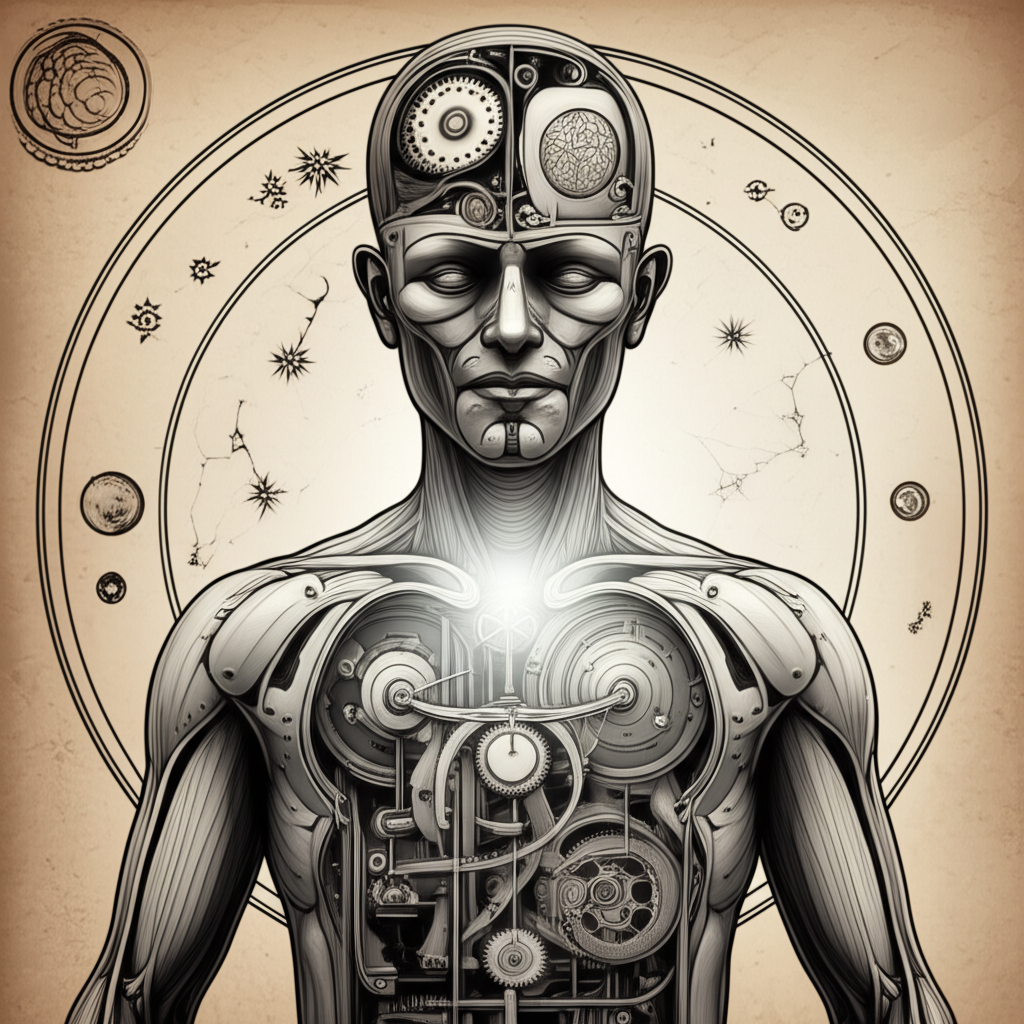
The Enduring Mystery: What Are the Soul's True Mechanics?
Perhaps the "mechanics of the soul" are not to be found in gears and levers, or even neural networks, but in the very principles that govern our consciousness, our identity across time, our capacity for moral choice, and our yearning for meaning.
Key "Mechanisms" Attributed to the Soul:
- Self-Awareness: The capacity to reflect on one's own existence and thoughts.
- Identity: The stable sense of "I" that persists through change.
- Free Will: The ability to make genuine choices independent of deterministic forces.
- Consciousness: The subjective experience of the world and oneself.
- Moral Compass: The faculty that discerns right from wrong and motivates ethical action.
- Transcendence: The aspiration for something beyond the material, the spiritual dimension.
The journey through the Great Books reveals that the "mechanics" of the soul are not static. They evolve with our understanding of the universe and ourselves. Whether we view the soul as the animating force of the body, a distinct thinking substance, or an emergent property of complex systems, the inquiry into its inner workings remains one of philosophy's most profound undertakings. It is a testament to our enduring fascination with what makes us, fundamentally, us.
YouTube Video Suggestions:
-
📹 Related Video: PLATO ON: The Allegory of the Cave
Video by: The School of Life
💡 Want different videos? Search YouTube for: ""Plato Aristotle Soul Philosophy Explained""
2. ## 📹 Related Video: KANT ON: What is Enlightenment?
Video by: The School of Life
💡 Want different videos? Search YouTube for: ""Descartes Mind Body Problem Explained Consciousness""