

The Celestial Clockwork: Unveiling the Mechanics of the Heavens
The quest to understand the mechanics of the heavens represents one of humanity's most enduring and transformative intellectual journeys. From the ancient Greek philosophers gazing at the stars to the groundbreaking physics of Isaac Newton, our attempts to chart the cosmos have not merely advanced astronomy; they have fundamentally reshaped our understanding of the world and our place within it. This article explores the evolution of celestial mechanics, highlighting how philosophical inquiry and scientific observation intertwined to reveal the intricate workings of the universe.
The Ancient Cosmos: Spheres of Perfection
For millennia, the movements of celestial bodies were a source of both wonder and profound mystery. Early civilizations developed elaborate mythologies and observational systems to track the sun, moon, and stars. The philosophical tradition, particularly within the Great Books of the Western World, reveals an initial understanding rooted in observation and rational deduction, albeit constrained by available tools and geocentric assumptions.
Aristotle's Crystalline Spheres:
The Aristotelian cosmos, dominant for over a thousand years, posited a geocentric model where the Earth lay at the center of the universe, surrounded by a series of concentric, crystalline spheres. Each sphere carried a celestial body—the Moon, the Sun, the planets, and finally, the fixed stars. These spheres moved in perfect circles, driven by an unmoved mover. This model, a cornerstone of ancient physics and cosmology, provided a coherent, if ultimately incorrect, explanation for observed celestial motions, aligning with philosophical notions of perfection and hierarchy.
Ptolemy's Epicycles:
As observations grew more precise, the simple Aristotelian model struggled to account for phenomena like the retrograde motion of planets. Claudius Ptolemy, in his monumental Almagest, refined the geocentric model by introducing sophisticated mathematical constructs:
- Deferents: Large circles around the Earth.
- Epicycles: Smaller circles whose centers moved along the deferents, carrying the planets.
- Equants: Points around which the deferent's center moved uniformly, explaining variations in planetary speed.
Ptolemy's system, while geometrically complex, allowed for remarkably accurate predictions of planetary positions, cementing its authority for centuries and demonstrating an early triumph of mathematical mechanics in astronomy.
The Copernican Revolution: Shifting Perspectives
The Renaissance ushered in a period of intense intellectual ferment, challenging established dogmas across various fields. The mechanics of the heavens were ripe for re-evaluation.
Nicolaus Copernicus and the Heliocentric Model:
In De Revolutionibus Orbium Coelestium (On the Revolutions of the Heavenly Spheres), Copernicus proposed a radical alternative: a heliocentric universe where the Sun, not the Earth, resided at the center. The Earth, along with the other planets, revolved around the Sun. This shift was more than just an astronomical adjustment; it was a profound philosophical reorientation, displacing humanity from the cosmic center and forcing a re-evaluation of our place in the world.
| Geocentric Model (Ptolemy) | Heliocentric Model (Copernicus) |
|---|---|
| Earth at the center | Sun at the center |
| Planets revolve around Earth | Planets revolve around Sun |
| Complex epicycles | Simpler explanation for retrograde motion |
| Humanity at cosmic center | Humanity on a moving planet |
Galileo, Kepler, and the Dawn of Modern Astronomy:
- Galileo Galilei's telescopic observations provided crucial empirical evidence supporting the Copernican view. His discovery of the phases of Venus (like the Moon's), the moons of Jupiter (a mini-solar system), and the imperfections of the Moon shattered the Aristotelian notion of perfect, immutable celestial bodies. His work, often at great personal risk, demonstrated the power of observation in physics and astronomy.
- Johannes Kepler's laws of planetary motion moved beyond circular orbits. Through meticulous analysis of Tycho Brahe's observational data, Kepler deduced that planets move in ellipses, not perfect circles, with the Sun at one focus. His laws — the law of ellipses, the law of equal areas, and the law of periods — provided a precise mathematical description of planetary mechanics, paving the way for a dynamic, rather than purely kinematic, understanding of celestial motion.
Newton's Grand Synthesis: The Universal Mechanic
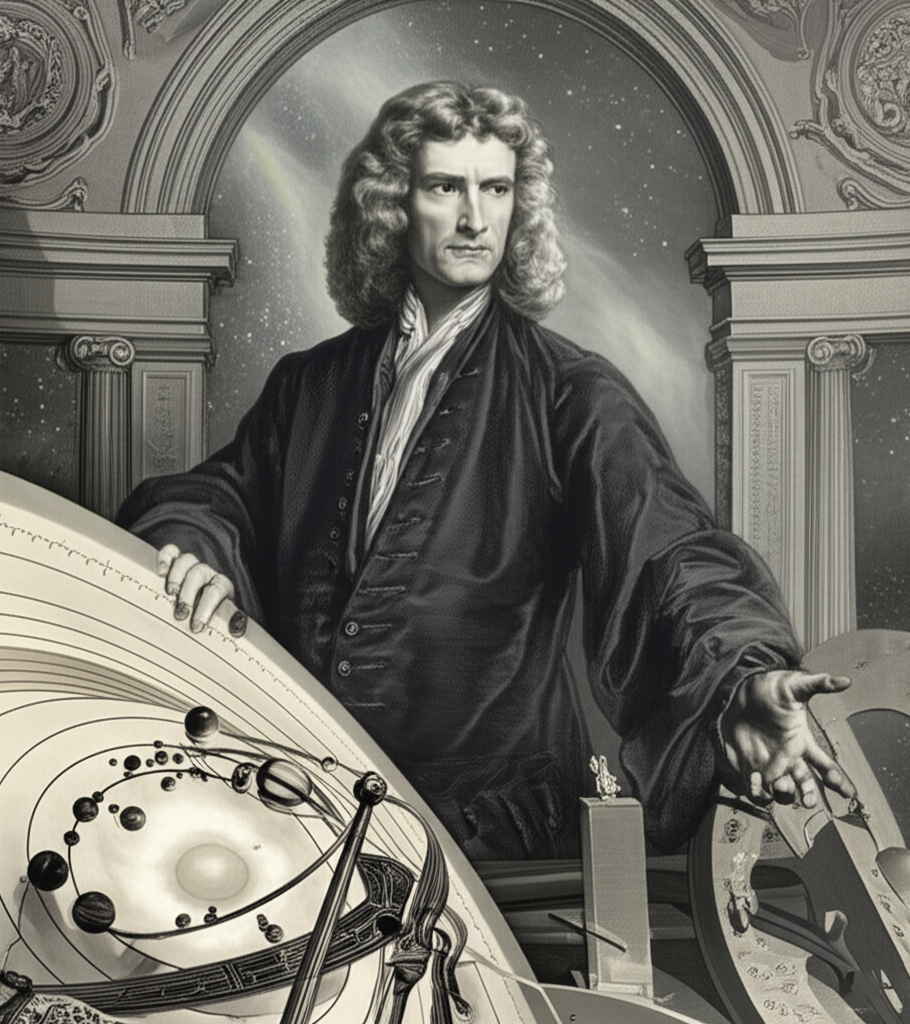
The disparate observations and mathematical descriptions found their grand unification in the work of Isaac Newton. His Philosophiæ Naturalis Principia Mathematica (Mathematical Principles of Natural Philosophy) stands as a monumental achievement, establishing the foundations of classical physics and forever changing our comprehension of the mechanics of the heavens.
The Law of Universal Gravitation:
Newton's genius lay in recognizing that the same force that causes an apple to fall to the Earth also governs the orbits of the planets. He posited the law of universal gravitation: every particle of matter attracts every other particle with a force directly proportional to the product of their masses and inversely proportional to the square of the distance between their centers.
This single, elegant law explained:
- Planetary orbits (confirming Kepler's laws).
- The tides.
- The fall of objects on Earth.
- The mechanics of comets and other celestial bodies.
Newton's work transformed the universe into a vast, deterministic machine, a "celestial clockwork" operating according to precise mathematical laws. The cosmos was no longer driven by divine spheres or epicycles, but by quantifiable forces. This mechanistic worldview deeply influenced Enlightenment thought, emphasizing rationality, order, and the possibility of understanding the entire world through scientific inquiry.
Beyond Classical Mechanics: A Continuously Evolving Understanding
While Newton's mechanics provided an incredibly accurate framework for most celestial phenomena, the 20th century brought new revolutions in physics that further refined our understanding. Albert Einstein's theories of relativity, particularly general relativity, offered a new conception of gravity not as a force, but as a curvature of spacetime caused by mass and energy. This provided even more precise predictions, especially for extreme gravitational environments, and expanded our view of the universe's mechanics beyond the purely Newtonian.
The journey from Aristotle's perfect spheres to Einstein's curved spacetime showcases humanity's relentless pursuit of knowledge. The mechanics of the heavens have always been more than just astronomy or physics; they are a mirror reflecting our deepest philosophical questions about order, chaos, our origins, and our place in the vast, unfolding world.
📹 Related Video: KANT ON: What is Enlightenment?
Video by: The School of Life
💡 Want different videos? Search YouTube for: ""History of Astronomy from Ancient Times to Newton""
📹 Related Video: ARISTOTLE ON: The Nicomachean Ethics
Video by: The School of Life
💡 Want different videos? Search YouTube for: ""Newton's Laws and Universal Gravitation Explained""