

The Mechanics of the Heavens: A Philosophical Voyage Through the Cosmic Clockwork
Summary: This article explores the historical and philosophical journey of humanity's quest to understand "The Mechanics of the Heavens." From ancient geocentric models to Newton's universal laws, we trace how our evolving comprehension of Astronomy and Physics has not only revealed the intricate Mechanics governing the celestial World but also profoundly reshaped our philosophical understanding of existence, causality, and humanity's place within the grand cosmic order. We delve into the intellectual shifts, the pivotal figures, and the enduring questions that arise from gazing skyward.
The Cosmic Dance of Reason: Unveiling the Universe's Operating System
For millennia, the night sky has been humanity's most profound canvas for contemplation. The predictable yet awe-inspiring movements of stars, planets, and moons spurred early philosophers and scientists alike to seek an underlying order, a grand design. This quest to decipher "The Mechanics of the Heavens" is more than just a chapter in the history of science; it is a fundamental narrative in the history of human thought, intricately woven into the fabric of philosophy. How does the World operate? Is it driven by divine will, inherent purpose, or immutable physical laws? These are the questions that have guided our celestial inquiries.
The journey to understand the heavens represents our species' relentless pursuit of knowledge, a testament to our capacity for observation, deduction, and revolutionary insight. It is a story of challenging established dogmas, embracing empirical evidence, and ultimately, constructing a coherent, mathematical framework for the universe.
From Celestial Spheres to Elliptical Paths: A Historical Trajectory
The evolution of our understanding of celestial Mechanics is a dramatic progression, marked by revolutionary shifts in perspective.
The Ancient Cosmos: Harmony and Order
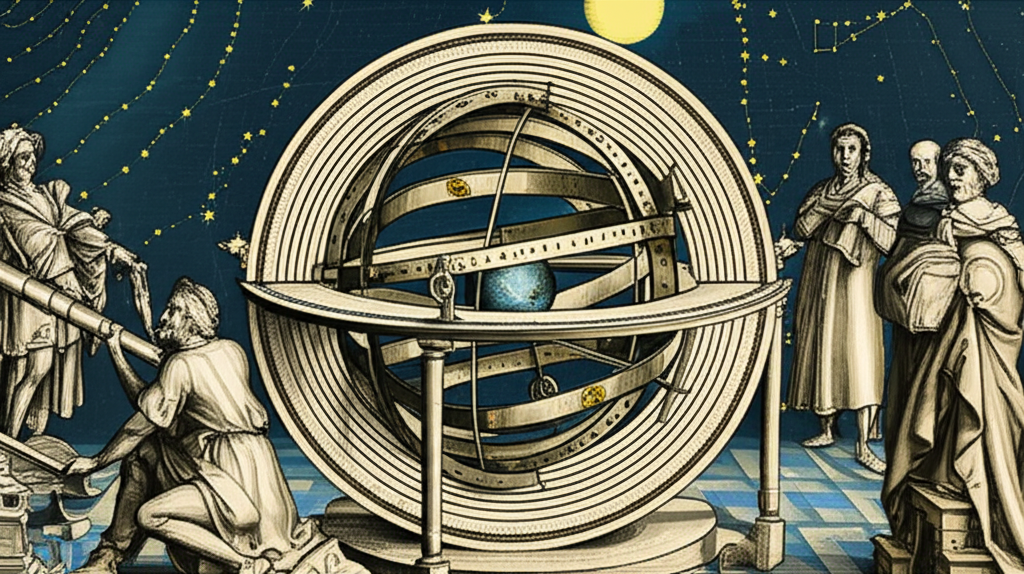
For centuries, the dominant view, deeply rooted in the philosophical traditions of Aristotle and later formalized by Ptolemy, was a geocentric World. Here, Earth stood motionless at the center, enveloped by a series of crystalline spheres, each carrying a celestial body in perfect circular motion. This model, while mathematically complex, offered a comforting sense of order and hierarchy, reflecting a cosmos designed for humanity.
- Key Characteristics of the Geocentric Model:
- Earth-centered: The World is the unmoving core of the universe.
- Perfect Circles: Celestial bodies move in uniform circular motion, reflecting divine perfection.
- Crystalline Spheres: Invisible, nested spheres carrying planets and stars.
- Philosophical Resonance: Supported the idea of a purposeful, human-centric universe.
The Copernican Revolution: A Shift in Perspective
The seeds of doubt were sown by Nicolaus Copernicus in the 16th century. His heliocentric model, placing the Sun at the center and the Earth among the other planets orbiting it, was a radical departure. While still clinging to perfect circular orbits, Copernicus's work initiated a profound intellectual shift, displacing humanity from the cosmic center and forcing a re-evaluation of our place in the World. It was a mathematical hypothesis that, initially, offered a simpler explanation for planetary retrograde motion.
Kepler's Laws: Unveiling the Ellipse
Building upon the meticulous observations of Tycho Brahe, Johannes Kepler made the crucial breakthrough. Abandoning the dogma of perfect circles, Kepler's three laws of planetary motion revealed the true, elliptical nature of planetary orbits. This was a triumph of empirical data over aesthetic prejudice, providing a more accurate and predictive Mechanics for the solar system. His work moved Astronomy firmly into the realm of Physics, demonstrating that celestial bodies obeyed quantifiable, mathematical rules.
Newton's Grand Synthesis: The Universal Mechanics
The culmination of this centuries-long quest arrived with Sir Isaac Newton in the late 17th century. His monumental work, Philosophiæ Naturalis Principia Mathematica (Mathematical Principles of Natural Philosophy), presented a unified theory that revolutionized our understanding of the universe.
The Unifying Force: Gravity
Newton's stroke of genius was the realization that the same force that causes an apple to fall to the Earth also governs the orbit of the Moon around the Earth, and the planets around the Sun. His law of universal gravitation provided a single, elegant explanation for both terrestrial and celestial Mechanics. This was the ultimate unification, dissolving the ancient distinction between the earthly and heavenly realms, showing that the entire World operated under the same fundamental Physics.
Calculus and the Language of the Cosmos
To articulate his theories, Newton developed calculus, a powerful mathematical tool that allowed him to describe motion, change, and forces with unprecedented precision. The universe, according to Newton, was a vast, intricate clockwork, operating according to immutable laws that could be expressed and understood through mathematics. This mechanistic view profoundly influenced Enlightenment thought, suggesting that all phenomena, from the smallest particle to the grandest celestial event, were ultimately predictable and governed by cause and effect.
The Philosophical Echoes of Celestial Mechanics
The profound revelations about the Mechanics of the heavens had far-reaching philosophical implications, challenging established theological and metaphysical frameworks.
Determinism vs. Free Will
Newton's mechanical universe, with its predictable laws of motion, raised questions about determinism. If every action is the result of prior causes, then is free will an illusion? This question has resonated through philosophy for centuries, prompting debates about the nature of causality, responsibility, and human agency within a seemingly predetermined World.
The Human Place in the Mechanical Universe
The shift from a geocentric to a heliocentric, and then to a vast, mechanically governed cosmos, forced humanity to re-evaluate its unique status. No longer at the center, we became inhabitants of a small planet orbiting an ordinary star in an immense universe. This intellectual decentering profoundly influenced existential thought, prompting questions about purpose, meaning, and our significance in the face of such cosmic grandeur.
Key Philosophical Shifts Initiated by Celestial Mechanics:
- From Teleology to Mechanism: A move from explanations based on purpose (telos) to explanations based on efficient causes and physical laws.
- Empiricism's Rise: Emphasis on observation and experimentation over pure reason or dogma.
- Secularization of Knowledge: Reduction of divine intervention in favor of natural laws.
- The Problem of Induction: How can we be sure that laws observed on Earth apply universally?
Beyond Newton: Einstein and the Modern Cosmos
While Newton's Mechanics provided an incredibly successful framework, the 20th century brought further revolutions. Albert Einstein's theories of relativity redefined our understanding of space, time, gravity, and the very fabric of the World. General Relativity, in particular, offered a new geometric interpretation of gravity, demonstrating that massive objects warp spacetime, and this warping dictates the paths of other objects. This further refined our understanding of celestial Physics and opened new avenues for cosmological inquiry, from black holes to the expanding universe. The quest to understand the Mechanics of the heavens remains an active and evolving field, continually pushing the boundaries of scientific and philosophical thought.
Conclusion: The Enduring Quest
The journey to comprehend "The Mechanics of the Heavens" is a testament to the human spirit's insatiable curiosity. From the ancient contemplation of celestial harmony to the sophisticated mathematical models of modern Physics, each step has not only deepened our understanding of the universe's operational Mechanics but also profoundly shaped our philosophical outlook. It is a story of scientific progress intertwined with philosophical inquiry, reminding us that the questions we ask about the World above are ultimately questions about ourselves and our place within the grand, unfolding cosmos. The stars continue to beckon, and the quest for knowledge, both scientific and philosophical, continues anew with each generation.
📹 Related Video: What is Philosophy?
Video by: The School of Life
💡 Want different videos? Search YouTube for: ""Newton's Laws of Motion Explained Philosophy""
📹 Related Video: What is Philosophy?
Video by: The School of Life
💡 Want different videos? Search YouTube for: ""Great Books of the Western World Astronomy Philosophy""