

The Celestial Clockwork: Unraveling the Mechanics of the Heavens
The human fascination with the night sky is as old as consciousness itself. From ancient myths explaining the movements of stars to the intricate mathematical models of modern physics, our quest to understand "The Mechanics of the Heavens" has been a driving force in intellectual history. This journey, richly documented in the Great Books of the Western World, reveals not just the evolution of astronomy but also profound shifts in our philosophical understanding of the world and our place within it. It's a tale of observation, conjecture, revolution, and the relentless pursuit of underlying mechanics.
From Cosmic Spheres to Universal Laws: A Historical Overview
Our understanding of the heavens didn't simply appear; it evolved through centuries of painstaking observation, brilliant insights, and often, fierce intellectual battles. The transition from mythological explanations to a scientific understanding of celestial mechanics represents one of humanity's greatest achievements.
-
Ancient & Medieval Cosmology (Ptolemy, Aristotle): For millennia, the prevailing view, codified by figures like Aristotle and Ptolemy (whose Almagest is a cornerstone of the Great Books), placed Earth at the center of the universe. This geocentric model, with planets and stars embedded in crystalline spheres, offered a seemingly intuitive and philosophically comforting framework. The heavens were considered perfect and immutable, distinct from the terrestrial world of change and decay. The mechanics were complex, involving epicycles and deferents to explain retrograde motion, but the core principle was Earth's centrality.
-
The Copernican Revolution (Copernicus, Kepler, Galileo): The Renaissance sparked a radical re-evaluation. Nicolaus Copernicus, in his On the Revolutions of the Heavenly Spheres, dared to propose a heliocentric model, placing the Sun at the center. This was more than an astronomical shift; it was a philosophical earthquake, challenging deeply held beliefs about humanity's cosmic status. Johannes Kepler, utilizing Tycho Brahe's meticulous data, mathematically described planetary motion with his three laws, demonstrating that planets move in ellipses, not perfect circles. Galileo Galilei, with his telescope, provided empirical evidence through observations of Jupiter's moons and the phases of Venus, further undermining the geocentric paradigm. His works, including Dialogue Concerning the Two Chief World Systems, are pivotal in the Great Books collection.
-
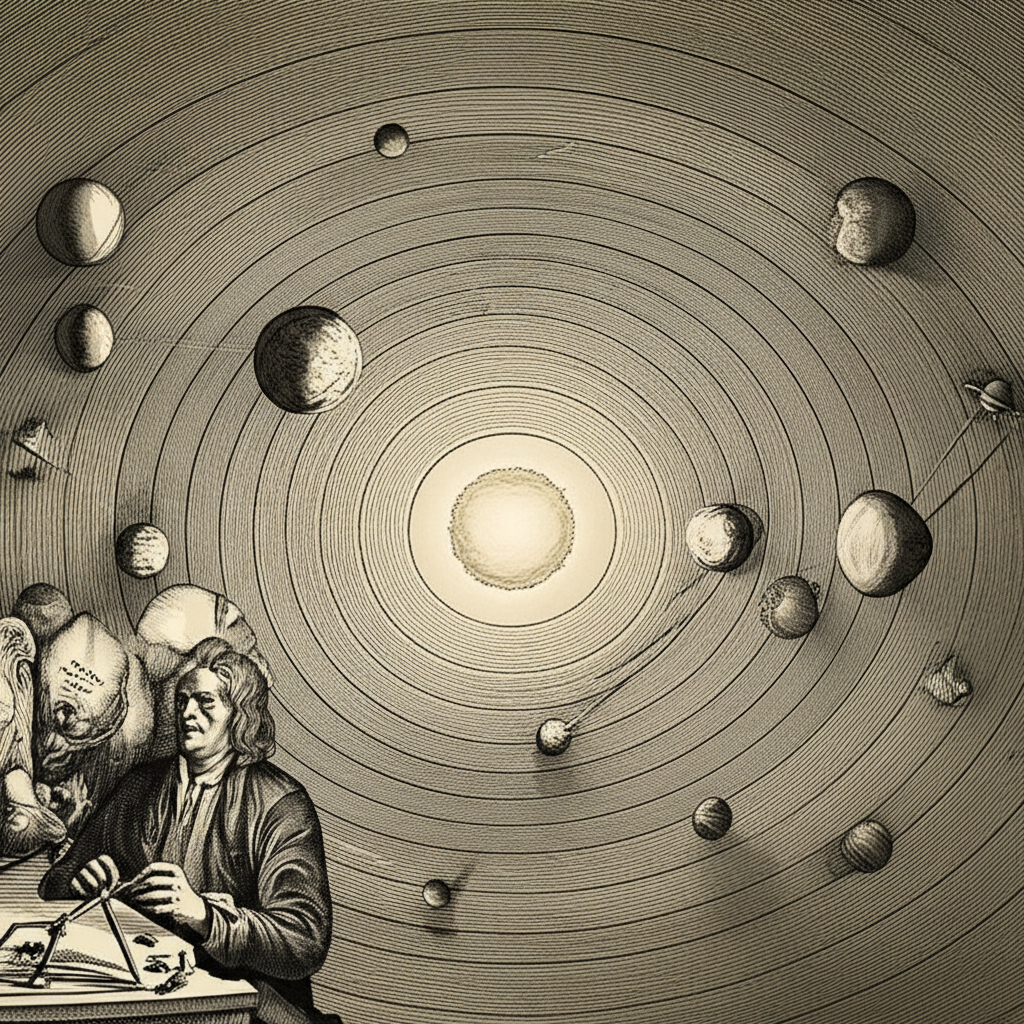
Newton's Grand Synthesis: The Universal Machine: The culmination of this revolution arrived with Isaac Newton. His Philosophiæ Naturalis Principia Mathematica (often simply Principia) is arguably the single most important work in the history of physics. Newton didn't just describe how planets moved; he explained why. His law of universal gravitation unified terrestrial and celestial mechanics, demonstrating that the same force that pulls an apple to the ground keeps the Moon in orbit around the Earth and the Earth around the Sun. The universe was no longer a collection of separate realms but a single, coherent system governed by immutable mathematical laws. This vision of the world as a vast, predictable machine profoundly influenced subsequent philosophy and science.
The Philosophical Resonance of Celestial Mechanics
The shift in understanding the mechanics of the heavens had profound philosophical implications, resonating through ethics, metaphysics, and epistemology.
- Determinism vs. Free Will: If the universe operates like a clockwork mechanism, perfectly predictable given its initial conditions, what becomes of human free will? This question, spurred by Newtonian physics, became a central debate, influencing thinkers from Laplace to Kant.
- The Divine Architect: For many, the intricate mechanics revealed by Newton pointed to a divine creator—a master clockmaker who set the universe in motion according to elegant mathematical laws. The ordered cosmos became evidence of intelligent design.
- Humanity's Place in the Cosmos: The move from a geocentric to a heliocentric world forced a re-evaluation of humanity's significance. Are we merely inhabitants of a minor planet orbiting an average star, or does our capacity to understand these grand mechanics elevate us?
Modern Perspectives and Continuing Inquiry
While Newton's mechanics provided an incredibly successful framework, the journey of understanding the heavens didn't end there. Einstein's theories of relativity revolutionized our understanding of space, time, and gravity, offering a new, more nuanced description of celestial mechanics, especially at extreme scales. Quantum mechanics further deepened our understanding of the universe at its most fundamental level, though its direct application to large-scale astronomical phenomena is different.
The ongoing exploration of the cosmos, from exoplanets to black holes, continues to challenge and expand our philosophical horizons. The mechanics of the heavens remain a fertile ground for both scientific discovery and profound contemplation.
Key Figures and Their Contributions to Celestial Mechanics:
- Ptolemy: Geocentric model, epicycles, deferents.
- Copernicus: Heliocentric model.
- Kepler: Laws of planetary motion (elliptical orbits).
- Galileo: Telescopic observations, empirical evidence for heliocentrism.
- Newton: Universal gravitation, calculus, unifying terrestrial and celestial physics.
The continuous dialogue between observation, theory, and philosophical interpretation ensures that "The Mechanics of the Heavens" remains one of the most compelling narratives in the history of human thought, constantly reminding us of the vastness and wonder of the world we inhabit.
📹 Related Video: ARISTOTLE ON: The Nicomachean Ethics
Video by: The School of Life
💡 Want different videos? Search YouTube for: ""History of Astronomy Great Books Western World""
📹 Related Video: ARISTOTLE ON: The Nicomachean Ethics
Video by: The School of Life
💡 Want different videos? Search YouTube for: ""Newtonian Mechanics Philosophical Implications""