

The Grand Dance of the Cosmos: Unpacking the Mechanics of the Heavens
The quest to comprehend the mechanics of the heavens represents one of humanity's most profound intellectual journeys, a story etched deep within the annals of Astronomy and Physics. From the earliest mythological narratives to the intricate mathematical models of today, our understanding of the cosmos has evolved dramatically, shifting from a divinely orchestrated mystery to a universe governed by discoverable laws. This article delves into how philosophers and scientists, drawing heavily from the foundational texts compiled in the Great Books of the Western World, painstakingly pieced together the operational principles of our vast World, transforming speculation into verifiable knowledge. It's a tale of observation, reason, and the relentless pursuit of truth that fundamentally reshaped our place in the universe.
Early Cosmic Visions: From Divine Order to Geometric Harmony
For millennia, the celestial sphere was a realm of gods, omens, and impenetrable mystery. Early civilizations wove intricate myths to explain the movements of the sun, moon, and stars, imbuing them with divine will and purpose. However, the ancient Greeks, particularly figures like Plato and Aristotle, marked a pivotal shift. They began to seek rational explanations, laying the groundwork for what would become scientific Astronomy.
- Plato's Ideal Forms and Cosmic Order: In works like Timaeus, Plato envisioned a cosmos built on perfect geometric forms, reflecting an underlying divine order. The celestial bodies moved in perfect circles, representing the most ideal and unchanging motion. This philosophical underpinning deeply influenced subsequent astronomical thought, demanding that observable phenomena conform to this ideal.
- Aristotle's Geocentric Universe: Aristotle, in texts such as On the Heavens, provided a comprehensive model that dominated Western thought for nearly two millennia. His universe was geocentric, with the Earth at its immovable center, surrounded by concentric crystalline spheres carrying the planets and stars. This system, while incorrect, was a monumental intellectual achievement, attempting to explain all observed celestial motions through a coherent, albeit complex, physical mechanics. The World was neatly divided into a terrestrial, corruptible realm and a celestial, incorruptible one.
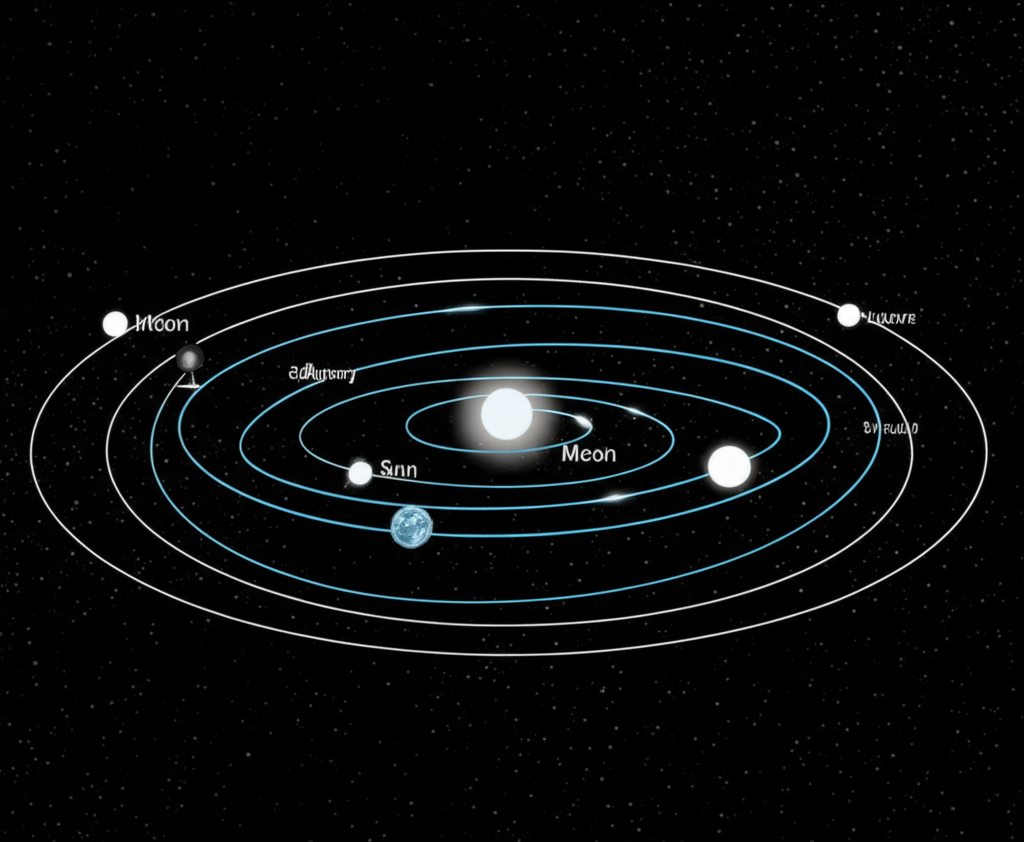
To account for the observed irregularities in planetary motion (like retrograde motion), later astronomers like Ptolemy, drawing on the Greek tradition, developed increasingly sophisticated systems of epicycles and deferents. These were complex mechanical adjustments to the geocentric model, attempting to "save the appearances" within the prevailing philosophical framework.
The Copernican Revolution: A Paradigm Shift in Perspective
The established Aristotelian-Ptolemaic World view, despite its mathematical intricacies, faced growing challenges. The Renaissance brought a renewed spirit of inquiry and a critical re-examination of ancient texts and observations.
- Nicolaus Copernicus and the Heliocentric Hypothesis: In his seminal work, De revolutionibus orbium coelestium (On the Revolutions of the Heavenly Spheres), Copernicus proposed a radical alternative: a heliocentric model. The sun, not the Earth, was at the center of the solar system, with the Earth and other planets revolving around it. This was not merely an astronomical adjustment; it was a profound philosophical reorientation, dethroning humanity from the cosmic center and initiating a revolution in thought.
- Tycho Brahe's Observations and Johannes Kepler's Laws: Tycho Brahe's meticulous astronomical observations, conducted without a telescope, provided the most accurate data of his time. His assistant, Johannes Kepler, inherited this treasure trove of information. Through years of painstaking calculation, Kepler abandoned the ancient dogma of perfect circular orbits. He discovered that planets move in elliptical paths and formulated three laws of planetary motion, introducing a new level of mathematical precision to Astronomy and effectively demonstrating the true mechanics of their orbits. This marked a crucial step towards modern Physics.
- Galileo Galilei and Empirical Evidence: Galileo's use of the telescope revolutionized observational Astronomy. His observations of the phases of Venus, the moons of Jupiter, and the imperfections of the Moon directly challenged the Aristotelian model and provided compelling empirical evidence for the Copernican system. His work, detailed in Sidereus Nuncius (Starry Messenger) and Dialogue Concerning the Two Chief World Systems, was a powerful advocate for observation and experimentation, linking the theoretical mechanics of the heavens to tangible proof.
Newton and the Grand Unification: Universal Mechanics
The stage was set for the ultimate synthesis, a grand explanation that would unify terrestrial and celestial mechanics. This monumental achievement came with Isaac Newton.
- Isaac Newton's Philosophiæ Naturalis Principia Mathematica: Published in 1687, Newton's Principia is arguably one of the most important scientific works ever written. In it, Newton laid out his three laws of motion and, crucially, the law of universal gravitation. This single law explained not only why an apple falls from a tree but also why the moon orbits the Earth and why planets follow Kepler's elliptical paths.
- A Clockwork Universe: Newton's work demonstrated that the same fundamental physics governed both the heavens and the Earth. The universe was no longer a realm of separate physical laws but a unified system, operating like a giant, intricate clockwork. The "mechanics of the heavens" became a subset of universal mechanics. This provided a comprehensive, quantitative framework for understanding the World that was testable and predictive. The cosmos was, for the first time, truly comprehensible through human reason and mathematics.
- The Power of Calculus: Newton, along with Leibniz, developed calculus – a new mathematical tool essential for describing continuous change and motion. This invention was fundamental to articulating the precise mechanics of gravitational forces and orbital dynamics, underscoring the indispensable role of advanced mathematics in understanding the physical World.
Philosophical Implications and Enduring Questions
The unraveling of the mechanics of the heavens had profound philosophical consequences, extending far beyond the realm of Astronomy and Physics.
- Deism and the Divine Watchmaker: Newton's universe, operating by immutable laws, fostered the philosophical concept of deism. God was seen as the grand architect, the "divine watchmaker" who set the universe in motion according to perfect laws, and then allowed it to run without direct intervention.
- Determinism and Free Will: If the universe operated like a machine, precisely predictable by its initial conditions and physical laws, what did this mean for human free will? This question became a central debate in philosophy, influencing thinkers from Laplace to Kant.
- The Enlightenment and the Power of Reason: The success of Newtonian mechanics fueled the Enlightenment, reinforcing the belief in human reason's ability to uncover the fundamental truths of the World. It demonstrated that through observation, experimentation, and logical deduction, humanity could unlock the secrets of nature.
- The Ongoing Quest: While Newton's mechanics provided an incredibly successful model, it was not the final word. The 20th century, with Einstein's theories of relativity and the advent of quantum mechanics, further refined our understanding, revealing that the universe's operations are even more intricate and counter-intuitive than Newton could have imagined. Yet, these new frontiers continue the same fundamental quest: to understand the underlying physics and mechanics that govern our existence in this vast and wondrous World.
Further Exploration
For those eager to delve deeper into the philosophical and scientific journey of understanding the cosmos, consider these resources:
- **## 📹 Related Video: KANT ON: What is Enlightenment?
Video by: The School of Life
💡 Want different videos? Search YouTube for: ""History of Astronomy from Ancient Greece to Newton" - Focus on the philosophical shifts and key figures."**
- **## 📹 Related Video: PLATO ON: The Allegory of the Cave
Video by: The School of Life
💡 Want different videos? Search YouTube for: ""Newton's Laws and Universal Gravitation Explained Philosophically" - Explore the impact of Newtonian mechanics on worldviews."**
Conclusion: The Enduring Legacy of Cosmic Inquiry
The story of "The Mechanics of the Heavens" is a testament to the enduring human spirit of inquiry. From ancient philosophers contemplating perfect spheres to Newton's grand unification of terrestrial and celestial mechanics, each step forward reshaped our understanding of the World and our place within it. This journey, meticulously documented in the Great Books of the Western World, highlights the symbiotic relationship between Astronomy, Physics, and philosophy, continuously pushing the boundaries of what is known and challenging us to ask deeper questions about the fundamental operations of the cosmos. The universe, once an inscrutable mystery, has progressively revealed its intricate, elegant mechanics, inviting us to marvel at its complexity and the power of human reason to comprehend it.