

The Grand Design: Unraveling the Mechanics of the Heavens
From the earliest human gazes upward, the celestial sphere has been an enduring source of wonder, mystery, and profound intellectual challenge. "The Mechanics of the Heavens" is not merely a scientific concept; it represents humanity's millennia-long quest to understand the underlying Physics that govern the cosmos, transforming our perception of the World and our place within it. This journey, chronicled through the annals of Astronomy and theoretical Mechanics, is a testament to the power of human reason to decipher the most intricate of cosmic dances. We begin with a summary of this epic intellectual voyage, tracing the evolution of thought from ancient philosophical speculation to the precise mathematical descriptions that unveiled the universe's grand, predictable order.
From Celestial Spheres to Universal Laws: An Introduction
Our fascination with the heavens is as old as consciousness itself. For millennia, the stars, planets, and moons moved with an apparent regularity that invited both reverence and rigorous inquiry. "The Mechanics of the Heavens" encapsulates this intellectual endeavor, exploring the historical evolution of our understanding of celestial motion. It’s a narrative that shifts from mystical interpretations and geocentric models to the revolutionary insights of heliocentrism and, ultimately, to Isaac Newton’s universal laws of gravitation and motion. This article delves into the pivotal moments and groundbreaking thinkers who transformed our comprehension of the cosmos, revealing the intricate, predictable mechanics that orchestrate the universe.
The Ancient Gaze: Early Astronomical Thought
Long before telescopes and calculus, ancient civilizations meticulously observed the night sky, charting the paths of the planets and stars. Their initial attempts to explain these motions were often intertwined with cosmology, philosophy, and religion.
- Plato and Aristotle: These Greek philosophers, key figures in the Great Books of the Western World, laid much of the conceptual groundwork. Plato's Eudoxus proposed a system of concentric, crystalline spheres to carry the celestial bodies, a model refined by Aristotle. This Aristotelian cosmos, characterized by perfect circular motion and a geocentric World view, dominated Western thought for over a thousand years. The heavens were seen as immutable and divine, distinct from the terrestrial realm.
- Ptolemy's Almagest: Claudius Ptolemy, in his monumental work Syntaxis Mathematica (known as the Almagest), presented the most sophisticated geocentric model. Employing epicycles, deferents, and equants, Ptolemy's system was remarkably accurate at predicting planetary positions, despite its underlying incorrect premise. It was a triumph of observational Astronomy and mathematical modeling, providing a framework that endured until the Renaissance.
Revolutionizing the Cosmos: The Dawn of Modern Mechanics
The medieval period largely preserved and elaborated upon the Ptolemaic system. However, the seeds of doubt and the desire for simpler, more elegant explanations began to sprout, leading to a profound scientific revolution.
- Nicolaus Copernicus: His De revolutionibus orbium coelestium (On the Revolutions of the Heavenly Spheres), published in 1543, proposed a heliocentric model where the Sun, not the Earth, was at the center of the universe. This radical shift was not immediately accepted but provided a simpler, more harmonious explanation for observed planetary motions, challenging the entrenched Aristotelian Physics and geocentric worldview.
- Johannes Kepler: Building on Tycho Brahe's meticulous observational data, Kepler formulated his three laws of planetary motion. These laws, derived empirically, described elliptical orbits and varying planetary speeds, shattering the ancient ideal of perfect circular motion and providing the mathematical framework for understanding the mechanics of planetary paths.
- Galileo Galilei: With his revolutionary use of the telescope, Galileo provided empirical evidence supporting the Copernican model. His observations of Jupiter's moons, the phases of Venus, and the imperfections of the Moon directly contradicted Aristotelian Astronomy and Physics, further paving the way for a new understanding of celestial mechanics. His work on terrestrial motion also laid crucial groundwork for Newton.
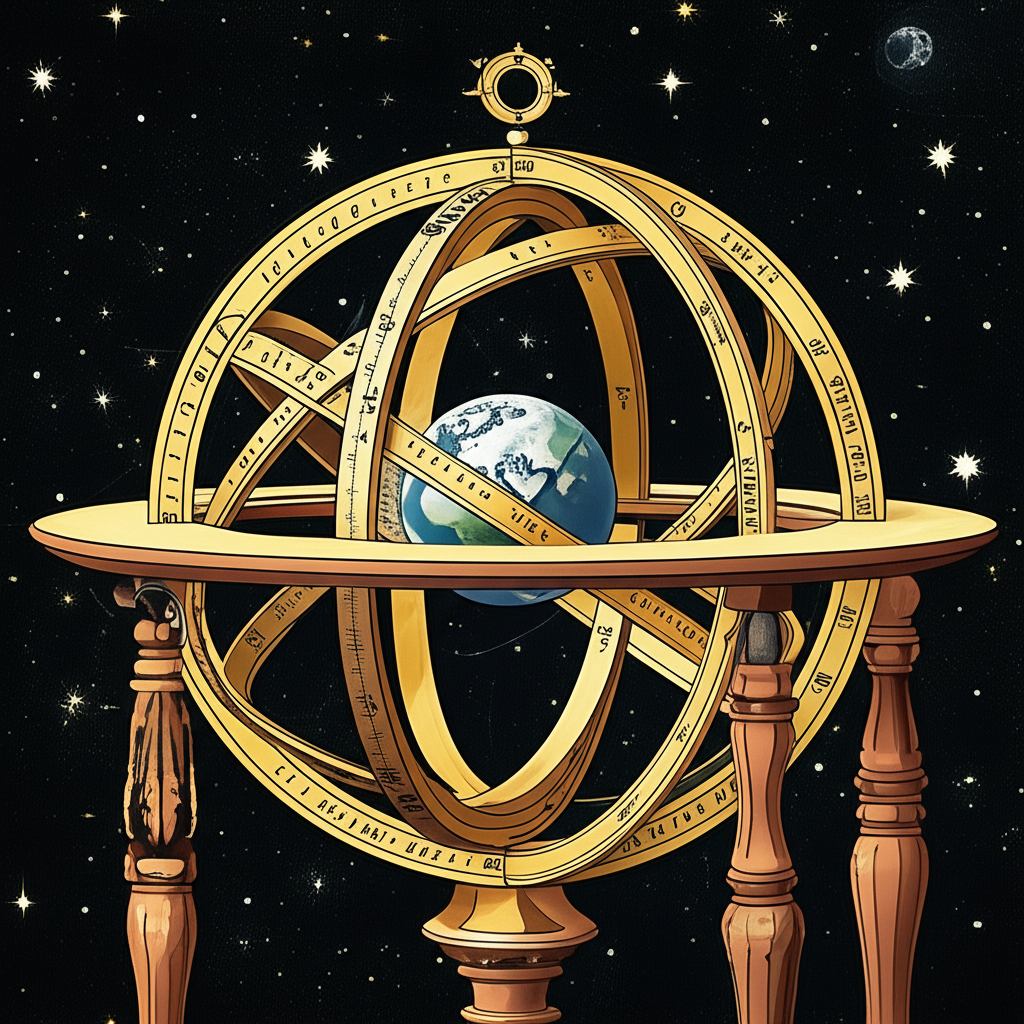
Newton's Grand Synthesis: Unifying Earth and Sky
The culmination of this intellectual journey arrived with Isaac Newton, whose work fundamentally reshaped our understanding of the universe.
- Principia Mathematica: In his Philosophiæ Naturalis Principia Mathematica (Mathematical Principles of Natural Philosophy), published in 1687, Newton presented a unified system of mechanics that applied equally to terrestrial and celestial phenomena. His three laws of motion and, most importantly, his law of universal gravitation, explained why apples fall to the Earth and why planets orbit the Sun.
- Universal Gravitation: This groundbreaking concept posited that every particle of matter in the universe attracts every other particle with a force directly proportional to the product of their masses and inversely proportional to the square of the distance between their centers. This single, elegant law explained Kepler's empirical observations, the tides, and the orbits of comets, truly establishing the mechanics of the heavens as a domain of predictable Physics. Newton demonstrated that the same forces governing our World also govern the most distant stars, unifying the cosmos under a single set of laws.
The Philosophical Echo: Our Place in the Cosmic Machine
Newton's synthesis had profound philosophical implications. It transformed the heavens from a realm of divine mystery into a vast, intricate, yet ultimately understandable machine. This mechanistic worldview influenced Enlightenment thought, promoting reason, predictability, and the idea of a universe governed by natural laws. While later developments in Physics like relativity and quantum mechanics would refine and expand upon Newton's framework, his contributions remain foundational to our understanding of the cosmos. The quest to understand the mechanics of the heavens continues to inspire, reminding us of the enduring human capacity for inquiry and the boundless wonders of the universe.
Key Figures and Their Contributions to Celestial Mechanics
| Figure | Era | Key Contribution | Impact on Celestial Mechanics |
|---|---|---|---|
| Plato/Aristotle | 4th Century BCE | Geocentric model, crystalline spheres, perfect circular motion. | Established the foundational, albeit incorrect, mechanics that dominated Western thought for over 1500 years, emphasizing philosophical ideals over empirical observation. |
| Claudius Ptolemy | 2nd Century CE | Almagest, refined geocentric model with epicycles, deferents, and equants. | Provided the most detailed and predictive geocentric system, a practical framework for Astronomy that allowed for accurate predictions despite its flawed premise, shaping the understanding of the World for centuries. |
| Nicolaus Copernicus | 16th Century | Heliocentric model (Sun at the center). | Initiated the scientific revolution by challenging the geocentric worldview, simplifying the mechanics of planetary motion and paving the way for modern Astronomy and Physics. |
| Johannes Kepler | 17th Century | Three Laws of Planetary Motion (elliptical orbits, equal areas in equal times, period-distance relation). | Empirically described the actual mechanics of planetary orbits, moving beyond perfect circles and providing the mathematical blueprint for Newton's later gravitational theory. |
| Galileo Galilei | 17th Century | Telescopic observations (Jupiter's moons, Venus's phases), laws of motion, inertia. | Provided crucial observational evidence for heliocentrism and laid the experimental groundwork for modern Physics, challenging Aristotelian mechanics and demonstrating that celestial bodies are subject to physical laws. |
| Isaac Newton | 17th Century | Universal Law of Gravitation, Three Laws of Motion, Calculus. | Unified terrestrial and celestial mechanics, explaining all observed motions with a single, elegant framework of Physics. His work established a mechanistic World view and provided the foundation for classical Astronomy and engineering. |
📹 Related Video: PLATO ON: The Allegory of the Cave
Video by: The School of Life
💡 Want different videos? Search YouTube for: ""Newton's Laws of Motion and Universal Gravitation Explained""
📹 Related Video: PLATO ON: The Allegory of the Cave
Video by: The School of Life
💡 Want different videos? Search YouTube for: ""The Copernican Revolution: How We Discovered Our Place in the Universe""