

The Mechanics of the Body and Life: A Philosophical Inquiry
Summary: The Embodied Enigma
Our existence is fundamentally intertwined with the intricate workings of the human body. This article delves into the profound philosophical implications of viewing the body as a complex machine, a perspective rooted in ancient thought and refined through centuries of scientific inquiry. We will explore how the principles of mechanics and physics underpin biological life, from the rhythmic beat of the heart to the complex processes of thought. This journey inevitably leads to deeper questions about consciousness, free will, and the ultimate mechanics of life and death, challenging us to consider whether our embodied existence can be fully explained by material processes alone or if something more transcendent is at play.
Introduction: The Machine Within
From the earliest stirrings of philosophical thought, humanity has grappled with the nature of its own being. What are we? Are we merely sophisticated arrangements of matter, subject to the same physical laws that govern the cosmos? Or is there an animating force, a soul, that transcends the material? The concept of the body as a machine, an elaborate system of levers, pumps, and conduits, has been a persistent and powerful metaphor in this ongoing inquiry. It is a perspective that invites us to examine the mechanics of life with a critical, philosophical eye, questioning not just how we function, but what that functioning implies about our very essence.
I. Ancient Whispers of Mechanism: From Organism to Apparatus
The idea that the body operates on discernible principles is not a modern invention. Ancient thinkers, though lacking our contemporary scientific tools, observed the functionality of living beings with keen insight.
Aristotle's Functionalism and Galen's Anatomy
Aristotle, in works like De Anima and his extensive biological treatises, meticulously observed the functions of organs, describing the heart as the primary organ of sensation and movement, and viewing life as an entelechy – the actualization of potential inherent in an organism. While not strictly "mechanistic" in the modern sense, his detailed descriptions laid a foundational understanding of the body's integrated systems, each part serving a specific purpose.
Later, the physician Galen, whose influence permeated Western medicine for over a millennium, conducted anatomical dissections and vivisections, systematically documenting the body's structures and their apparent mechanics. He saw the blood vessels, nerves, and muscles as a complex network, each contributing to the overall function, a testament to the intricate design of the human form. These early investigations, though often speculative, began to peel back the layers of mystery, suggesting that the body was not merely a passive vessel but an active, dynamic apparatus.
The Dawn of Dissection: Unveiling the Inner Workings
The Renaissance saw a resurgence of anatomical study, with figures like Andreas Vesalius challenging Galen's doctrines through direct observation. His De humani corporis fabrica (On the Fabric of the Human Body) was a landmark work, revealing the astonishing detail and complexity of human anatomy. These detailed mappings of bones, muscles, and organs further solidified the view of the body as an incredibly sophisticated, albeit organic, machine.
II. Descartes' Automaton: The Body as a Clockwork
It was René Descartes in the 17th century who most explicitly articulated the body as a machine, a grand automaton operating under the laws of physics.
The Mind-Body Problem and Mechanistic Reduction
In works such as Discourse on Method and Meditations on First Philosophy, Descartes posited a radical dualism: the mind (res cogitans – thinking substance) was entirely distinct from the body (res extensa – extended substance). For Descartes, the body was a purely mechanical entity, akin to a clockwork mechanism or an elaborate hydraulic system. All its functions – digestion, circulation, muscle movement – could, in principle, be explained by the laws of mechanics.
"I suppose the body to be nothing else than a statue or machine made of earth, which God forms with the express purpose of rendering it as nearly as possible like us..." – René Descartes, Treatise on Man
This view was revolutionary, allowing for the scientific study of the body without encroaching upon the spiritual domain of the soul. It set the stage for modern biology and medicine, encouraging a reductionist approach to understanding physiological processes.
Physics as the Language of the Body
Descartes believed that the same physics that governed the movement of celestial bodies and falling apples also dictated the internal operations of the human body. Blood circulated like water in pipes, muscles contracted like springs, and nerves transmitted signals like wires. This perspective essentially transformed the body into a problem of applied physics, a challenge for engineers and natural philosophers to decipher.
III. The Intricate Dance of Life: Biological Mechanics in Action
Modern science has profoundly deepened our understanding of the body's mechanics, revealing an astonishing level of complexity and elegance.
Circulation, Respiration, and Motion: Engines of Existence
Consider the fundamental systems that define life:
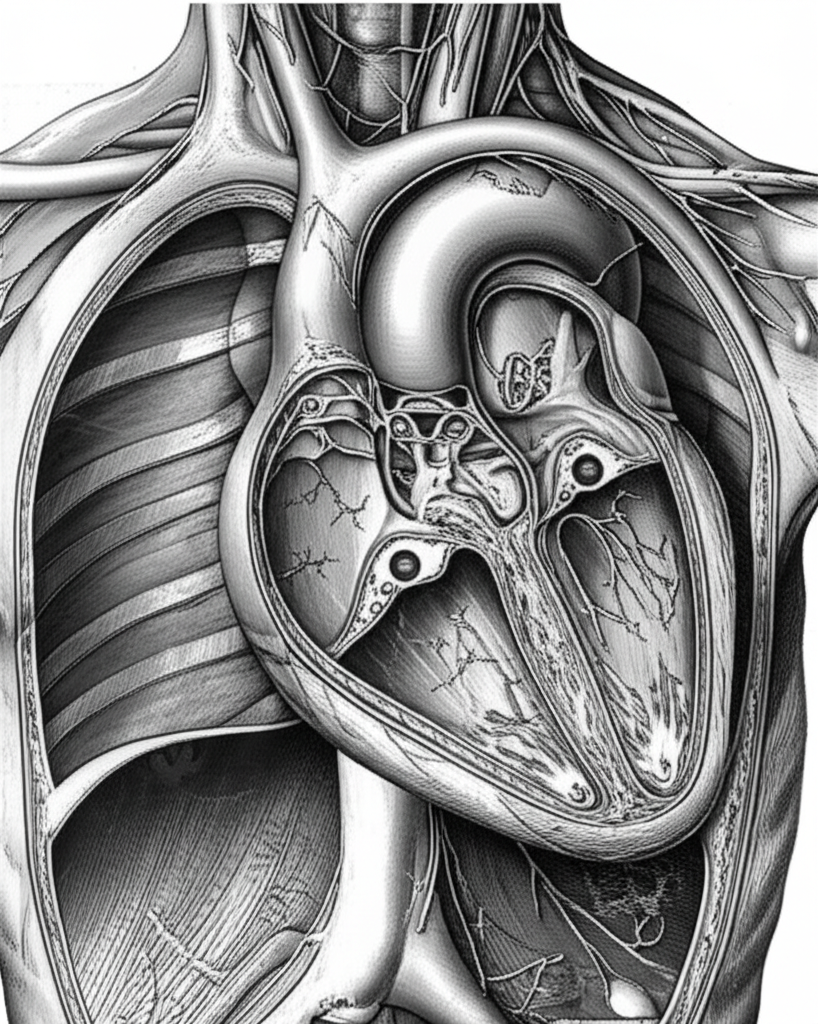
- Circulation: The heart, a remarkable muscular pump, tirelessly propels blood through an extensive vascular network. This system, governed by principles of fluid dynamics and pressure, delivers oxygen and nutrients while removing waste. Its mechanics are vital for sustaining every cell.
- Respiration: The lungs, acting as sophisticated air pumps and gas exchangers, facilitate the intake of oxygen and expulsion of carbon dioxide. This process relies on pressure differentials, muscle contractions, and the physical properties of gases, all governed by physics.
- Motion: Our skeletal and muscular systems function as a complex arrangement of levers and pulleys. Bones provide structure, while muscles, through contraction and relaxation, generate force, allowing for locomotion, manipulation, and intricate movements. Biomechanics, a field at the intersection of biology and mechanics, studies these systems in detail.
The Elegant Simplicity of Complex Systems
Beyond these macroscopic functions, the mechanics extend to the microscopic and molecular levels. Proteins fold into specific shapes, enzymes catalyze reactions with precision, and cells divide and communicate through intricate biochemical pathways – all ultimately governed by the fundamental laws of physics and chemistry. The body is not just a collection of parts, but a symphony of interconnected mechanical and chemical processes, each contributing to the maintenance of life.
IV. Life and Death: The Ultimate Mechanical Imperative
The mechanistic view profoundly shapes our understanding of life and death.
The Cessation of Function: When the Machine Fails
From a purely mechanical perspective, death can be understood as the irreversible cessation of the body's vital functions. The heart stops pumping, the lungs cease to respire, and the brain's electrical activity flatlines. It is the ultimate mechanical failure, the moment when the complex apparatus can no longer sustain itself. This perspective has driven medical science to understand disease as a malfunction of these mechanics and to develop interventions to repair or replace faulty parts.
Beyond the Gears: Is Life More Than Its Mechanics?
Yet, this raises profound philosophical questions: Is life merely an emergent property of these complex mechanics? If we could perfectly replicate every physical and chemical process, would we create life? Or is there an irreducible quality to life that transcends its material components? The mechanics provide a framework, but many philosophers argue they do not fully capture the essence of being alive, the subjective experience, or the phenomenon of consciousness itself.
V. Contemplating Consciousness: The Ghost in the Machine?
Perhaps the greatest challenge to a purely mechanistic view of the body lies in the enigma of consciousness.
Where Does Awareness Reside?
If the brain is an incredibly complex biological computer, how does it generate subjective experience, self-awareness, and the richness of our inner world? This is the "hard problem" of consciousness. While neuroscience continues to map brain activity and correlate it with mental states, the leap from neural firings (a mechanical/electrical process) to phenomenal experience remains a philosophical chasm.
The Limits of a Purely Mechanistic Explanation
Philosophers have long debated whether consciousness is an epiphenomenon, a byproduct of complex mechanics, or if it requires a non-physical explanation. The mechanistic view, while powerful for explaining physiological processes, often struggles to account for phenomena like intentionality, qualia (the subjective quality of experience), and free will. To say that "I think" is merely the result of neurons firing feels, to many, incomplete. This is where the mechanics of the body confront the limits of their explanatory power, inviting us to look beyond the purely material.
VI. Conclusion: The Enduring Paradox of Embodied Existence
The journey into "The Mechanics of the Body and Life" is a profound philosophical expedition. From Aristotle's observations to Descartes' radical dualism, and on to modern biomechanics, we have continuously sought to understand the intricate workings of our physical selves. The body is undeniably a marvel of natural engineering, operating under the precise laws of physics, a testament to the power of mechanics.
Yet, as we dissect and analyze, the larger questions persist. Does a complete understanding of the body's mechanics truly explain life itself, with its subjective experiences, its capacity for thought, and its inevitable journey towards death? Or is there an emergent quality, perhaps even a transcendent aspect, that defies purely reductionist explanations? The paradox of our embodied existence lies in this tension: we are both intricate machines and conscious beings, forever caught between the gears of physics and the boundless expanse of philosophical inquiry. This contemplation remains, as ever, at the heart of what it means to be human.
📹 Related Video: What is Philosophy?
Video by: The School of Life
💡 Want different videos? Search YouTube for: ""Descartes mind-body problem explained" "Philosophy of biology mechanistic view""