

The Intricate Dance of Being: Mechanics, Body, and the Philosophical Inquiry into Life
From the earliest stirrings of philosophical thought, humanity has grappled with the profound mystery of existence, often beginning with the most immediate and tangible evidence of life: the body. This article delves into how the mechanics of our physical form, understood through the lens of physics, intersects with the larger, more enigmatic questions of life and death. We will explore how philosophers, from ancient Greece to the Enlightenment and beyond, have attempted to reconcile the observable, clockwork precision of biological processes with the elusive essence of consciousness and being, ultimately asking whether life is merely a complex machine or something more.
The Body as a Grand Machine: A Philosophical Perspective
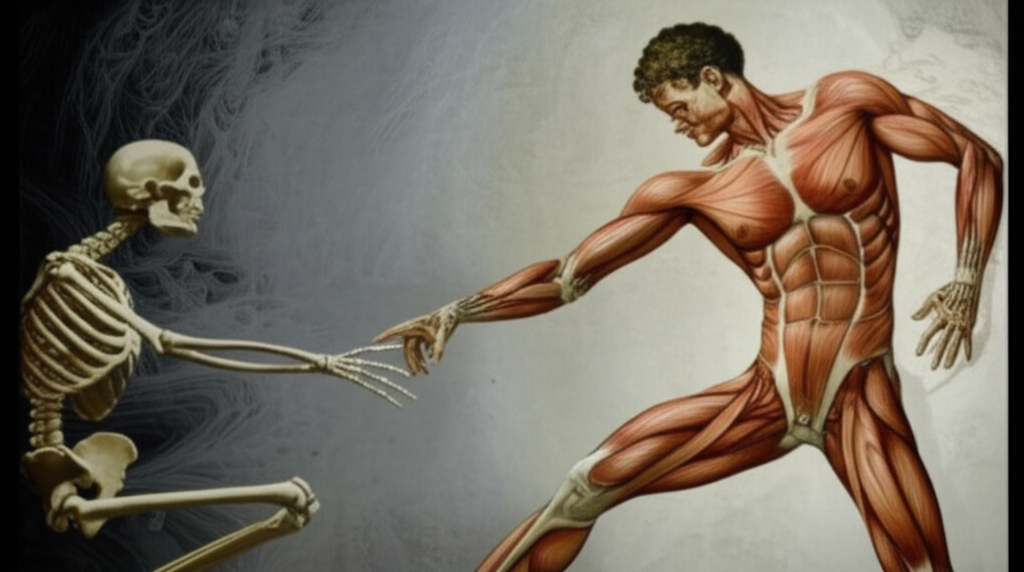
The human body, in its astonishing complexity and functionality, has long served as both an object of scientific scrutiny and a canvas for philosophical speculation. Is it merely an intricate arrangement of levers, pulleys, and chemical reactions, or does it house something beyond the purely material?
Ancient Insights into Somatic Function
Ancient thinkers, even without the advanced scientific tools of today, recognized the sophisticated mechanics of the body. Plato, in his Timaeus, describes the body as a vessel for the soul, ingeniously constructed by a divine craftsman. While not using modern physics terminology, he acknowledges the intricate design required for function. Aristotle, in his De Anima, offered a more integrated view, where the soul is not separate from the body but rather its form – the animating principle that gives the body its life. For Aristotle, the mechanics of breathing, movement, and perception are intrinsic to the life of the organism, not merely a container for an external force. The heart, for instance, was seen as the center of sensation and movement, a vital organ whose proper mechanics were essential for life.
The Cartesian Dualism and its Legacy
Centuries later, René Descartes, a pivotal figure in the Great Books of the Western World, radically reshaped this discourse. For Descartes, the body was unequivocally a machine, governed by the same physics that dictate the motion of inanimate objects. In his Treatise on Man, he meticulously detailed how nerves, muscles, and fluids could account for all bodily functions, even complex behaviors, without recourse to a non-physical soul. The pineal gland, for him, was the unique point of interaction between the purely material, extended body and the immaterial, thinking mind. This dualistic framework, while offering a clear separation, left subsequent philosophers with the enduring "mind-body problem": how can something entirely non-physical interact with something entirely physical? The mechanics of the body became a realm of scientific inquiry, while the life of the mind remained a philosophical enigma.
Physics, Physiology, and the Spark of Life
The scientific revolution, fueled by figures like Isaac Newton, cemented a mechanistic worldview, suggesting that the universe operates according to immutable laws of physics. This paradigm inevitably extended to the study of life.
Newtonian Physics and Biological Determinism
With the advent of Newtonian physics, the universe was increasingly viewed as a giant clockwork mechanism. This perspective profoundly influenced biology, leading to a strong emphasis on understanding the body's mechanics through cause and effect. Physiology sought to reduce biological processes – digestion, circulation, respiration – to chemical and physical reactions. The heart became a pump, the lungs bellows, and the brain an intricate network of electrical signals. This deterministic view suggested that if we could understand all the mechanics of the body, we could fully understand life itself. Yet, despite immense progress, the question of what truly constitutes life beyond its constituent mechanics persists.
The Enigma of Consciousness
While physics and physiology brilliantly explain the mechanics of neuronal firing or metabolic pathways, they struggle to account for the subjective experience of consciousness. How does the purely physical interaction of atoms and molecules give rise to the feeling of redness, the taste of sweetness, or the profound sense of self? This "hard problem" of consciousness highlights the gap between a purely mechanistic understanding of the body and the full spectrum of human life. Philosophers continue to debate whether consciousness is an emergent property of complex mechanics, a fundamental aspect of reality, or something else entirely.
Life, Death, and the End of the Mechanism
The ultimate test of any philosophical or scientific theory of life lies in its ability to confront death. If the body is a machine, what happens when it breaks down?
Mortality as a Mechanical Failure?
From a purely mechanistic standpoint, death is the cessation of the body's mechanics. The heart stops pumping, the brain ceases electrical activity, and the complex system that sustained life grinds to a halt. The laws of physics continue to apply, leading to decomposition and the return of the body's* elements to the earth. This perspective, while scientifically accurate, often feels incomplete when confronted with the emotional and existential weight of death. Is the totality of a person's life simply reducible to the functioning of their biological mechanics?
Beyond the Physical: The Enduring Questions
This is where philosophy steps in, often drawing from traditions found in the Great Books. While the mechanics of the body provide a framework for understanding life and death, they do not fully address the questions of meaning, purpose, or what, if anything, transcends the physical. Is there a soul that departs? Does consciousness simply cease? What is the legacy of a life? These are questions that physics cannot answer, pushing us beyond the purely material realm into metaphysics, ethics, and theology. The dance between the observable mechanics and the unobservable essence of life remains one of philosophy's most compelling and persistent inquiries.
Comparing Mechanistic and Vitalistic Views of Life
| Aspect | Mechanistic View | Vitalistic View (Historical) |
|---|---|---|
| Nature of Life | Reducible to physical and chemical processes. | Possesses a unique, non-physical "vital force." |
| Body Function | Explained by mechanics and physics. | Guided by an animating principle (e.g., soul, élan vital). |
| Origin of Life | Arises from complex organization of matter. | Requires the presence of a vital force. |
| Consciousness | Emergent property of brain mechanics. | Often linked to a non-physical soul or mind. |
| Death | Cessation of physical processes; mechanical failure. | Departure or extinction of the vital force. |
📹 Related Video: ARISTOTLE ON: The Nicomachean Ethics
Video by: The School of Life
💡 Want different videos? Search YouTube for: ""Descartes Dualism Explained: Mind and Body Problem""
📹 Related Video: ARISTOTLE ON: The Nicomachean Ethics
Video by: The School of Life
💡 Want different videos? Search YouTube for: ""Aristotle on the Soul and Life: De Anima Summary""