

The Cosmic Dance: Unraveling the Mechanics of Planetary Motion
The celestial ballet, a spectacle of unwavering precision, has captivated humanity since time immemorial. For millennia, the seemingly erratic paths of planets across the night sky defied simple explanation, prompting profound philosophical and scientific inquiry. This pillar page delves into The Mechanics of Planetary Motion, tracing the intellectual journey from ancient, earth-centered cosmology to the elegant, mathematically precise universal laws that govern our solar system. We will explore how our understanding of Astronomy evolved through meticulous observation, revolutionary Physics, and an increasing reliance on Quantity to describe the universe, ultimately transforming our place within the cosmos. This is a story not just of scientific discovery, but of humanity's evolving relationship with truth, observation, and the very nature of reality.
A Journey Through the Heavens: From Mysticism to Mechanism
Our quest to comprehend the heavens is a testament to the enduring human spirit of inquiry. What began as mythological interpretations and qualitative descriptions gradually transformed into a rigorous scientific discipline, driven by a profound desire to understand the underlying mechanics of the universe. This journey, chronicled within the pages of the Great Books of the Western World, reveals a fascinating interplay between philosophical speculation, empirical observation, and mathematical innovation.
From Celestial Spheres to Epicycles: Early Conceptions of Cosmic Order
For centuries, the dominant view of the cosmos placed Earth at its unmoving center. Influenced by Aristotle, this geocentric model posited a universe of perfect, concentric crystalline spheres, each carrying a celestial body. The planets, sun, and stars were thought to move in eternal, circular paths – the most perfect of all motions – reflecting a divine order. This was less about predictive mechanics and more about a harmonious, teleological physics, where everything had its natural place and purpose.
However, the observed motions of planets, particularly their retrograde loops, presented a significant challenge to this elegant simplicity. To reconcile observation with the geocentric ideal, Ptolemy, in his monumental Almagest, developed an extraordinarily complex system of epicycles, deferents, and equants. This intricate model, while geometrically cumbersome, was remarkably effective at predicting planetary positions. It demonstrated an early reliance on quantity – using mathematical constructs to account for observational data – even if its underlying physics remained rooted in a geocentric paradigm. The beauty lay in its explanatory power, even as its complexity hinted at deeper, yet undiscovered, truths.
A Heliocentric Dawn: Copernicus and the Re-envisioning of the Universe
The intellectual landscape began to shift dramatically with Nicolaus Copernicus. His heliocentric model, published posthumously in De revolutionibus orbium coelestium, proposed a radical alternative: the Sun, not the Earth, was the center of the universe, with Earth and the other planets revolving around it. While still adhering to the perfect circles of ancient Astronomy, Copernicus's model offered a more elegant and conceptually simpler explanation for many observed phenomena, including retrograde motion.
This was more than just a change in astronomical models; it was a profound philosophical reorientation. It challenged centuries of established dogma and the anthropocentric view of the cosmos. The mechanics remained circular, but the perspective fundamentally altered, paving the way for future breakthroughs by suggesting that the heavens might operate according to principles less tied to human intuition and more to mathematical harmony.
Elliptical Paths and Empirical Laws: Kepler's Mathematical Revelation
The true revolution in understanding planetary mechanics came with Johannes Kepler. Building upon the incredibly precise and extensive observational data painstakingly collected by Tycho Brahe, Kepler meticulously analyzed the motion of Mars. He abandoned the ancient dogma of perfect circles, driven by the sheer quantity and accuracy of the empirical evidence. After years of arduous calculation, he formulated his three laws of planetary motion, which provided a purely descriptive yet incredibly accurate account of how planets move:
- First Law (Law of Ellipses): Planets orbit the Sun in elliptical paths, with the Sun at one of the two foci. This was a radical departure from the circular orbits assumed by all previous models.
- Second Law (Law of Equal Areas): A line segment joining a planet and the Sun sweeps out equal areas during equal intervals of time. This implied that planets move faster when closer to the Sun and slower when further away.
- Third Law (Law of Harmonies): The square of the orbital period of a planet is directly proportional to the cube of the semi-major axis of its orbit. This law established a mathematical relationship between the orbital size and period for all planets, hinting at an underlying universal principle.
Kepler's laws represent a monumental triumph of empirical Astronomy and mathematical physics. They shifted the focus from why planets moved (divine perfection) to how they moved, providing a precise, quantitative description of their mechanics.
Galileo's Gaze: Empirical Evidence and the Challenge to Dogma
While Kepler was describing the how, Galileo Galilei was providing the crucial observational evidence that dismantled the old Aristotelian physics and supported the Copernican worldview. With his innovative use of the telescope, Galileo made a series of discoveries that profoundly challenged the prevailing wisdom:
- The phases of Venus, mirroring those of the Moon, could only be explained if Venus orbited the Sun.
- The moons of Jupiter demonstrated that not everything revolved around the Earth, providing a miniature model of a heliocentric system.
- The imperfections on the Moon's surface and the spots on the Sun contradicted the notion of perfect, unblemished celestial bodies.
Galileo's work underscored the power of empirical observation and direct evidence over philosophical conjecture and traditional authority. His meticulous measurements and descriptions brought a new level of quantity to Astronomy, fundamentally altering the discourse around celestial mechanics.
The Unifying Force: Newton's Universal Gravitation and the Birth of Modern Mechanics
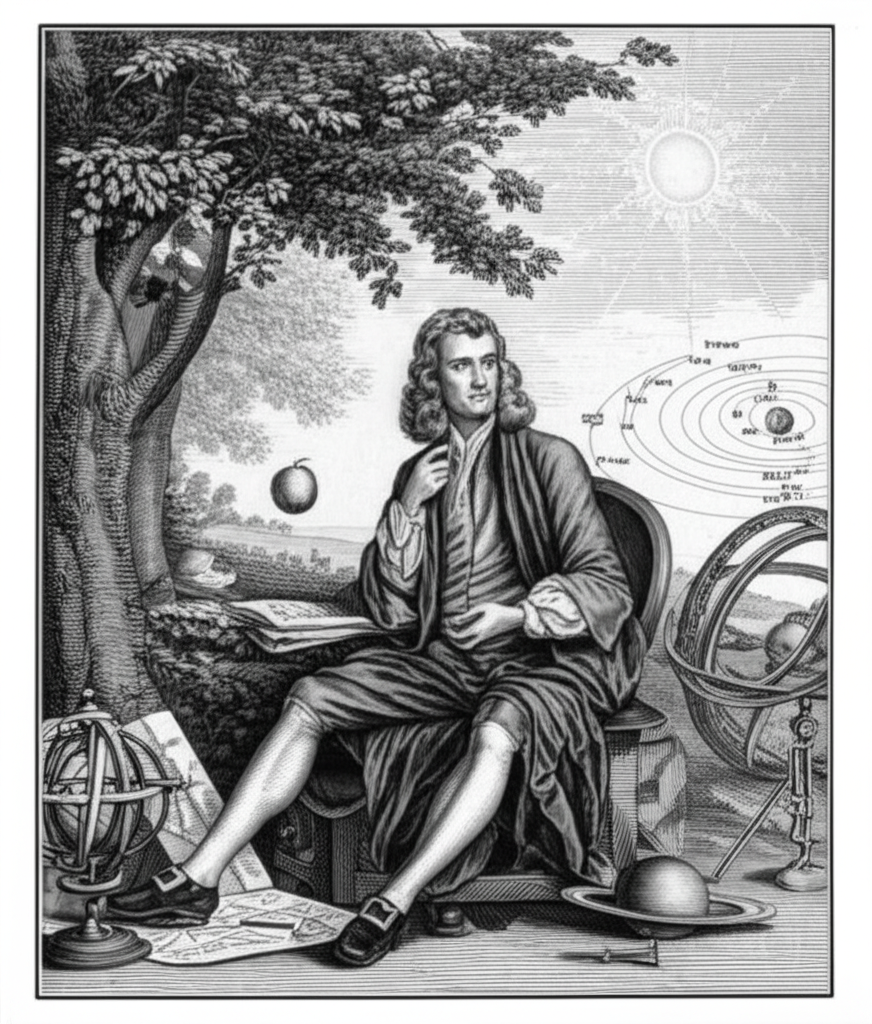
The culminating achievement in understanding planetary mechanics belongs to Isaac Newton. In his Philosophiæ Naturalis Principia Mathematica, Newton synthesized the disparate observations and laws into a single, elegant, and universal framework. He didn't just describe how planets moved (Kepler), but explained why they moved that way.
Newton's law of universal gravitation stated that every particle of matter in the universe attracts every other particle with a force directly proportional to the product of their masses and inversely proportional to the square of the distance between their centers. This single law, based on the principles of physics and expressed with precise quantity, explained:
- Kepler's elliptical orbits.
- The acceleration of falling objects on Earth.
- The tides.
- The motion of comets.
It established that the same mechanics governed both the terrestrial and celestial realms, erasing the ancient distinction between the two. Newton's work provided a deterministic, clockwork universe, where the motion of every object, from an apple to a planet, could be calculated and predicted with astonishing accuracy. This represented the true birth of modern mechanics and laid the foundation for much of classical physics.
Beyond the Equations: The Philosophical Resonance of Planetary Motion
The journey to understand the mechanics of planetary motion was not merely a scientific endeavor; it was a profound philosophical awakening. The shift from a geocentric to a heliocentric, and then to a gravitationally governed, universe challenged entrenched beliefs about humanity's place in the cosmos.
The emphasis on quantity and mathematical description, pioneered by Kepler and perfected by Newton, transformed physics from a qualitative study of essences to a quantitative science of forces and motion. This mechanistic worldview, while immensely powerful for prediction and understanding, also raised new questions about free will, determinism, and the role of a divine creator in a universe that seemed to operate according to immutable laws.
The Great Books remind us that each step in this scientific progression was accompanied by intellectual struggle and deep contemplation. The elegance of Kepler's ellipses, the audacity of Galileo's observations, and the unifying power of Newton's gravitation did not just explain the heavens; they reshaped our understanding of knowledge itself, emphasizing empirical evidence and rational inquiry as pathways to truth.
The Enduring Quest for Cosmic Understanding
The mechanics of planetary motion, meticulously charted over centuries, stands as one of humanity's greatest intellectual achievements. It demonstrates our capacity to observe, to question, to hypothesize, and to ultimately uncover the elegant, underlying physics that governs the universe. From the intricate epicycles of Ptolemy to the grand synthesis of Newton, each step was a testament to the insatiable human curiosity and the power of quantity to unlock cosmic secrets.
Even today, our understanding continues to evolve. While Newton's laws remain incredibly accurate for most everyday and solar system applications, Einstein's theory of relativity offers an even more profound and accurate description of gravity and spacetime, particularly at extreme scales. The universe, it seems, always holds more mysteries to unravel, inviting us to continue our philosophical and scientific journey into the cosmic dance.
Further Exploration:
📹 Related Video: ARISTOTLE ON: The Nicomachean Ethics
Video by: The School of Life
💡 Want different videos? Search YouTube for: ""The Copernican Revolution and its philosophical impact""
📹 Related Video: ARISTOTLE ON: The Nicomachean Ethics
Video by: The School of Life
💡 Want different videos? Search YouTube for: ""Newton's Laws and the Clockwork Universe: Philosophical Implications""