

The Cosmic Dance: Unraveling the Mechanics of Planetary Motion
From the earliest stargazers to the modern astrophysicist, humanity has been captivated by the celestial ballet above. The apparent movement of planets across the night sky has inspired awe, wonder, and a relentless quest for understanding. This pillar page explores how our comprehension of the mechanics governing these celestial bodies has evolved, tracing the intellectual journey from ancient philosophical speculation to the precise mathematical models of modern physics. We will delve into how the study of astronomy transformed from a descriptive art into a rigorous science, profoundly impacting our philosophical worldview and revealing the power of quantity in unlocking the universe's secrets. This journey is not merely scientific; it is a profound exploration of humanity's place in the cosmos, our capacity for reason, and our enduring desire to find order in the seemingly chaotic.
The Ancient Cosmos: Order, Philosophy, and the Geocentric View
For millennia, the Earth was considered the unmoving center of the universe, a view deeply intertwined with philosophical and theological beliefs. The movements of the stars and planets were often seen as manifestations of divine order or mystical forces.
Plato's Ideal Forms and Celestial Spheres
In the philosophical tradition, Plato, in works like the Timaeus (a foundational text in the Great Books of the Western World), envisioned a cosmos ordered by a divine craftsman, the Demiurge. The heavens were considered perfect and eternal, governed by ideal, unchanging forms. This led to the pervasive idea that celestial bodies must move in perfect circles, reflecting divine harmony and geometric purity. Any observed deviation from perfect circular motion presented a significant challenge to this philosophical ideal.
Aristotle's Geocentric Universe and the Prime Mover
Aristotle, building upon Platonic ideas but grounded more in empirical observation (though limited by ancient tools), solidified the geocentric model. In On the Heavens, he posited a universe composed of concentric crystalline spheres, with Earth at the center. The moon, sun, planets, and fixed stars were embedded in these spheres, each moving in a perfect circle. Beyond the outermost sphere lay the "Prime Mover," an unmoved mover that imparted motion to the entire cosmos. This model separated the corruptible, changeable "sublunary" realm (Earth) from the perfect, eternal "superlunary" realm (the heavens), providing a comprehensive philosophical and physical framework that dominated Western thought for nearly two millennia.
Ptolemy's Almagest: Refining the Geocentric Model
By the 2nd century AD, astronomical observations had revealed inconsistencies with simple circular orbits around the Earth. Claudius Ptolemy, in his monumental work Almagest (another cornerstone from the Great Books of the Western World), tackled this challenge. He developed a highly sophisticated geocentric model, introducing concepts like epicycles (small circles whose centers move along larger circles called deferents) and equants (points from which the angular speed of the epicycle center appears constant). This intricate system, while complex, allowed for remarkably accurate predictions of planetary positions, demonstrating an early, sophisticated application of quantity and geometry to reconcile observation with the geocentric ideal. Ptolemy's work was a testament to human ingenuity in attempting to fit data into a preconceived philosophical framework.
| Ancient Thinker | Key Contribution to Planetary Motion | Philosophical Underpinnings |
|---|---|---|
| Plato | Ideal circular motion; divine order | Forms, Demiurge, perfect harmony |
| Aristotle | Geocentric spheres; Prime Mover | Natural motion, sublunary/superlunary distinction |
| Ptolemy | Epicycles, deferents, equants; predictive model | Reconciling observation with geocentric dogma |
The Copernican Revolution: A Shift in Perspective
The dominance of the geocentric model began to wane as observational precision improved and the mathematical complexities grew unwieldy. A fundamental shift in perspective was needed.
Challenging the Earth's Centrality
Nicolaus Copernicus, in De revolutionibus orbium coelestium (On the Revolutions of the Heavenly Spheres), published in 1543, proposed a heliocentric model, placing the Sun, not the Earth, at the center of the universe. While still adhering to perfect circular orbits and requiring some epicycles, Copernicus's model offered a more elegant and mathematically simpler explanation for planetary movements, particularly the retrograde motion of planets. This was a profound philosophical challenge, unseating humanity from its perceived central position and sparking a revolution in thought.
Galileo's Telescope: Empirical Evidence and the Birth of Modern Physics
The true turning point came with Galileo Galilei. His refinement of the telescope allowed for unprecedented astronomical observations, which he documented in works like Sidereus Nuncius (Starry Messenger) and later, Dialogue Concerning the Two Chief World Systems. Galileo's observations provided crucial empirical evidence supporting the heliocentric view:
- The phases of Venus: Similar to the Moon's phases, they could only be explained if Venus orbited the Sun.
- The moons of Jupiter: These demonstrated that not everything orbited the Earth, showing a miniature "solar system" within our own.
- Sunspots and the Moon's imperfect surface: These challenged the Aristotelian notion of perfect, unblemished celestial bodies.
Galileo's work marked a critical transition from purely philosophical or geometric astronomy to an astronomy grounded in empirical observation and the nascent principles of physics.
Kepler's Laws: The Geometry of Motion
While Copernicus shifted the center, it was Johannes Kepler who truly unlocked the geometric mechanics of planetary motion, moving beyond the ancient ideal of perfect circles.
From Circles to Ellipses: A Triumph of Quantity
Kepler, working with the incredibly precise observational data of Tycho Brahe, spent years trying to fit planetary orbits into perfect circles, even within the Copernican framework. His meticulous calculations, detailed in works like Astronomia Nova and Harmonies of the World (parts of which are in the Great Books of the Western World), eventually led him to a revolutionary conclusion: planetary orbits are not circles, but ellipses. This was a monumental leap, shattering millennia of philosophical and astronomical dogma and demonstrating the profound power of quantity (mathematics) to reveal the true nature of reality.
Here are Kepler's three laws of planetary motion:
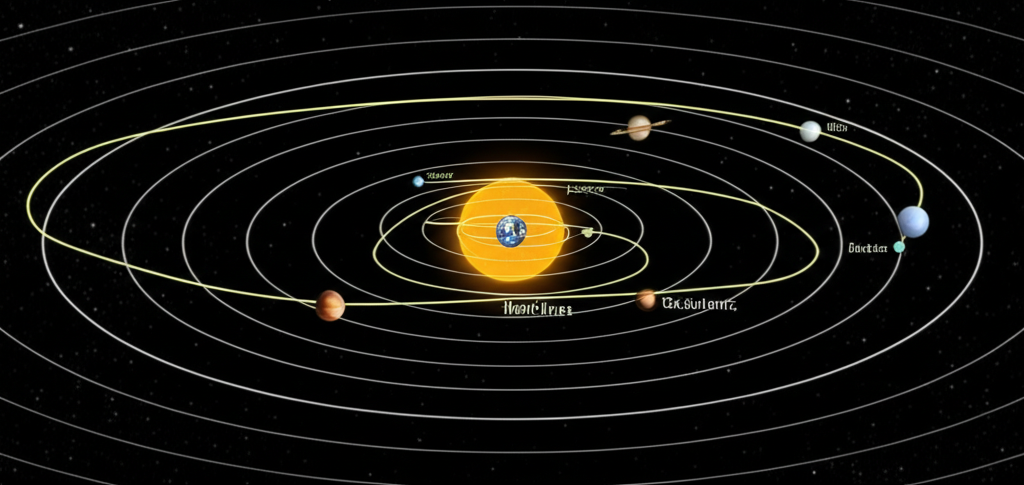
- The Law of Ellipses: The orbit of every planet is an ellipse with the Sun at one of the two foci.
- The Law of Equal Areas: A line segment joining a planet and the Sun sweeps out equal areas during equal intervals of time. This implies that planets move faster when they are closer to the Sun and slower when they are farther away.
- The Law of Harmonies: The square of the orbital period ($T$) of a planet is directly proportional to the cube of the semi-major axis ($a$) of its orbit ($T^2 \propto a^3$). This law established a mathematical relationship between the distance of a planet from the Sun and the time it takes to complete an orbit, unifying the solar system under a single quantitative rule.
Kepler's laws provided a precise, mathematically descriptive framework for how planets move, but they did not explain why they moved that way. That grand synthesis was left to Isaac Newton.
📹 Related Video: KANT ON: What is Enlightenment?
Video by: The School of Life
💡 Want different videos? Search YouTube for: ""Kepler's Laws of Planetary Motion explained simply""
Newton's Universal Gravitation: The Grand Synthesis of Mechanics
The final, most profound leap in understanding the mechanics of planetary motion came with Isaac Newton, who not only described how planets move but also explained the fundamental force driving that motion.
Principia Mathematica: Unifying Earthly and Celestial Physics
In his monumental work, Philosophiæ Naturalis Principia Mathematica (Mathematical Principles of Natural Philosophy), published in 1687 (a seminal text in the Great Books of the Western World), Newton presented a comprehensive theory of universal gravitation and his three laws of motion. This was a paradigm shift because it unified terrestrial physics (the mechanics of objects on Earth) with celestial physics (the mechanics of planetary motion) under a single set of universal laws.
Newton proposed that every particle of matter in the universe attracts every other particle with a force that is directly proportional to the product of their masses and inversely proportional to the square of the distance between their centers. This elegant, universal law explained:
- Why objects fall to Earth.
- Why the Moon orbits the Earth.
- Why planets orbit the Sun, and why they follow Kepler's elliptical paths.
- The tides, and many other phenomena.
Newton's work established a deterministic, mechanistic view of the universe, where the motion of every object, from an apple to a planet, could be calculated and predicted with astonishing precision using mathematical quantity.
The Philosophical Ramifications of a Clockwork Universe
The success of Newton's physics had profound philosophical ramifications. It fostered the idea of a "clockwork universe," a grand machine operating according to immutable natural laws, set in motion by a divine creator but then running autonomously. This view influenced Enlightenment thinkers, promoted rationalism, and sparked debates about free will versus determinism. The universe, once a realm of mysterious, arbitrary forces, became a system understandable through reason and quantity, a testament to the power of human intellect to uncover its fundamental mechanics.
📹 Related Video: PLATO ON: The Allegory of the Cave
Video by: The School of Life
💡 Want different videos? Search YouTube for: ""Newton's Laws of Motion and Universal Gravitation Explained""
Conclusion
The journey to understand the mechanics of planetary motion is a testament to humanity's intellectual evolution. From ancient philosophical ideals of perfect celestial spheres to the precise, universal laws of Newtonian physics, our understanding of the cosmos has been utterly transformed. This odyssey, propelled by observation, mathematical ingenuity, and a relentless pursuit of truth, has not only revealed the intricate mechanics of the heavens but has also profoundly shaped our philosophical worldview. The interplay between astronomy, physics, and the rigorous application of quantity continues to be a cornerstone of human knowledge, reminding us that the quest to understand the universe is inextricably linked to our quest to understand ourselves and our place within its grand, ordered tapestry.