

The Mechanics of Planetary Motion: A Philosophical Inquiry
The dance of celestial bodies across the night sky has captivated humanity for millennia, inspiring not only awe but also profound philosophical and scientific inquiry. From ancient myths to modern astrophysics, understanding the mechanics of planetary motion has been a cornerstone of our intellectual journey, pushing the boundaries of astronomy, physics, and our very conception of the cosmos. This pillar page delves into the historical evolution of our understanding of how planets move, examining the philosophical shifts and scientific breakthroughs that redefined our place in the universe, highlighting the critical role of observation, mathematics, and the relentless pursuit of truth found within the Great Books of the Western World.
From Celestial Spheres to Elliptical Orbits: A Historical Overview
Our quest to comprehend planetary motion began with philosophical rather than purely empirical considerations. Early thinkers sought to impose order and perfection upon the heavens, leading to intricate, yet ultimately flawed, models.
Ancient Greek Cosmology: The Perfection of Circles
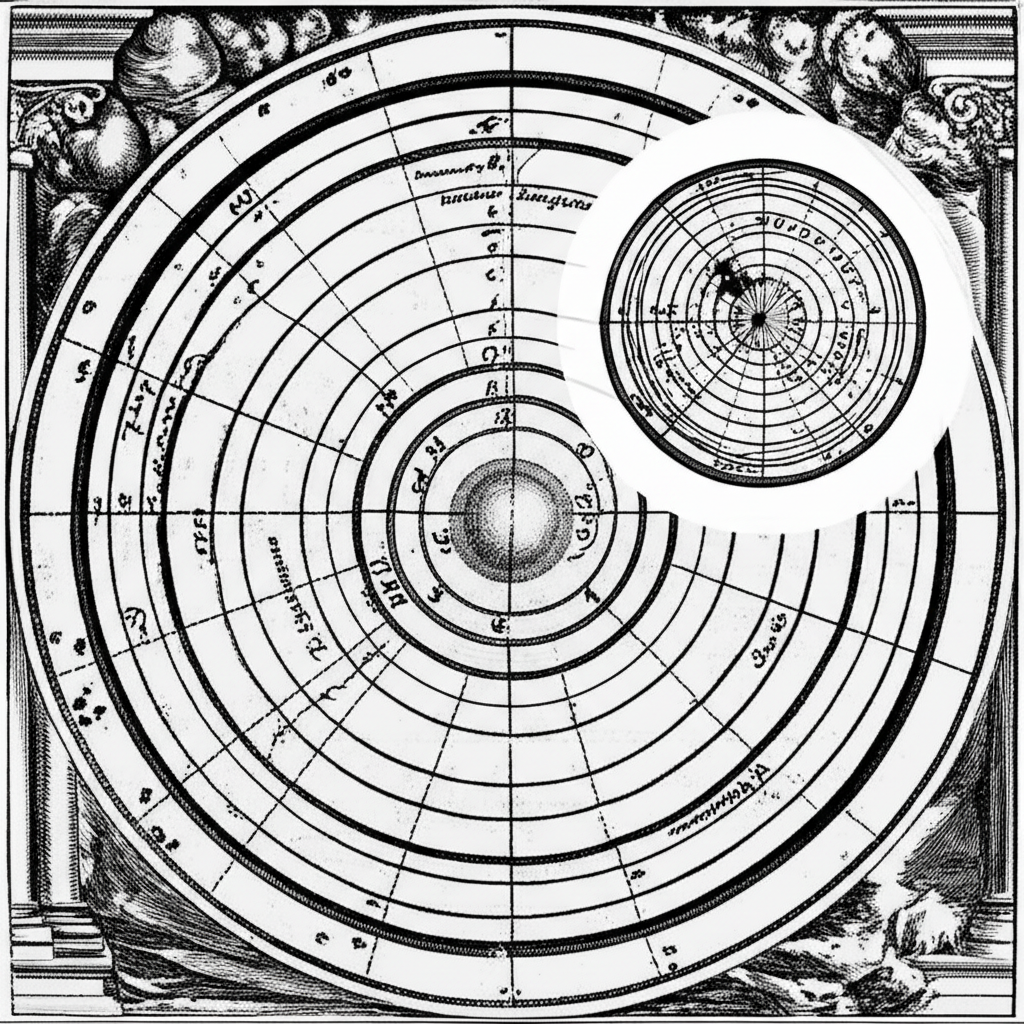
For many centuries, the dominant view, deeply rooted in the philosophical traditions of Plato and Aristotle, posited a geocentric universe. The Earth, static and central, was surrounded by a series of crystalline spheres, each carrying a celestial body.
- Plato's Influence: In Timaeus, Plato speaks of a divine craftsman (demiurge) who fashioned the cosmos with perfect geometric forms. The circle, symbolizing eternal recurrence and perfection, was the natural path for celestial objects.
- Aristotle's System: Expanding on this, Aristotle, in works like On the Heavens, articulated a universe divided into two realms: the corruptible terrestrial and the immutable celestial. Heavenly bodies moved in perfect circles because they were made of aether, a fifth element inherently predisposed to such motion. This philosophical premise profoundly shaped early astronomy.
The observed retrograde motion of planets (their apparent backward movement) posed a significant challenge to this perfect circular model. Ptolemy, in his Almagest, developed an elaborate system of epicycles and deferents to reconcile observations with the philosophical demand for circular motion around the Earth, a testament to the power of a prevailing paradigm.
The Copernican Revolution: Shifting Perspectives
The paradigm began to crack with Nicolaus Copernicus. His heliocentric model, though initially met with resistance, offered a simpler, more elegant explanation for planetary movements.
- De Revolutionibus Orbium Coelestium: Copernicus's seminal work proposed that the Sun, not the Earth, was at the center of the universe, and that the Earth itself was a planet, orbiting the Sun. This was not merely a scientific adjustment; it was a profound philosophical challenge to anthropocentric views of the cosmos. The Earth was demoted from its unique, central position, initiating a shift that would reverberate through philosophy and theology.
Kepler's Laws: The Quantity of Observation
Johannes Kepler, building on the meticulous observational data of Tycho Brahe, made the crucial leap that finally broke the stranglehold of perfect circles. His work demonstrated the immense power of quantity – precise measurement and mathematical analysis – in revealing the true mechanics of the heavens.
- First Law: Planets move in elliptical orbits, with the Sun at one focus. This was a radical departure from millennia of philosophical insistence on circles.
- Second Law: A line joining a planet and the Sun sweeps out equal areas during equal intervals of time. This introduced the concept of varying planetary speed throughout its orbit.
- Third Law: The square of the orbital period of a planet is directly proportional to the cube of the semi-major axis of its orbit. This provided a mathematical relationship between the size of an orbit and the time it takes to complete it, revealing a quantitative harmony in the cosmos.
Kepler's laws, born from painstaking empirical analysis and mathematical rigor, laid the groundwork for a new era of physics and astronomy, where observation and quantity superseded purely philosophical preconceptions about celestial perfection.
Newton's Grand Synthesis: Universal Gravitation
The fragmented insights of Copernicus and Kepler were unified by Isaac Newton, whose work represented a monumental synthesis of terrestrial and celestial mechanics.
The Force of Gravity: Unifying Terrestrial and Celestial Mechanics
Newton's Philosophiæ Naturalis Principia Mathematica (often simply Principia) presented a single, universal law that explained both the fall of an apple on Earth and the orbits of planets.
- Universal Gravitation: Every particle of matter in the universe attracts every other particle with a force that is directly proportional to the product of their masses and inversely proportional to the square of the distance between their centers. This elegant mathematical formulation provided the underlying mechanics for Kepler's empirical laws.
- Calculus: To articulate his laws of motion and gravitation, Newton famously developed calculus, a new mathematical language capable of describing change and motion with unprecedented precision. This underscored the growing importance of quantity and advanced mathematics in understanding the universe.
Philosophical Implications: Determinism and Divine Order
Newtonian physics had profound philosophical implications. The universe was seen as a grand, clockwork mechanism, operating according to immutable laws.
- Cosmic Determinism: If all motion could be predicted given initial conditions, did this imply a deterministic universe, where free will was an illusion? This question vexed philosophers for centuries.
- Divine Architect: For many, Newton's orderly universe was evidence of a divine creator, a "Watchmaker God" who set the cosmic gears in motion. The intricate mechanics of planetary motion became a testament to divine intelligence.
Beyond Newton: Einstein and the Fabric of Spacetime
Just as Newton had superseded Aristotle, Albert Einstein's theories of relativity challenged and expanded upon Newtonian mechanics, especially at extreme scales and velocities.
Relativity and the Redefinition of Mechanics
Einstein's work, particularly his theory of general relativity, offered a radical new perspective on gravity and the mechanics of the universe.
- Gravity as Spacetime Curvature: Instead of gravity being a force acting at a distance, Einstein proposed that massive objects warp the fabric of spacetime itself. Planets orbit the Sun not because the Sun exerts a force, but because they are following the curves in spacetime created by the Sun's immense mass.
- Redefining Motion: This fundamentally altered our understanding of mechanics. Motion was no longer just about forces acting on objects, but about objects moving through a dynamically curved geometry.
The Philosophical Shift: From Forces to Geometry
Einstein's theories ushered in another profound philosophical shift. The universe was no longer a collection of discrete objects interacting via forces, but a unified, dynamic entity where matter and energy were intricately interwoven with the very structure of spacetime.
- Relativity of Observation: The concept of absolute space and time, central to Newton, was replaced by a more relative understanding, dependent on the observer's frame of reference. This challenged intuitive notions of reality and objectivity.
- The Universe as a Single System: The cosmos became an even more interconnected whole, where the mechanics of planetary motion were merely one manifestation of a deeper, geometric reality.
The Enduring Philosophical Questions of Planetary Motion
The scientific journey through the mechanics of planetary motion has consistently illuminated deeper philosophical questions about the nature of reality, knowledge, and our place in the cosmos.
Order, Chaos, and the Nature of Reality
The discovery of predictable planetary orbits, from Kepler's ellipses to Newton's gravitational laws, instilled a sense of cosmic order. Yet, the question remains: is this order inherent, or is it a construct of our minds, a way of imposing meaning on a fundamentally indifferent universe?
- The Problem of Induction: How can we be sure that the laws we observe will continue to hold true? This philosophical challenge, explored by David Hume, questions the certainty of scientific knowledge derived from observation.
- Fine-Tuning: The apparent "fine-tuning" of physical constants that allow for stable planetary systems and, ultimately, life, prompts ongoing debate about teleology and the existence of a designer.
The Role of Quantity in Understanding the Cosmos
The evolution of our understanding of planetary motion is a testament to the power of quantity – of mathematics, measurement, and empirical data – in unlocking the secrets of the universe.
- From Qualitative to Quantitative: Early astronomy was largely qualitative, driven by philosophical ideals of perfection. The shift to Kepler and Newton marked a decisive move towards rigorous quantitative analysis, revealing the underlying mathematical harmony of the cosmos.
- The Limits of Quantity: While quantity provides precision and predictive power, philosophy asks what it truly tells us about the essence of things. Does describing planetary motion mathematically fully explain why it happens, or just how it happens?
Astronomy as a Lens for Metaphysics
Throughout history, astronomy has served as a powerful lens through which humanity has explored metaphysical questions – questions about existence, knowledge, values, reason, mind, and language.
- Cosmological Arguments: The existence of an orderly universe, particularly the mechanics of planetary motion, has been used as evidence for the existence of God or a first cause by various philosophers.
- Human Significance: As our understanding of the vastness and complexity of the cosmos has grown, it has continuously forced us to re-evaluate our own significance and unique position within the universe.
The mechanics of planetary motion, therefore, is not merely a scientific field of study. It is a rich tapestry woven with threads of physics, astronomy, mathematics, and profound philosophical inquiry, continuously reshaping our understanding of the universe and our place within it. The journey from perfect circles to warped spacetime illustrates humanity's relentless pursuit of knowledge, driven by both empirical observation and the enduring philosophical questions that define our existence.
📹 Related Video: PLATO ON: The Allegory of the Cave
Video by: The School of Life
💡 Want different videos? Search YouTube for: ""Great Books of the Western World Cosmology" - for discussions on ancient Greek views of the universe and the philosophical underpinnings of early astronomy."
📹 Related Video: What is Philosophy?
Video by: The School of Life
💡 Want different videos? Search YouTube for: ""Newtonian Mechanics Philosophical Implications" - for videos exploring determinism, the clockwork universe, and the impact of Newton's physics on philosophy."