

The Celestial Dance: Unraveling the Mechanics of Planetary Motion
The cosmos, with its silent, ceaseless ballet of celestial bodies, has captivated human imagination since time immemorial. From the earliest stargazers to the sophisticated observatories of today, humanity has sought to decipher the intricate mechanics governing the heavens. This pillar page embarks on a journey through the evolution of our understanding of planetary motion, tracing the philosophical and scientific inquiries that transformed our view of the universe. We'll explore how observation, mathematics, and profound shifts in physics have refined our comprehension of the celestial dance, moving from geocentric dogma to the elegant laws of gravitation and beyond, ever pondering the quantity and quality of the forces at play.
The Ancient Cosmos: Observing the Dance
Our earliest attempts to understand the planets were deeply intertwined with philosophy and cosmology. The wandering stars, unlike the fixed constellations, posed a profound puzzle, challenging our ancestors to impose order on what seemed chaotic.
From Myth to Model: Early Astronomical Thought
Ancient civilizations wove elaborate myths around the celestial bodies, imbuing them with divine agency. However, it was the Greek philosophers who began to systematically observe and attempt to model the heavens. Aristotle, a towering figure whose influence permeated Western thought for millennia, posited a geocentric universe in his On the Heavens. For Aristotle, the Earth was fixed at the center, surrounded by a series of perfect, crystalline spheres, each carrying a celestial body. The planets, sun, and moon moved in perfect circles, driven by an "Unmoved Mover." This model was not merely a scientific hypothesis; it was a profound philosophical statement about humanity's central place in a divinely ordered cosmos.
Ptolemy, in his monumental work Almagest, further refined this geocentric model. To account for the observed retrograde motion of planets (their apparent backward movement), Ptolemy introduced the ingenious concepts of epicycles (small circles whose centers moved along larger circles called deferents) and equants. While incredibly complex, Ptolemy's system provided a remarkably accurate predictive tool for its time, dominating astronomy for over 1,400 years. The mechanics described were intricate, a testament to the observational prowess and mathematical ingenuity of the ancients, even if based on a fundamentally flawed premise regarding the Earth's position.
The Copernican Revolution: Shifting Perspectives
The intellectual landscape of the Renaissance, with its renewed emphasis on observation and mathematical reasoning, began to challenge the long-held geocentric worldview.
A Heliocentric Paradigm Shift
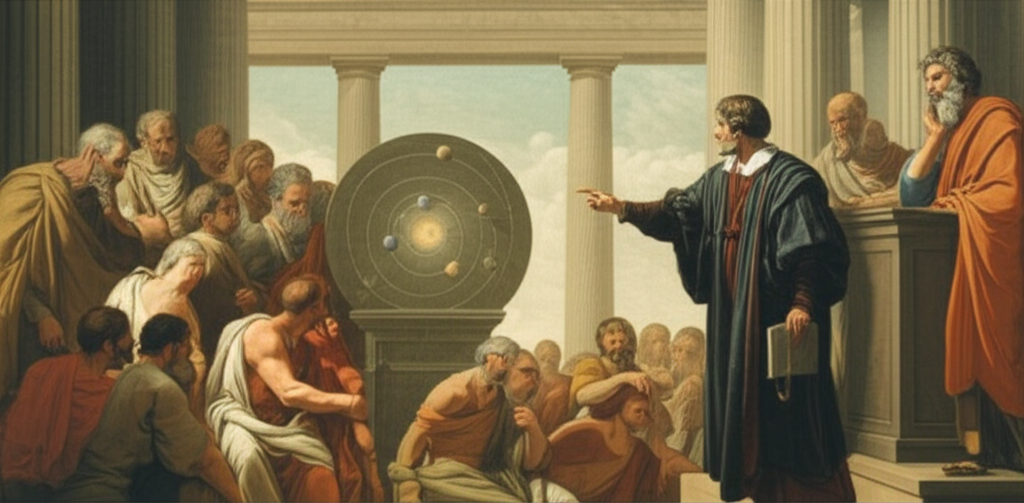
Nicolaus Copernicus, a Polish astronomer, dared to propose a radical alternative in his De revolutionibus orbium coelestium (On the Revolutions of the Heavenly Spheres). Published posthumously in 1543, it placed the Sun, not the Earth, at the center of the universe. This heliocentric model offered a simpler, more elegant explanation for the observed planetary motions, including retrograde motion, which was now understood as an optical illusion caused by Earth's own orbit.
The Copernican model was more than just a new astronomical theory; it was a profound philosophical and theological challenge. It dethroned humanity from its perceived central position, initiating a paradigm shift that would reverberate through all branches of knowledge. The notion of quantity in celestial mechanics began to shift from complex geometric constructs designed to save appearances to a search for simpler, underlying mathematical relationships. Tycho Brahe, a Danish nobleman, made meticulous and unprecedentedly accurate naked-eye observations of the planets, especially Mars. Though he himself held to a geocentric-heliocentric hybrid model, his vast and precise data set became the critical foundation upon which the next great leap in understanding planetary mechanics would be built.
Kepler's Laws: Unveiling the Ellipses
The stage was set for Johannes Kepler, Brahe's assistant, to synthesize these observations with a new mathematical vision.
The Geometry of the Heavens
Kepler, driven by a deep conviction in the mathematical harmony of the cosmos, spent years meticulously analyzing Brahe's data, particularly the notoriously irregular orbit of Mars. His relentless pursuit led to three revolutionary laws of planetary motion, published in Astronomia nova (1609) and Harmonices Mundi (1619). These laws fundamentally altered the understanding of celestial mechanics, moving beyond the ancient Greek ideal of perfect circles.
| Kepler's Law | Description |
|---|---|
| First Law | Law of Ellipses: Each planet moves in an elliptical orbit, with the Sun at one focus. This challenged the ancient belief in perfect circular motion. |
| Second Law | Law of Equal Areas: A line connecting a planet and the Sun sweeps out equal areas in equal intervals of time. This means planets move faster when closer to the Sun and slower when farther away, a direct consequence of the conservation of angular momentum. |
📹 Related Video: What is Philosophy?
Video by: The School of Life
💡 Want different videos? Search YouTube for: "The Mechanics of Planetary Motion philosophy"