

The Celestial Dance: Unpacking the Mechanics of Planetary Motion
By Chloe Fitzgerald
Introduction: The Clockwork Universe and the Human Mind
From the earliest stargazers to the pioneers of modern astronomy, humanity has been captivated by the silent, majestic ballet of the planets. How do these celestial bodies traverse the vast cosmic stage with such unwavering precision? The quest to understand "The Mechanics of Planetary Motion" is more than a scientific endeavor; it is a profound philosophical journey, reflecting our evolving understanding of order, causality, and the very nature of existence. This pillar page delves into the historical and scientific frameworks that have shaped our comprehension of the cosmos, exploring the intricate physics and mathematical quantity that govern the heavens, as illuminated by the foundational texts of Western thought.
I. Ancient Visions: The Geocentric Universe and its Philosophical Underpinnings
For millennia, the prevailing view of the cosmos placed Earth at its stationary center, a model largely solidified by the Greek philosopher Aristotle and later refined by Ptolemy. This geocentric system, meticulously described in works like Ptolemy's Almagest (a cornerstone of the Great Books of the Western World), presented a universe of concentric spheres, each carrying a planet or star, moving in perfect circles.
- Aristotelian Cosmology:
- Earth as Center: Immutable, heavy, and distinct from the celestial realm.
- Celestial Perfection: The heavens composed of aether, moving in perfect, eternal circles.
- Teleological Explanation: Motion driven by a desire for perfection or a divine prime mover.
- Ptolemaic Refinements:
- Epicycles and Deferents: Complex geometric constructs to explain observed retrograde motion of planets while maintaining circular paths.
- Mathematical Sophistication: A triumph of observation and mathematical modeling within the geocentric paradigm.
The philosophical implications of this model were immense. It reinforced a human-centric view of the universe, suggesting a divine order where Earth and its inhabitants held a privileged position. The mechanics of this system, while mathematically intricate, were ultimately subservient to a grander, often theological, narrative.
II. The Copernican Revolution: A Shift in Perspective and Quantity
The sixteenth century brought a seismic shift with Nicolaus Copernicus's De revolutionibus orbium coelestium (another pivotal text in the Great Books collection). Copernicus proposed a heliocentric model, placing the Sun at the center of the solar system. This wasn't merely a change in astronomical coordinates; it was a radical re-evaluation of humanity's place in the cosmos and initiated a new era in the mechanics of celestial understanding.
Table 1: Geocentric vs. Heliocentric Models
| Feature | Geocentric (Ptolemy) | Heliocentric (Copernicus) |
|---|---|---|
| Central Body | Earth | Sun |
| Planetary Paths | Complex epicycles and deferents around Earth | Simpler, circular orbits around the Sun |
| Philosophical Impact | Earth-centric, divine order, human privilege | Earth as one of many planets, challenge to anthropocentrism |
| Primary Motion | Celestial spheres revolve around Earth | Earth and planets revolve around the Sun |
Johannes Kepler, building upon the meticulous observational data of Tycho Brahe, further refined Copernicus's model. Kepler's three laws of planetary motion, published in works like Astronomia nova, introduced elliptical orbits and precisely quantified the relationship between a planet's orbital period and its distance from the Sun. These laws were a triumph of empirical astronomy and demonstrated the power of mathematical quantity in describing natural phenomena, paving the way for a truly mechanistic understanding.
III. Newton's Grand Synthesis: Universal Gravitation and the Laws of Motion
The profound insights of Isaac Newton, articulated in his Philosophiæ Naturalis Principia Mathematica (another indispensable volume from the Great Books), provided the definitive framework for "The Mechanics of Planetary Motion." Newton's genius lay in unifying terrestrial and celestial physics under a single set of universal laws.
-
Newton's Laws of Motion:
- Inertia: An object at rest stays at rest, and an object in motion stays in motion with the same speed and in the same direction unless acted upon by an unbalanced force.
- Force and Acceleration: The acceleration of an object is directly proportional to the net force acting on it and inversely proportional to its mass (F=ma).
- Action-Reaction: For every action, there is an equal and opposite reaction.
-
The Law of Universal Gravitation:
- Every particle in the universe attracts every other particle with a force that is directly proportional to the product of their masses and inversely proportional to the square of the distance between their centers.
- This elegant mathematical law, expressed as F = Gm₁m₂/r², explained why planets orbit the Sun, why apples fall from trees, and why tides occur. It demonstrated that the same fundamental mechanics governed both the heavens and the Earth.
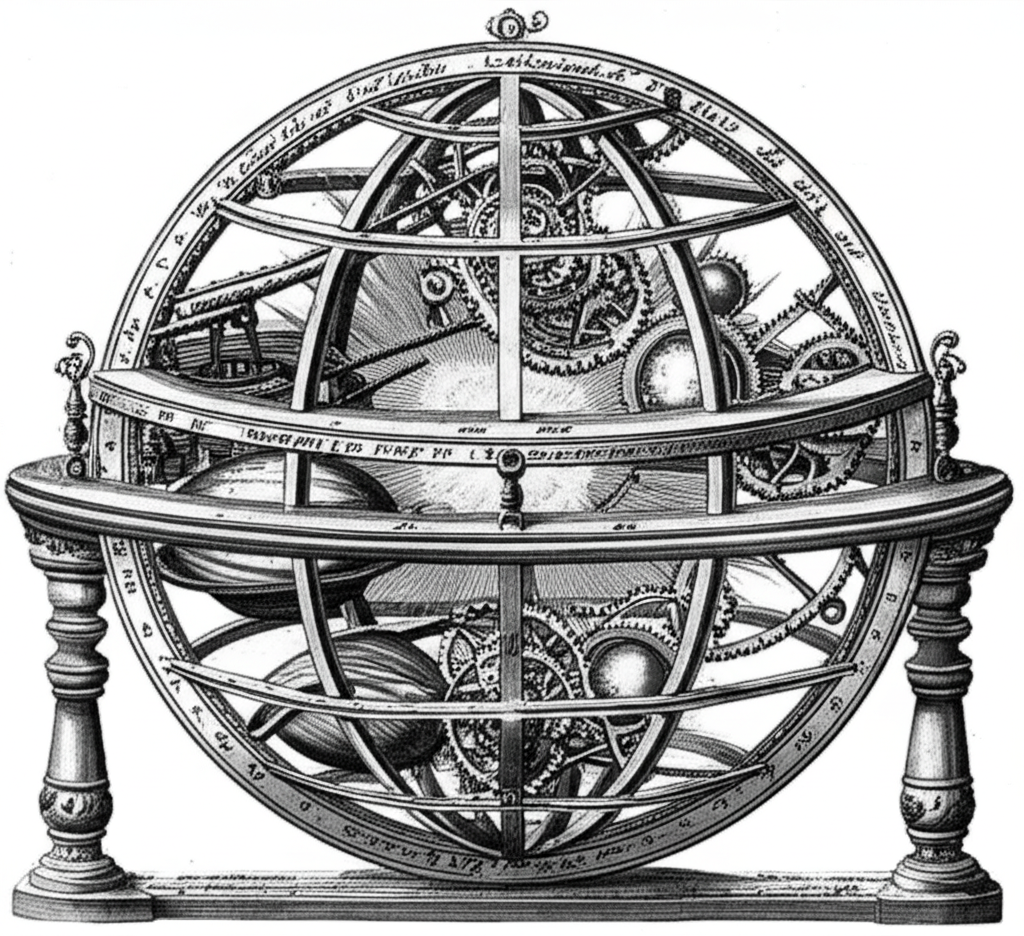
Newton's work transformed astronomy into a predictive science, where the future positions of planets could be calculated with astonishing accuracy. The universe was no longer seen as driven by mystical forces or divine desire, but by quantifiable, immutable laws of physics. This mechanistic worldview, where the universe operated like a giant clockwork mechanism, profoundly influenced Enlightenment thought and the philosophy of science.
IV. Beyond Newtonian Mechanics: Einstein and Modern Astronomy
While Newton's mechanics provided an incredibly robust framework, subtle discrepancies eventually emerged. The anomalous precession of Mercury's orbit, for instance, could not be fully explained by Newtonian physics. This led to Albert Einstein's revolutionary theory of General Relativity in the early 20th century, which offered a new understanding of gravity.
- General Relativity's New Perspective:
- Gravity is not a force in the Newtonian sense, but a manifestation of the curvature of space-time caused by mass and energy.
- Planets orbit the Sun not because a force pulls them, but because they are following the shortest path (geodesics) through the curved space-time around the Sun.
- This theory precisely accounted for Mercury's orbital anomaly and made new, testable predictions, such as the bending of light by massive objects.
Today, modern astronomy continues to build upon these foundations, exploring exoplanets, black holes, and the large-scale structure of the universe, always seeking to refine our understanding of the underlying physics and the intricate mechanics at play. The pursuit of ever-greater precision in measuring celestial quantity remains a hallmark of the field.
V. Philosophical Echoes: Order, Determinism, and the Human Quest for Knowledge
The journey to understand the mechanics of planetary motion has consistently prompted profound philosophical questions. The discovery of universal laws governing the cosmos, particularly Newton's physics, led to ideas of a deterministic universe, famously encapsulated by Laplace's demon: if one knew the precise position and momentum of every particle at a given instant, one could predict the entire future of the universe. This raised questions about free will and the role of divine intervention.
The elegance and predictive power of celestial mechanics have also fueled a deep appreciation for the order and beauty of the universe. From the "music of the spheres" envisioned by Pythagoras to the intricate mathematical quantity of Einstein's field equations, the cosmos has served as a canvas for humanity's intellectual and spiritual aspirations. The ongoing dialogue between astronomy, physics, and philosophy continues to shape our understanding of existence, reminding us that the quest for knowledge is as boundless as the universe itself.
📹 Related Video: KANT ON: What is Enlightenment?
Video by: The School of Life
💡 Want different videos? Search YouTube for: ""Great Books of the Western World Astronomy" for discussions on Ptolemy, Copernicus, and Newton's contributions to celestial mechanics from a humanities perspective."
📹 Related Video: ARISTOTLE ON: The Nicomachean Ethics
Video by: The School of Life
💡 Want different videos? Search YouTube for: ""Newton's Laws and Planetary Orbits Explained" for a clear physics-based explanation of the mechanics."