

The Celestial Dance: Unraveling the Mechanics of Planetary Motion
The night sky has, since time immemorial, captivated human imagination, prompting us to gaze upwards and ponder our place in the grand cosmic ballet. But beyond the wonder lies a profound intellectual quest: understanding how these celestial bodies move. This isn't merely a question of astronomy; it delves into the very mechanics of the universe, compelling us to explore the fundamental physics that govern the cosmos. From ancient philosophical conjectures to modern scientific precision, the study of planetary motion has been a cornerstone of human inquiry, profoundly shaping our understanding of reality, causality, and the role of quantity in describing the natural world.
What is the Mechanics of Planetary Motion?
At its core, the mechanics of planetary motion refers to the scientific principles and mathematical frameworks that describe and predict the movement of planets and other celestial bodies. It's the study of the forces acting upon these objects and the resulting trajectories they trace through space. This field sits at the intersection of astronomy (observing celestial phenomena) and physics (explaining the underlying laws). It asks: What causes planets to orbit? Why do they follow specific paths? How can we predict their future positions?
Historically, this quest moved from purely observational and qualitative descriptions to a highly sophisticated, quantitative understanding. It's a journey from simply noting that planets move, to precisely calculating their velocities, accelerations, and the gravitational forces at play.
Why is Understanding Planetary Motion Philosophically Important?
The study of planetary motion transcends mere scientific curiosity; it carries immense philosophical weight.
- Challenging Anthropocentrism: The shift from a geocentric (Earth-centered) to a heliocentric (Sun-centered) model, championed by figures like Copernicus and Galileo, dramatically altered humanity's perceived place in the cosmos. It was a profound philosophical reorientation, suggesting that Earth was not the unique center of creation, but merely one planet among many.
- The Power of Reason and Observation: The quest to understand planetary motion highlighted the interplay between empirical observation and rational deduction. Thinkers like Kepler meticulously analyzed observational data, while Newton synthesized these observations into universal laws through rigorous mathematical reasoning. This process underscored the efficacy of the scientific method as a path to knowledge.
- The Nature of Natural Law: The discovery of universal laws governing planetary motion, particularly Newton's law of universal gravitation, suggested a universe governed by immutable, discoverable principles. This raised profound questions about divine intervention, determinism, and the very fabric of reality—was the universe a clockwork mechanism set in motion by a divine watchmaker, or an evolving system governed by inherent laws?
- The Role of Quantity: The shift from qualitative descriptions to precise, quantitative measurements and mathematical laws transformed our understanding of explanation itself. It demonstrated that the universe could be understood not just through narrative or analogy, but through numbers, equations, and predictive models, fundamentally altering the philosophical landscape of scientific inquiry.
A Historical Journey: From Heavenly Spheres to Universal Gravitation
The narrative of understanding planetary motion is a testament to humanity's enduring intellectual perseverance, evolving dramatically over millennia.
Ancient Greek Cosmology: The Perfect Spheres
For much of antiquity, the dominant worldview, heavily influenced by Aristotle and later refined by Ptolemy (both featured in the Great Books of the Western World), posited a geocentric universe.
- Aristotle's Cosmos: Aristotle envisioned a universe of concentric, crystalline spheres, with Earth at the unmoving center. The celestial bodies—Moon, Sun, planets, and fixed stars—were embedded in these spheres, moving in perfect circles. This model was philosophically appealing, suggesting a hierarchical and orderly cosmos, reflecting divine perfection. The mechanics here were driven by an inherent desire of celestial bodies to move in circles, their "natural motion."
- Ptolemy's Refinements: To account for observed irregularities (like retrograde motion), Ptolemy introduced epicycles and deferents in his Almagest. While complex, his model was remarkably predictive for its time and held sway for over 1,400 years, demonstrating the lengths to which rational thought could go to preserve a cherished philosophical framework.
The Copernican Revolution: A Heliocentric Shift
The 16th century witnessed a paradigm shift, initiated by Nicolaus Copernicus.
- Copernicus's De Revolutionibus: Copernicus proposed a heliocentric model, placing the Sun at the center of the solar system, with Earth and other planets orbiting it. This was a radical departure, simplifying many of Ptolemy's complexities but challenging deeply ingrained theological and philosophical beliefs about Earth's centrality. The mechanics were still based on perfect circles, retaining some Aristotelian aesthetic.
Kepler's Laws: The Dawn of Empirical Mechanics
Johannes Kepler, a brilliant mathematician and astronomer, meticulously analyzed the precise observational data collected by Tycho Brahe. His work, drawing heavily on quantity, revolutionized astronomy and laid the groundwork for modern physics.
Kepler's Three Laws of Planetary Motion:
- Law of Orbits: Planets orbit the Sun in ellipses, with the Sun at one focus. This broke the ancient dogma of perfect circular motion.
- Law of Areas: A line segment joining a planet and the Sun sweeps out equal areas during equal intervals of time. This implied that planets move faster when closer to the Sun.
- Law of Periods: The square of the orbital period ($T$) of a planet is directly proportional to the cube of the semi-major axis ($a$) of its orbit ($T^2 \propto a^3$). This provided a precise, quantitative relationship between a planet's distance from the Sun and the time it takes to complete an orbit.
Kepler's laws, found in his Astronomia Nova, were purely descriptive; they explained how planets moved but not why. They were the empirical foundation upon which Newton would build.
Newton's Synthesis: Universal Gravitation
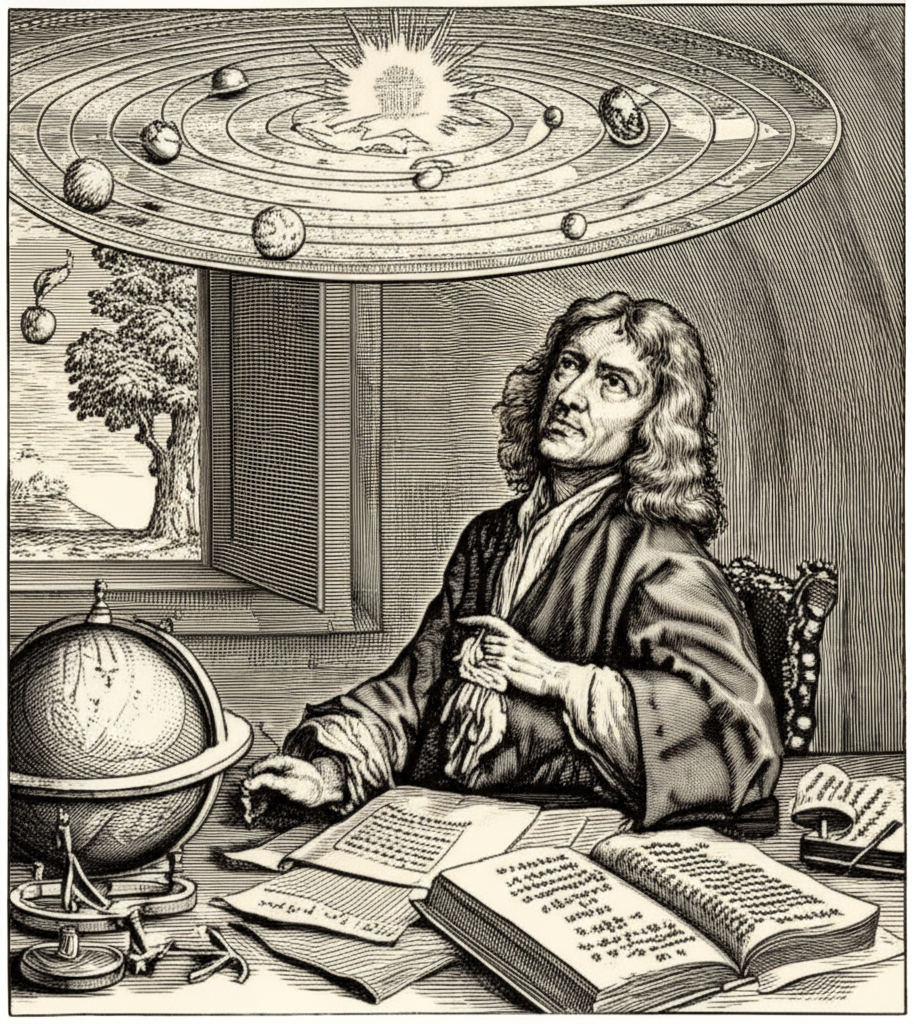
Isaac Newton, one of the most towering figures in the Great Books tradition, provided the unifying explanation for Kepler's laws and terrestrial mechanics in his Principia Mathematica.
- Law of Universal Gravitation: Newton proposed that every particle in the universe attracts every other particle with a force that is directly proportional to the product of their masses and inversely proportional to the square of the distance between their centers. This single law, expressed mathematically, explained both why an apple falls to Earth and why planets orbit the Sun.
- Calculus and Quantitative Physics: Newton developed calculus to articulate his laws, demonstrating the immense power of advanced mathematics in describing the physical world. His work established physics as a predictive science based on quantitative laws and universal forces. The mechanics of the cosmos were no longer mystical but governed by quantifiable, measurable interactions.
Philosophical Implications in the Newtonian Universe
Newton's success in unifying celestial and terrestrial mechanics had profound philosophical repercussions.
- The Clockwork Universe: The universe was increasingly seen as a vast, deterministic machine, operating according to precise, immutable laws. This raised questions about free will, divine intervention, and the nature of causality. If all events were predetermined by physical laws, what role did human agency play?
- Empiricism vs. Rationalism: While Newton's work was deeply rational, it was also firmly grounded in empirical observation. This strengthened the philosophical commitment to seeking knowledge through both sensory experience and logical deduction, a cornerstone of the Enlightenment.
- The Enduring Role of Quantity: The triumph of Newtonian physics solidified the idea that true understanding of the natural world required precise quantitative measurement and mathematical formulation. This continues to influence how we approach scientific inquiry and philosophical debates about the nature of reality.
Modern Perspectives and Further Questions
While Newton's laws remain incredibly accurate for most practical applications within the solar system, modern physics has further refined our understanding.
- Einstein's Relativity: Albert Einstein's theories of special and general relativity offered a new paradigm for understanding gravity, not as a force acting at a distance, but as a curvature of spacetime caused by mass and energy. This provided even greater precision for extreme gravitational phenomena and led to a deeper, albeit more abstract, understanding of the mechanics of the universe.
- Quantum Mechanics: While primarily concerned with the subatomic world, quantum mechanics introduces probabilistic elements that challenge the purely deterministic view of the Newtonian universe, opening new philosophical avenues regarding causality and the nature of reality.
- The Search for Exoplanets: Modern astronomy continues to build upon these foundations, using the mechanics of planetary motion to detect exoplanets by observing the subtle gravitational wobbles they induce in their host stars, further expanding our cosmic perspective.
The mechanics of planetary motion continues to be a vibrant field, not only for scientific discovery but also for philosophical reflection. It compels us to ask fundamental questions about the universe's order, our capacity to understand it, and the very nature of existence.
Conclusion: A Universe of Order and Inquiry
From the ancient Greek contemplation of perfect spheres to Newton's universal laws and Einstein's warped spacetime, the journey to understand the mechanics of planetary motion is a testament to the enduring human spirit of inquiry. This exploration has not only advanced our scientific knowledge in astronomy and physics but has also profoundly shaped our philosophical perspectives on causality, determinism, the nature of natural law, and the critical role of quantity in unlocking the universe's secrets. As we continue to gaze at the stars, the celestial dance remains a boundless source of wonder, inviting us to ever deeper levels of understanding and philosophical contemplation.
Further Exploration:
-
📹 Related Video: What is Philosophy?
Video by: The School of Life
💡 Want different videos? Search YouTube for: ""Philosophy of Science Newton Kepler Gravity""
-
📹 Related Video: PLATO ON: The Allegory of the Cave
Video by: The School of Life
💡 Want different videos? Search YouTube for: ""Great Books Western World Cosmology Aristotle Plato""