

The Enduring Enigma: Unpacking the Mechanics of Light and Time
Summary: This article delves into the profound interrelationship between light and time, exploring how their fundamental mechanics shape our understanding of reality. From ancient philosophical inquiries into existence and change to the revolutionary insights of modern physics, we trace how the constant speed of light underpins our very conception of space and time, drawing upon the rich intellectual heritage found within the Great Books of the Western World. We examine how these concepts, often taken for granted, are in fact deeply intertwined, challenging our perceptions and inviting continuous philosophical and scientific inquiry.
Introduction: The Fabric of Reality
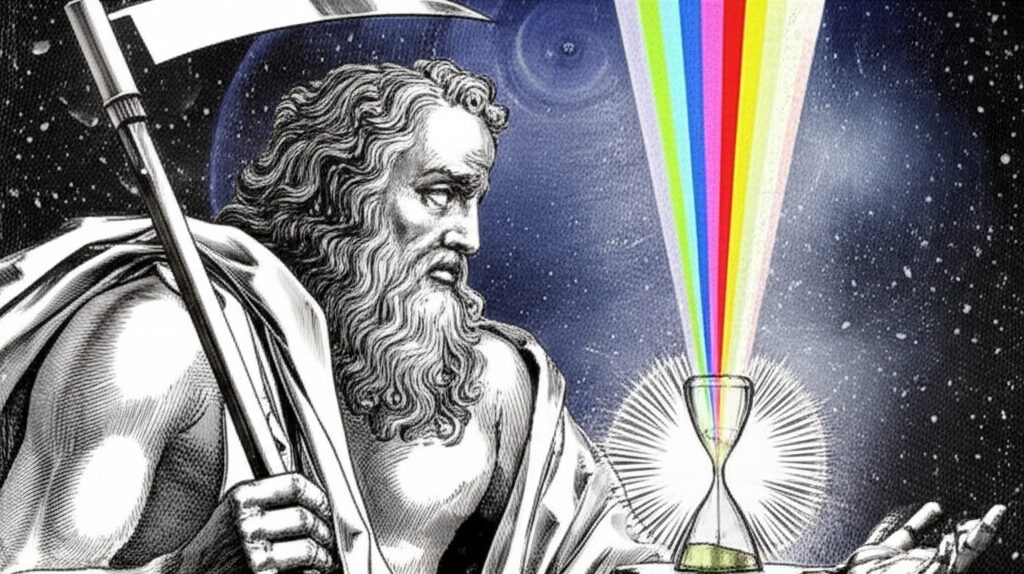
From the moment ancient thinkers first gazed upon the cosmos, the concepts of light and time have been central to humanity's quest to understand existence. Light, the very medium of our perception, illuminates the world, while time provides the framework for change and causality. Yet, beyond their everyday utility, these phenomena conceal profound philosophical and physical depths. What are the true mechanics governing their interaction, and how do they conspire to create the reality we inhabit? This inquiry has traversed millennia, from the pre-Socratics pondering the nature of being to Einstein's radical redefinition of the universe, with each era building upon the foundations laid by the great minds documented in collections like the Great Books of the Western World.
Light: The Universe's Messenger
Light, in its essence, is more than just illumination; it is the fundamental carrier of information, the constant against which all motion is measured. Its study, a cornerstone of physics, reveals a fascinating duality, behaving as both a wave and a particle. This wave-particle duality, a concept that perplexed even the brightest minds, underscores the intricate mechanics at play at the quantum level.
- Wave Nature: Light propagates as electromagnetic waves, characterized by frequency and wavelength, responsible for the spectrum of colors we perceive.
- Particle Nature: Light also consists of discrete packets of energy called photons, which interact with matter in distinct ways, explaining phenomena like the photoelectric effect.
The constant speed of light in a vacuum—approximately 299,792,458 meters per second—is not merely a high velocity; it is a universal constant, a bedrock principle that fundamentally reshapes our understanding of space and time. It dictates the ultimate speed limit of the universe, profoundly influencing everything from atomic interactions to the expansion of galaxies.
Time: The Unyielding Arrow of Existence
If light is the universe's messenger, time is its rhythm. But what is time? Is it an objective, external dimension, flowing uniformly and independently, as Newton posited? Or is it a subjective experience, a product of consciousness, as some idealists suggest? The Great Books of the Western World are replete with diverse perspectives:
- Aristotle: Viewed time as "the number of motion with respect to 'before' and 'after'," intimately tied to change and movement in the physical world. Without change, he argued, there would be no time.
- Augustine of Hippo: In his Confessions, wrestled with the paradox of time, concluding that it exists primarily in the human mind as memory of the past, attention to the present, and expectation of the future. "What then is time? If no one asks me, I know; if I wish to explain it to one who asks, I know not."
- Immanuel Kant: Proposed time as an a priori intuition, a fundamental structure of human perception, not an objective feature of the world in itself, but a necessary condition for us to experience phenomena.
These differing philosophical perspectives highlight the profound difficulty in grappling with time's true nature. Is it a river we swim in, or a construct of our own minds?
The Relativistic Dance: Light, Space, and Time
The revolutionary insights of Albert Einstein, particularly his theories of special and general relativity, irrevocably linked light, space, and time. He demonstrated that the mechanics of the universe are such that space and time are not independent entities but are woven together into a single fabric called spacetime. The constant speed of light is the linchpin of this unification.
Consider these implications:
- Time Dilation: Observers in relative motion experience time differently. For an object moving at relativistic speeds, time slows down relative to a stationary observer. This isn't a trick of perception; it's a fundamental aspect of physics.
- Length Contraction: Similarly, the length of an object moving at high speeds appears to contract in the direction of motion relative to a stationary observer.
- Mass-Energy Equivalence (E=mc²): Light's constant speed (c) is central to the most famous equation in physics, demonstrating the inherent equivalence of mass and energy.
These phenomena are not mere theoretical curiosities; they are experimentally verified and form the basis for technologies like GPS, which must account for relativistic effects to maintain accuracy. The constancy of light's speed forces a radical re-evaluation of our intuitive understanding of time and space, transforming them from absolute backdrops into dynamic, interwoven elements of the cosmic tapestry. The very definition of a "second" is now tied to atomic mechanics, a testament to the precision required to measure time in a relativistic universe.
Philosophical Repercussions and Enduring Mysteries
The insights from modern physics have profound philosophical repercussions, echoing and expanding upon the inquiries found in the Great Books. If time is relative, how do we conceive of free will or moral responsibility? If simultaneity is not absolute, what does it mean for shared experience?
The interplay between light and time continues to be a fertile ground for philosophical debate and scientific discovery. The quest to unify quantum mechanics (governing the very small) with general relativity (governing the very large) remains the holy grail of modern physics, promising further revelations about the fundamental nature of space, time, and the universe itself. The journey of inquiry, initiated by ancient philosophers and propelled by modern scientists, continues to unfold, each new discovery shedding more light on the intricate mechanics of existence.
📹 Related Video: KANT ON: What is Enlightenment?
Video by: The School of Life
💡 Want different videos? Search YouTube for: ""Einstein's Theory of Relativity Explained Simply""
📹 Related Video: PLATO ON: The Allegory of the Cave
Video by: The School of Life
💡 Want different videos? Search YouTube for: ""What is Time? Philosophical Perspectives""