

The Mechanics of Light and Time: A Philosophical Interrogation
This article delves into the profound philosophical implications of the mechanics of light and time, moving beyond mere physics to explore how these fundamental elements shape our understanding of reality, space, and existence itself. We will examine how scientific discoveries, particularly in relativity, compel us to reconsider ancient philosophical questions about perception, causality, and the very fabric of the cosmos, echoing debates found within the Great Books of the Western World.
Unraveling the Fabric of Reality
From the earliest philosophical inquiries to the most cutting-edge theories of modern physics, the nature of light and time has stood as a central enigma. They are not merely phenomena we observe, but active participants in the construction of our perceived reality. The mechanics by which light travels and time unfolds are not just scientific facts; they are philosophical revelations, challenging our intuitive grasp of the universe and forcing us to confront the limits of our understanding.
The Constant Velocity of Light: A Universal Clock
One of the most astonishing discoveries in physics is the constant speed of light in a vacuum, c. This isn't just a number; it's a profound statement about the universe. Light doesn't just illuminate space; it defines it, and, crucially, it defines time. Imagine the philosophical weight of a universal constant that dictates the very pace of existence.
- The Ultimate Speed Limit: Nothing can travel faster than light, establishing a fundamental boundary for causality and information transfer.
- Relativity's Cornerstone: This constant speed is the bedrock of Einstein's theories of special and general relativity, fundamentally altering our understanding of space and time.
- A Measure of Distance and Time: Light-years are not just units of distance but also of time, indicating how long light has traveled to reach us, offering glimpses into the universe's past.
This unwavering consistency in light's mechanics forces us to rethink our subjective experience of time. If light's speed is absolute, then what does that imply for the absoluteness of time itself?
Time's Elasticity: A Relativistic Dance
Einstein's theory of relativity shattered the Newtonian concept of absolute time. Instead, time is relative, its passage dependent on the observer's motion and gravitational field. The mechanics of light are inextricably linked to this elasticity of time and space.
Key Relativistic Phenomena:
| Phenomenon | Description | Philosophical Implication |
|---|---|---|
| Time Dilation | Time passes more slowly for objects moving at speeds approaching light, or in strong gravitational fields. | Challenges the notion of a universal "now"; suggests multiple, equally valid presents. |
| Length Contraction | Objects moving at relativistic speeds appear shorter in their direction of motion. | Space itself is not fixed but contracts and expands based on relative velocity, affecting our perception of physical dimensions. |
| Mass-Energy Equivalence (E=mc²) | Mass and energy are interchangeable, with light's speed being the conversion factor. | Demonstrates the deep interconnectedness of matter, energy, and the fundamental mechanics of the universe. |
These insights from physics resonate with ancient philosophical debates, particularly those found in the Great Books of the Western World. Thinkers like Aristotle, in his Physics, grappled with time as a measure of motion, a concept that, while different, foreshadows the relational nature of time that modern physics unveils. Augustine, in his Confessions, famously pondered, "What then is time? If no one asks me, I know; if I wish to explain it to one who asks, I know not." Modern physics doesn't necessarily provide a simple answer but rather a more complex, interwoven understanding.
The Observer and the Observed: A Philosophical Conundrum
The mechanics of light are not just about how it travels, but how it interacts with and informs our perception. Without light, there is no sight, and thus a profoundly different experience of space and time. This brings us to a crucial philosophical point: the role of the observer.
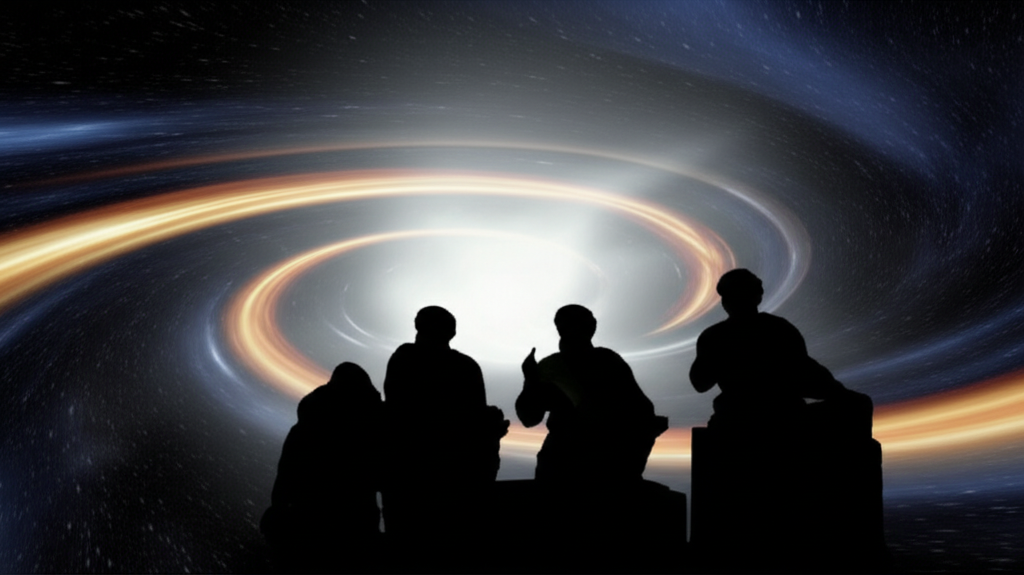
Consider Plato's Allegory of the Cave from The Republic, a cornerstone of the Great Books. Prisoners perceive only shadows cast by firelight, mistaking them for reality. In a modern context, the mechanics of light and time suggest that our "reality" is always, to some extent, a projection, an interpretation based on the information light carries to us. The past we see from distant stars is not the star's present; it is a ghost of what was, delivered by light's journey across space and time.
Philosophical Questions Arising from Light and Time
The mechanics of light and time compel us to ask fundamental questions:
- Is Time Fundamental or Emergent? Is time a fundamental dimension of reality, or an emergent property of the universe's mechanics?
- The Nature of Causality: If time is relative, how does this affect our understanding of cause and effect? Can events truly be simultaneous for all observers?
- The Reality of the Past, Present, and Future: Do all moments in time exist simultaneously, or is only the present real?
- Perception vs. Reality: To what extent does our perception, mediated by light, construct our reality of space and time?
- The Limits of Knowledge: Are there inherent limits to what we can know about the universe, given the constraints imposed by the speed of light?
These are not merely scientific queries; they are deeply philosophical inquiries that have preoccupied thinkers for millennia and continue to do so. The dialogue between physics and philosophy is essential for a holistic understanding.
Conclusion: A Continuum of Inquiry
The mechanics of light and time are more than just principles of physics; they are gateways to profound philosophical contemplation. They reveal a universe far stranger and more intricate than our everyday experience suggests, a universe where space and time are interwoven, where perception is relative, and where the very fabric of existence is a dynamic, interconnected whole. As we continue to probe the universe with scientific rigor, we simultaneously deepen our philosophical understanding, standing on the shoulders of giants from the Great Books of the Western World to confront the enduring mysteries of reality.
YouTube Video Suggestions:
-
📹 Related Video: What is Philosophy?
Video by: The School of Life
💡 Want different videos? Search YouTube for: ""Philosophy of Time Einstein Relativity""
-
📹 Related Video: What is Philosophy?
Video by: The School of Life
💡 Want different videos? Search YouTube for: ""What is Time? Physics and Philosophy""