

The Mechanics of Light and Time: A Philosophical Inquiry
The dance between light and time is not merely a subject for physicists, but a profound philosophical arena where our understanding of reality, perception, and existence itself is forged. This article delves into the intricate mechanics that bind these two fundamental phenomena, tracing their conceptual evolution from ancient philosophical musings to the startling revelations of modern physics. We will explore how the unchanging speed of light fundamentally reshapes our intuitive grasp of time and space, challenging us to reconsider the very fabric of the cosmos and our place within it.
The Enduring Mystery: Light, Time, and Human Understanding
From the earliest flickers of consciousness, humanity has grappled with the nature of light and the relentless march of time. Why does the sun rise and set, bringing forth a new day? What is the essence of that illumination that reveals the world to us? And how does the past recede, the present unfold, and the future beckon? These are not merely scientific questions but existential quandaries that have shaped philosophical discourse for millennia. The mechanics of their operation, once attributed to divine will or cosmic cycles, have progressively yielded to the rigorous inquiry of human intellect, revealing a universe far more interconnected and counter-intuitive than our senses initially suggest.
The Ancient Gaze: Light as Revelation and Time as Flux
Before the advent of modern physics, light was often understood less as a physical phenomenon and more as a metaphor for truth, knowledge, and even the divine. Within the pages of the Great Books of the Western World, we encounter profound reflections on light's significance:
- Plato's Allegory of the Cave: In The Republic, Plato masterfully uses light to symbolize enlightenment. The prisoners, bound in darkness, perceive only shadows, mistaking them for reality. True knowledge, true reality, is revealed only when one ascends into the light of the sun, representing the Form of the Good. Here, light is not just illumination, but the very source of intellectual and moral clarity.
- Aristotle's Metaphysics: While more grounded in empirical observation, Aristotle, too, recognized light's role in perception. His emphasis on actuality and potentiality can be seen as a philosophical framework for understanding how light actualizes our vision, making the potential of objects to be seen a reality.
Similarly, time has been a perennial puzzle. Is it a linear progression, a cyclical recurrence, or a subjective experience?
- Augustine's Confessions: One of the most eloquent and agonizing explorations of time comes from St. Augustine, who, in Confessions, famously pondered: "What then is time? If no one asks me, I know; if I wish to explain it to one who asks, I know not." He grappled with its elusive nature, concluding that time exists primarily in the human mind, as a "distension" of the soul, measuring the past in memory, the present in attention, and the future in expectation.
These ancient perspectives, while lacking the empirical tools of modern science, laid the philosophical groundwork for understanding the deep implications of light and time for human knowledge and existence.
The Modern Synthesis: Physics Unveils the Relativistic Mechanics
The 20th century brought a revolutionary shift, transforming our understanding of light and time from philosophical abstractions to quantifiable, interconnected physical entities. Albert Einstein's theories of relativity fundamentally altered the perceived mechanics of the cosmos.
Key Concepts from Relativistic Physics:
- The Constant Speed of Light: Perhaps the most astonishing discovery is that the speed of light in a vacuum (approximately 299,792,458 meters per second) is constant for all observers, regardless of their own motion. This seemingly simple fact has profound implications.
- Space-Time Fabric: Einstein demonstrated that space and time are not independent entities but are interwoven into a single four-dimensional continuum called space-time. Mass and energy warp this fabric, influencing the paths of objects and light.
- Time Dilation: One of the most counter-intuitive consequences is that time is not absolute. For observers in relative motion, time passes differently. A clock moving at high speed relative to a stationary observer will appear to tick more slowly. This is not an illusion but a fundamental mechanic of the universe.
- Length Contraction: Similarly, objects moving at high speeds appear to contract in the direction of their motion.
These principles, verified by countless experiments, reveal a universe where the mechanics of light dictate the very nature of time and space. The constancy of light speed is the bedrock upon which the entire relativistic edifice rests, challenging our intuitive, Newtonian understanding of an absolute, universal clock.
Light, Time, and the Fabric of Reality: Philosophical Implications
The revelations of modern physics force a re-evaluation of many long-held philosophical tenets. If time is relative, what does that mean for free will, causality, or even our sense of a shared present?
- The Subjectivity of the Present: If two observers moving at different speeds experience time differently, their "now" is not precisely the same. This challenges the notion of a universal present moment, suggesting that reality might be a more complex, interwoven tapestry of individual presents.
- Causality and the Speed of Light: The constant speed of light acts as the ultimate speed limit in the universe, profoundly influencing causality. Information cannot travel faster than light, meaning that events can only causally influence other events within their "light cone." This defines the boundaries of what can affect what, and when.
- The Interdependence of Space and Time: The concept of space-time means we can no longer think of space as merely an empty container or time as a separate, flowing river. They are inextricably linked, and changes in one necessarily affect the other. Our journey through space is simultaneously a journey through time.
| Concept | Pre-Relativistic View | Relativistic View |
|---|---|---|
| Light Speed | Variable, depends on observer's motion | Constant for all inertial observers |
| Time | Absolute, universal flow | Relative, dependent on observer's motion & gravity |
| Space | Absolute, fixed backdrop | Relative, interwoven with time (space-time) |
| Reality | Objective, universally shared present | Subjective "presents," interconnected events |
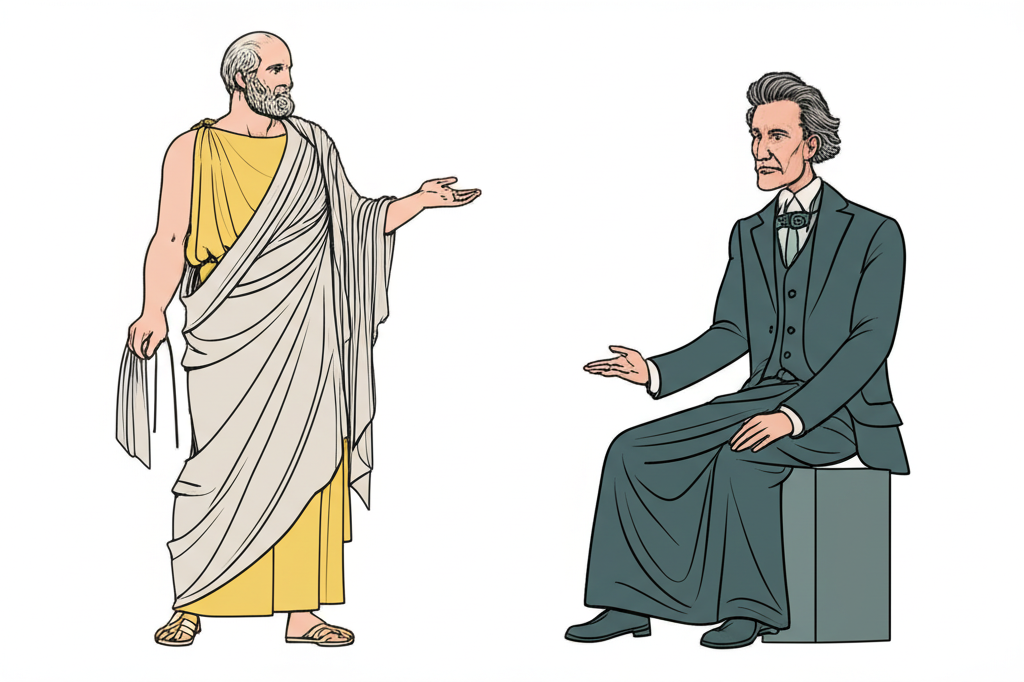 , stand on opposite sides of a shimmering, translucent hourglass. The hourglass is not simply measuring sand, but instead shows swirling light particles within, suggesting the flow of time. Behind Plato, ancient scrolls and a faint outline of a cave are visible. Behind the physicist, a complex cosmic background with warped grid lines representing space-time is subtly rendered. Both figures are gesturing towards the hourglass, their expressions indicating deep contemplation and respectful disagreement.)
A Philosophical Conundrum: Meaning in the Mechanics
The mechanics of light and time, as revealed by physics, present us with a universe of profound strangeness and elegant order. While science provides the "how," philosophy continues to grapple with the "what does it mean?" How do we integrate these mind-bending truths into our lived experience and our quest for meaning? The Great Books remind us that even the most rigorous scientific understanding does not fully exhaust the human need to understand our place in the cosmos. The constant speed of light and the relativity of time are not just equations; they are invitations to rethink our most fundamental assumptions about reality, pushing the boundaries of human knowledge and philosophical inquiry.
YouTube Video Suggestions:
-
📹 Related Video: KANT ON: What is Enlightenment?
Video by: The School of Life
💡 Want different videos? Search YouTube for: ""Einstein's Theory of Relativity Explained Simply""
-
📹 Related Video: KANT ON: What is Enlightenment?
Video by: The School of Life
💡 Want different videos? Search YouTube for: ""Philosophical Implications of Time Dilation""