

The Mechanics of Light and Time: A Philosophical Interrogation
The relationship between light and time is not merely a subject for theoretical Physics; it is a profound philosophical bedrock upon which our understanding of reality is constructed. From ancient contemplations on the nature of existence to Einstein's revolutionary insights, the mechanics governing light's propagation and time's flow reveal an intricate dance that challenges our intuitive grasp of Space and being. This article delves into how these fundamental elements are intertwined, exploring their historical interpretations and modern scientific revelations, ultimately questioning what it means to experience and measure reality.
The Ancient Glimmer: Light, Time, and Truth
For millennia, philosophers have grappled with the essence of light and Time. In the Great Books of the Western World, light often symbolizes truth, knowledge, and divine illumination, as seen in Plato's allegory of the cave, where the sun's light represents ultimate reality. Similarly, Time has been a perennial enigma. Aristotle, in his Physics, posited Time as the measure of motion, an attribute of change rather than an independent entity. This classical view of Time as an observable sequence, and light as a medium of perception, laid the groundwork for understanding the universe's mechanics through human experience.
Early Philosophical Perspectives:
- Plato: Light as the source of truth, illuminating the Forms.
- Aristotle: Time defined by change and motion; Space as a container.
- Augustine of Hippo: Time as a psychological construct, existing in the mind (past as memory, future as expectation, present as attention). His famous query, "What then is time? If no one asks me, I know; if I wish to explain it to one who asks, I know not," profoundly captures its elusive nature.
These early inquiries, while lacking the empirical tools of modern Physics, established a crucial philosophical framework for discussing the fundamental constituents of our reality.
Light's Unyielding Pace: A Revolution in Mechanics
The 19th and 20th centuries brought a seismic shift in our understanding of light's mechanics. The Michelson-Morley experiment's perplexing null result, followed by Albert Einstein's Special Theory of Relativity, unveiled a counter-intuitive truth: the speed of light in a vacuum is constant for all inertial observers, regardless of their own motion. This seemingly simple postulate shattered classical notions of absolute Time and Space.
This constancy of light's speed, roughly 299,792,458 meters per second, is not just a scientific fact; it is a profound philosophical statement about the universe. It means that our perception and measurement of Time and Space are relative to our frame of reference. The mechanics of light dictate the mechanics of reality.
Time's Elastic Nature: The Relativistic Continuum
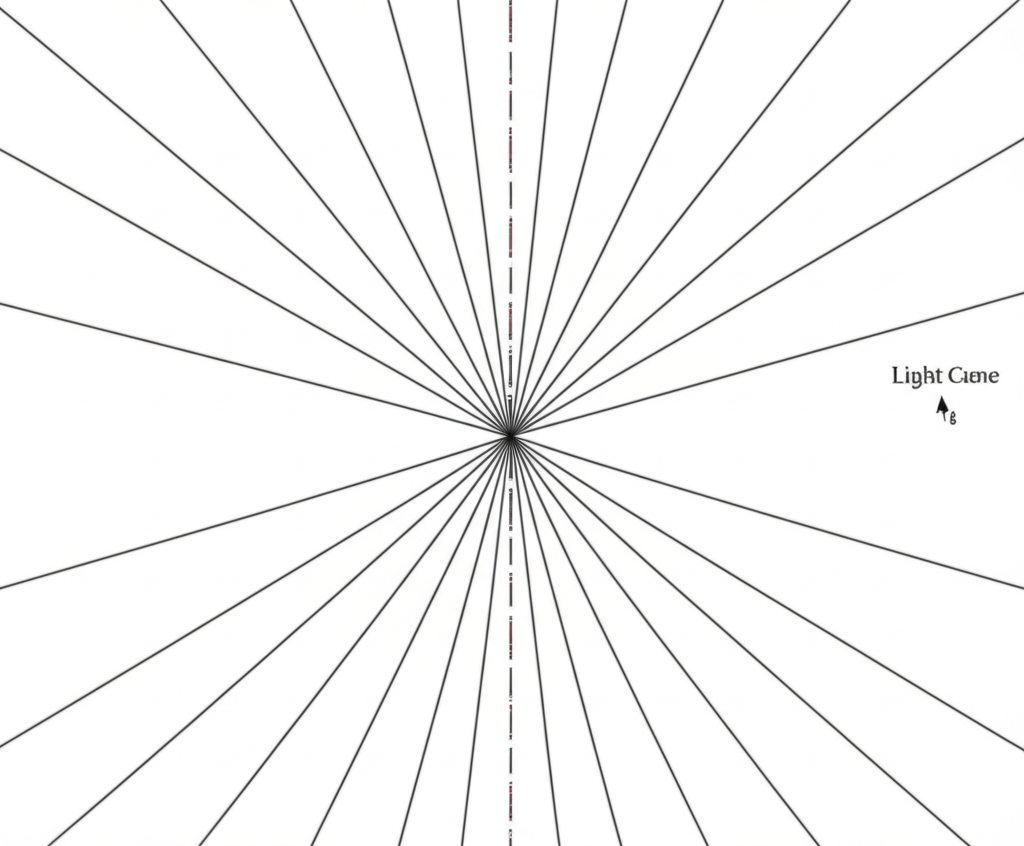
If light's speed is constant, then something else must give. That 'something else' is Time itself, along with Space. Einstein showed that Time is not a universal, immutable river flowing uniformly for everyone. Instead, it is elastic, capable of stretching and compressing depending on an observer's relative motion and gravitational field. This phenomenon, known as time dilation, is a direct consequence of the constant speed of light.
Key Relativistic Effects on Time:
- Time Dilation: Clocks in motion relative to an observer run slower. The faster an object moves, the slower Time passes for it from the perspective of a stationary observer.
- Length Contraction: Objects moving at high speeds appear shorter in the direction of motion to a stationary observer.
- Relativity of Simultaneity: Events that appear simultaneous to one observer may not be simultaneous to another observer moving at a different velocity.
These effects are not illusions; they are intrinsic mechanics of Space-Time, validated by experiments with atomic clocks and observations of cosmic rays. The Physics of light has irrevocably altered our philosophical conception of Time.
The Fabric of Spacetime: An Indivisible Unity
The most profound implication of these mechanics is the unification of Space and Time into a single, four-dimensional continuum: Spacetime. Light, traveling through this fabric, acts as the ultimate messenger, its constant speed establishing the causal structure of the universe. Events are not just located in Space and at a particular Time; they are points in Spacetime.
Philosophically, this challenges our everyday experience of Space as a stage and Time as a separate, universal clock. Instead, Space and Time are inextricably linked, each influencing the other. The path of light through Spacetime is the shortest possible path, a geodesic, and this path is bent by gravity, further demonstrating the deep connection between matter, energy, Space, and Time.
Philosophical Questions Arising from Relativistic Mechanics:
- Is there an objective "now"? If simultaneity is relative, does a universal present moment exist?
- What is the nature of existence across different frames of reference? Do objects "exist" differently for observers in relative motion?
- How does human consciousness experience and construct Time in light of its relativistic nature? Is our subjective experience of Time merely an emergent property, or does it hold deeper significance?
- What are the implications for free will if Spacetime implies a fixed continuum of events?
These questions push the boundaries of Physics into the realm of metaphysics, demanding a re-evaluation of fundamental concepts that have been debated since the Great Books.
Conclusion: Light, Time, and the Human Condition
The mechanics of light and Time, as revealed by modern Physics, are far more intricate and counter-intuitive than the classical philosophers could have imagined. Yet, their foundational inquiries into the nature of reality, perception, and being remain profoundly relevant. Light, no longer just a metaphor for truth, is the very constant that sculpts Space and bends Time. Time, no longer a simple measure of motion, is a dynamic dimension interwoven with Space.
Understanding these mechanics is not merely an academic exercise; it forces us to confront the limits of our perception and the vastness of the universe's inherent logic. It is a testament to the enduring human quest to comprehend the fundamental principles that govern our existence, a quest that continues to bridge the chasm between the empirical observations of Physics and the profound questions of philosophy.
📹 Related Video: KANT ON: What is Enlightenment?
Video by: The School of Life
💡 Want different videos? Search YouTube for: ""Einstein's Theory of Relativity Explained Simply""
📹 Related Video: PLATO ON: The Allegory of the Cave
Video by: The School of Life
💡 Want different videos? Search YouTube for: ""What is Time? Philosophical Perspectives""