

The Mechanics of Astronomical Bodies: A Philosophical Inquiry
Summary:
This article delves into the fundamental mechanics governing the movements of celestial objects, from the ancient, geocentric models to the sophisticated physics of Newtonian gravitation and Einsteinian relativity. We explore how humanity's understanding of astronomy has evolved, driven by observation, mathematical rigor, and the persistent human desire to comprehend the cosmos. Through this journey, we consider the philosophical implications of these discoveries, particularly how the precise quantity and interaction of forces shape our perception of order, predictability, and our place within the grand, mechanistic dance of the universe, drawing insights from the "Great Books of the Western World."
Introduction: Setting the Stage for Cosmic Order
From the earliest stargazers to the modern astrophysicist, humanity has been captivated by the silent, majestic ballet of the heavens. The orderly progression of planets, the predictable cycle of seasons, the very rhythm of day and night—all are testament to an underlying cosmic mechanics. But what are these mechanisms? How do the celestial bodies interact, and what does their predictable physics tell us about the nature of reality itself? In this exploration, we shall traverse the intellectual landscape of astronomy, examining the evolution of our understanding, from the intuitive observations of antiquity to the profound mathematical theories that reveal the intricate quantity and quality of forces at play.
The Ancient Gaze: Early Understandings of Celestial Motion
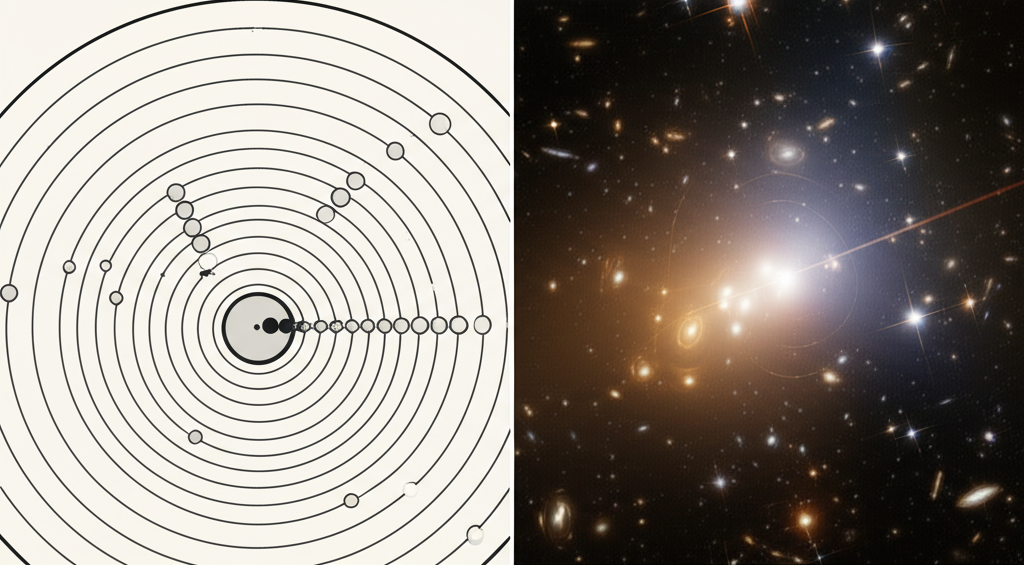
Before the advent of telescopes and calculus, the human mind grappled with the apparent wanderings of the planets against the fixed backdrop of stars. Figures like Aristotle, whose cosmology profoundly influenced Western thought for millennia, posited a geocentric universe of concentric spheres, where celestial bodies moved in perfect circles, driven by divine intelligence. Ptolemy, building upon this Aristotelian framework, introduced epicycles and deferents in his Almagest—a masterwork of observational astronomy that, despite its incorrect premise, provided a remarkably accurate predictive model for the apparent motions, a testament to the power of quantitative observation even within a flawed paradigm. These early models, found within the pages of the 'Great Books,' represent humanity's initial, profound attempt to impose order and understand the mechanics of the cosmos, shaping philosophical thought on everything from human destiny to the structure of society.
Newton's Grand Synthesis: Unveiling Universal Mechanics
The Copernican revolution, championed by Galileo's observations and Kepler's precise laws of planetary motion, shattered the geocentric paradigm, placing the Sun at the center. Yet, it was Isaac Newton, whose Principia Mathematica stands as a monumental achievement in the 'Great Books' canon, who provided the overarching framework—the universal mechanics—that explained why planets moved as they did. Newton's genius lay in recognizing that the same force that pulls an apple to the ground also keeps the Moon in orbit around the Earth, and the Earth around the Sun.
-
Gravitation: The Invisible Hand of the Cosmos
Newton's Law of Universal Gravitation posited that every particle in the universe attracts every other particle with a force directly proportional to the product of their masses and inversely proportional to the square of the distance between their centers. This elegant formulation, a cornerstone of classical physics, transformed our understanding of celestial mechanics. It replaced the mystical 'prime mover' with a quantifiable, predictable force, allowing for unprecedented accuracy in predicting planetary orbits, tides, and the trajectories of comets. The universe, once a realm of divine inscrutability, became a grand, intricate clockwork. -
The Language of Physics: Expressing Quantity and Motion
Central to Newton's success was his development of calculus, a mathematical tool essential for describing continuous change and motion. His laws of motion, expressed with precise quantity and vector notation, provided the vocabulary to articulate the mechanics of the cosmos. Force, mass, acceleration—these fundamental concepts, measurable and interlinked, allowed scientists to move beyond mere description to profound explanation. The ability to quantify these interactions transformed astronomy from a descriptive science into a predictive one, demonstrating the immense power of mathematics as the language of physics.
Beyond Newton: Relativity and the Fabric of Spacetime
While Newton's mechanics proved remarkably accurate for most astronomical phenomena, the early 20th century brought new challenges and insights. Albert Einstein's theories of Special and General Relativity offered a more profound, albeit more abstract, understanding of gravity. Rather than a force acting at a distance, Einstein proposed that gravity is a manifestation of the curvature of spacetime itself, caused by the presence of mass and energy. Massive objects, like stars and galaxies, warp the fabric of the universe, and other objects simply follow the shortest path through this curved geometry. This revolutionary perspective, while not overturning Newtonian physics for everyday scales, offered a deeper truth about the mechanics of extremely massive objects, black holes, and the universe on its grandest scales, again pushing the boundaries of what we understand about quantity and interaction in the cosmos.
The Philosophical Echoes of Celestial Mechanics
The journey through the mechanics of astronomical bodies is not merely a scientific one; it is deeply philosophical. From the ancient contemplation of cosmic harmony to the deterministic universe of Newton, and then to the interwoven spacetime of Einstein, each epoch-making discovery has reshaped humanity's self-perception. Are we merely cogs in a vast, indifferent machine, or does the very intelligibility of these physics suggest a profound connection between the human mind and the cosmic order? The ability to measure, predict, and understand the intricate quantity of celestial motion speaks to the human capacity for reason and the persistent quest for truth, echoing the very essence of philosophical inquiry found in the 'Great Books'—the search for order amidst apparent chaos, and meaning within the vast expanse.
Conclusion: Our Place in a Mechanistic Universe
The mechanics of astronomical bodies, from the elegant ellipses of Kepler to the spacetime distortions of Einstein, reveal a universe of astonishing order and precision. This scientific journey, meticulously documented and debated across centuries within the pages of the 'Great Books of the Western World,' is a testament to the human intellect's enduring power to unravel cosmic mysteries. By understanding the underlying physics that govern the dance of planets and galaxies, we gain not only predictive power but also a profound sense of our place—a tiny, yet conscious, part of an unimaginably vast and intricately ordered cosmos, driven by fundamental laws of quantity and interaction. The stars may be distant, but their mechanics are deeply woven into the fabric of human thought and philosophy.
📹 Related Video: ARISTOTLE ON: The Nicomachean Ethics
Video by: The School of Life
💡 Want different videos? Search YouTube for: ""Newtonian Physics explained for philosophers""
📹 Related Video: KANT ON: What is Enlightenment?
Video by: The School of Life
💡 Want different videos? Search YouTube for: ""Einstein's General Relativity: A Philosophical Perspective""