

Celestial Choreography: The Mechanics of Astronomical Bodies
Summary: The study of "The Mechanics of Astronomical Bodies" represents one of humanity's longest-standing intellectual quests, bridging the gap between raw observation and profound philosophical inquiry. From the earliest stargazers to modern astrophysicists, our understanding of the heavens has evolved from qualitative wonder to precise, quantitative physics. This article explores how the principles of mechanics have illuminated the grand cosmic dance, revealing a universe governed by discoverable laws and challenging our very conception of reality.
The Grand Design: Unraveling Celestial Motion
For millennia, the night sky has been a canvas for human imagination and a profound source of philosophical contemplation. The seemingly erratic yet ultimately predictable movements of planets, stars, and other celestial phenomena have spurred countless civilizations to seek underlying order. This quest to understand the "how" of cosmic motion – the mechanics of it all – has been a foundational pillar of both astronomy and physics, profoundly shaping our worldview.
From the cyclical rhythms that dictated ancient agricultural calendars to the complex calculations guiding modern space probes, the desire to predict and explain the movements of astronomical bodies has driven scientific progress. Yet, beyond the purely scientific, lies a deep philosophical current: what does this intricate mechanics tell us about the nature of existence, causality, and our place within the vast cosmic tapestry?
Early Inquiries: Spheres, Circles, and Divine Order
The foundational texts of the Great Books of the Western World reveal a sustained engagement with celestial mechanics from the earliest philosophical traditions. For the ancient Greeks, exemplified by figures like Plato and Aristotle, the heavens were the realm of perfection. Celestial bodies were thought to move in perfect circles, an embodiment of divine harmony and order.
- Plato's Ideal Forms: The observed, imperfect motions were seen as mere shadows of an underlying, ideal mathematical reality. The goal of astronomy was to "save the phenomena" by finding the perfect geometrical arrangements that explained the apparent wanderings.
- Aristotle's Crystalline Spheres: Aristotle posited a geocentric universe where each celestial body was embedded in a series of concentric, crystalline spheres, driven by a Prime Mover. This qualitative model provided a coherent, albeit ultimately incorrect, explanation for the observed movements, deeply intertwined with his broader physics and metaphysics.
- Ptolemy's Epicycles: Claudius Ptolemy, whose Almagest became the definitive astronomical text for over a millennium, refined the geocentric model with a sophisticated system of epicycles, deferents, and equants. While complex, his work demonstrated an early, albeit indirect, attempt to introduce quantity into astronomy to predict planetary positions with greater accuracy.
These early models, though flawed by modern standards, laid the groundwork for scientific inquiry by attempting to impose rational order on the cosmos. The shift from qualitative observation to quantitative prediction was a slow, arduous process.
The Copernican Revolution and the Dawn of Quantitative Astronomy
The Renaissance brought a profound re-evaluation of these ancient models. Nicolaus Copernicus, by placing the Sun at the center of the solar system, initiated a paradigm shift that would fundamentally alter our understanding of celestial mechanics.
Key Developments:
- Copernicus's Heliocentric Model (1543): While still employing perfect circles, Copernicus offered a simpler, more elegant explanation for retrograde motion, challenging the long-held geocentric view. This was a monumental step in astronomy.
- Tycho Brahe's Precision Observations: Brahe's meticulous and extensive naked-eye observations, unparalleled in their accuracy, provided the crucial data needed to dismantle older models.
- Johannes Kepler's Laws of Planetary Motion (Early 17th Century): Using Brahe's data, Kepler revolutionized astronomy by demonstrating that planets move in ellipses, not circles, and at varying speeds. This was a triumph of quantity and mathematical description, injecting true physics into the study of celestial orbits. His three laws are:
- Planets orbit the Sun in ellipses, with the Sun at one focus.
- A line connecting a planet to the Sun sweeps out equal areas in equal times.
- The square of a planet's orbital period is proportional to the cube of the semi-major axis of its orbit.
- Galileo Galilei's Telescopic Discoveries: Galileo's observations of Jupiter's moons, the phases of Venus, and the craters on the Moon provided empirical evidence that further undermined the Aristotelian-Ptolemaic system, showing that not all celestial bodies orbited Earth and that the heavens were not immutable. His work laid critical groundwork for modern physics.
The shift from speculative cosmology to empirical astronomy and mathematical physics was transformative. The universe was beginning to reveal itself not as a realm of perfect forms, but as a system governed by precise, quantifiable laws.
Newton's Grand Synthesis: Universal Mechanics
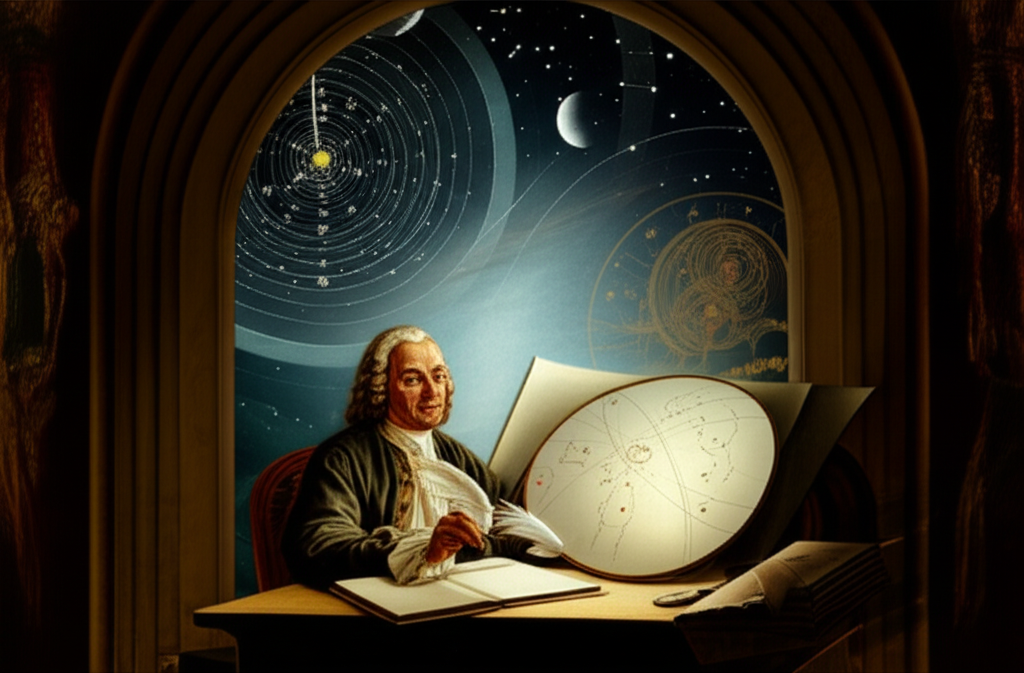
The ultimate triumph in understanding the mechanics of astronomical bodies came with Isaac Newton's Philosophiæ Naturalis Principia Mathematica (1687), another cornerstone of the Great Books. Newton didn't just describe how planets moved; he explained why they moved that way.
Newton's Universal Law of Gravitation posited that every particle of matter in the universe attracts every other particle with a force directly proportional to the product of their masses and inversely proportional to the square of the distance between their centers. This single, elegant law unified terrestrial physics with celestial mechanics.
Newton's Contributions to the Mechanics of Astronomical Bodies:
- Unification of Heaven and Earth: The same force that causes an apple to fall to the ground also keeps the Moon in orbit around the Earth and the Earth around the Sun. This was a radical departure from the ancient view of separate celestial and terrestrial realms.
- Predictive Power: Newton's laws allowed for incredibly accurate predictions of planetary motions, cometary paths, and tidal forces. The universe was revealed as a vast, intricate clockwork mechanism.
- Emphasis on Quantity: Newton's work was fundamentally quantitative, expressed in mathematical equations that could be tested and verified. This firmly established the empirical and mathematical foundations of modern physics and astronomy.
- Philosophical Impact: Newton's system suggested a universe operating according to rational, discoverable laws, fostering an Enlightenment-era belief in cosmic order and the power of human reason.
Beyond Newton: Refining the Cosmic Dance
While Newton's mechanics provided an astonishingly accurate framework, the journey of understanding didn't end there. The 20th century brought new revolutions, notably Albert Einstein's theories of relativity.
- Special Relativity (1905): Redefined space and time, showing their interconnectedness.
- General Relativity (1915): Replaced Newton's concept of gravity as a force with a more profound understanding: gravity as the curvature of spacetime itself, caused by mass and energy. This provided even greater accuracy, explaining phenomena like the precession of Mercury's orbit that Newton's physics couldn't fully account for.
These advancements demonstrate that the quest to understand the mechanics of astronomical bodies is an ongoing process, continually refining our models and pushing the boundaries of physics and astronomy. Each new layer of understanding further solidifies the role of quantity and rigorous mathematical formulation in describing the cosmos.
The Philosophical Echoes of Celestial Mechanics
The journey from ancient qualitative observation to modern quantitative physics has profound philosophical implications.
- Order and Predictability: The discovery of universal laws governing celestial mechanics instilled a sense of cosmic order, suggesting a universe that is not capricious but rational and predictable. This has fueled debates about determinism, free will, and the nature of causality.
- The Human Capacity for Knowledge: Our ability to decipher the intricate mechanics of the cosmos speaks volumes about the power of human reason, observation, and mathematical ingenuity. It underscores our unique position as beings capable of comprehending the universe we inhabit.
- Humility and Wonder: While physics and astronomy explain the "how," they often deepen the "why" questions. The sheer scale and complexity of the universe, even when its mechanics are understood, continue to inspire awe and humility, reminding us of our small but significant place within it.
The study of astronomical mechanics is not merely a scientific discipline; it is a philosophical endeavor, continually challenging our assumptions, expanding our horizons, and inviting us to contemplate the deepest mysteries of existence.
YouTube Video Suggestions:
-
📹 Related Video: What is Philosophy?
Video by: The School of Life
💡 Want different videos? Search YouTube for: "Philosophy of Science Newton Gravity"
-
📹 Related Video: What is Philosophy?
Video by: The School of Life
💡 Want different videos? Search YouTube for: "History of Astronomy Philosophy"