

The Immeasurable Measured: A Philosophical Journey Through Time and Space
The very act of living, of experiencing, is predicated on the twin pillars of Time and Space. Yet, for all their ubiquity, their true nature and, more profoundly, their measurement, have confounded philosophers and scientists alike for millennia. This article delves into the rich philosophical tradition, drawing from the Great Books of the Western World, to explore how humanity has grappled with the challenge of quantifying these fundamental aspects of reality, and what that quantification truly implies. We will journey through ancient inquiries into Quantity, the rise of Mathematics as a descriptive language, and the enduring questions that persist regarding the fabric of our existence.
The Elusive Canvas: Defining and Quantifying Reality
From the earliest philosophical inquiries, the desire to understand the world around us has necessitated a means of describing its extent and duration. Before we can measure, however, we must first define. What is Time? What is Space? Are they independent entities, mere containers for events and objects, or are they emergent properties of existence itself? These are not trivial questions, for our answers profoundly shape how we approach their measurement.
The Great Books offer a fascinating progression of thought. Plato, in his Timaeus, speaks of a cosmic receptacle, a chora, which serves as the spatially extended "mother" of all becoming. This provides a primordial, almost mythical, ground for Space. Aristotle, in his Physics, offers a more empirical approach, defining time not as an independent entity but as "the number of motion with respect to 'before' and 'after'." He grapples with the concept of the infinite divisibility of both, laying groundwork for the paradoxes that would challenge thinkers for centuries.
The Ancient Quest for Quantity
The very concept of Quantity became central to understanding the cosmos. How much of something is there? How long does it last? This innate human drive to quantify led to the earliest forms of measurement, often rooted in practical needs but quickly evolving into abstract philosophical inquiry.
Early Philosophical Approaches to Space:
- Plato's Chora: A primal, formless "receptacle" that provides the spatial arena for the creation of the cosmos. It is not Space as we measure it, but its necessary precondition.
- Aristotle's Place: Defined as the innermost motionless boundary of what contains a body. This relative definition of Space is deeply tied to the presence of objects. The idea of "empty space" was largely anathema to him.
Early Philosophical Approaches to Time:
- Aristotle's Number of Motion: Time is inherently linked to change and movement. Without change, there is no Time. This definition immediately ties Time to observable phenomena, making its measurement an observation of motion.
- Augustine's Confessions: A profound meditation on the nature of Time, where he famously asks, "What then is time? If no one asks me, I know; if I wish to explain it to one who asks, I know not." He explores Time as a distention of the soul, a subjective experience of past, present, and future, challenging the notion of an objective, external measure.
The Dawn of Mathematics: The Language of Measurement
It was through Mathematics that the abstract philosophical concepts of Time and Space began to yield to systematic measurement. Euclid's Elements, a cornerstone of Western thought, provided the foundational geometry for understanding and quantifying Space. Lines, planes, angles, and volumes could be precisely defined and measured, giving rise to engineering, architecture, and astronomy.
| Aspect of Reality | Philosophical Definition (Early) | Mathematical Approach to Measurement |
|---|---|---|
| Space | Container, Place, Receptacle | Euclidean Geometry (points, lines, planes, volumes) |
| Time | Number of Motion, Distention of Soul | Cycles (celestial, mechanical), Ratios of Change |
| Quantity | How Much, How Many | Arithmetic, Algebra, Calculus |
The measurement of Time proved more elusive than Space. While spatial dimensions could be marked out and compared, Time flows relentlessly, invisibly. Early attempts relied on natural cycles: the sun's passage, the moon's phases, the seasons. Sundials, water clocks (clepsydras), and later mechanical clocks, were human inventions designed to capture and segment this flow, transforming the continuous into discrete, measurable units. This technological advance, however, did not resolve the philosophical debate about Time's true nature, but rather provided a practical framework for living within its perceived bounds.
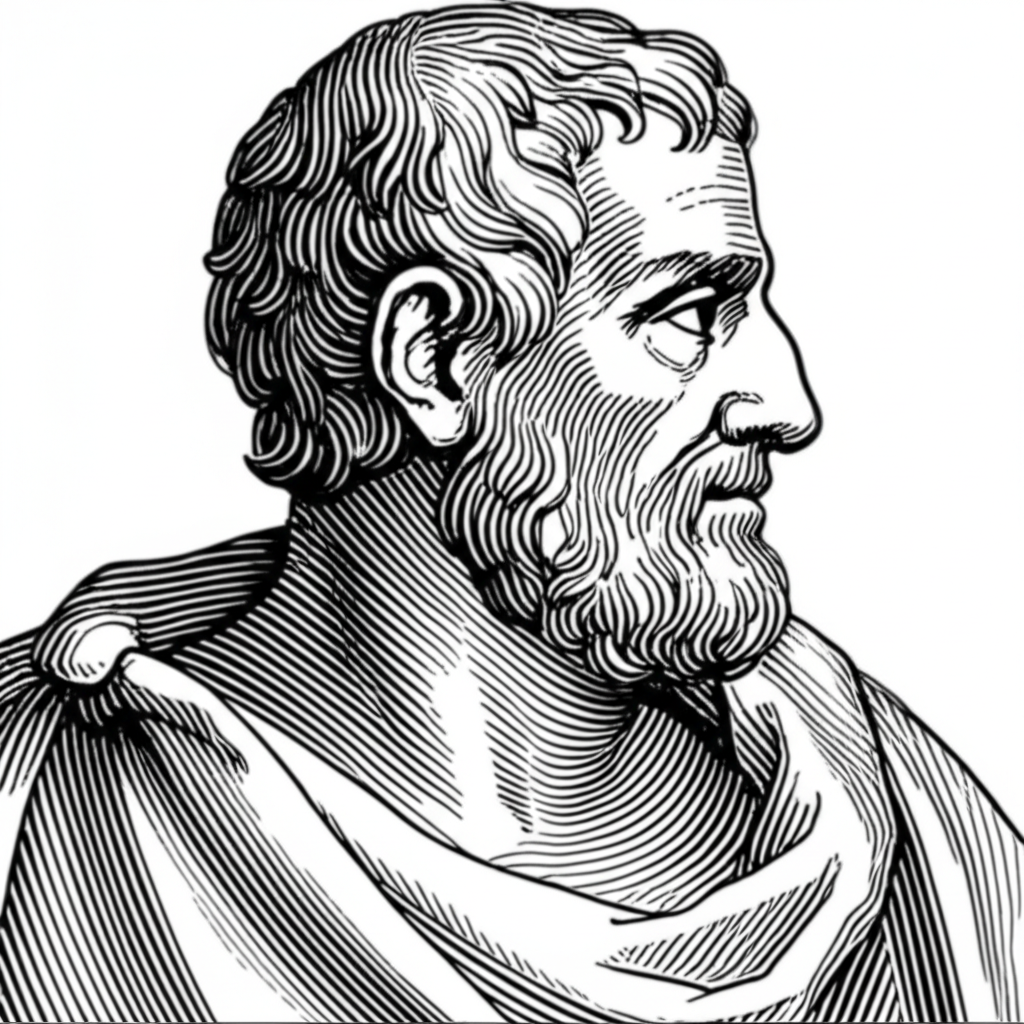 contemplating a sundial and a star chart, with geometric shapes (a cube, a sphere) subtly integrated into the background, symbolizing the intellectual effort to measure both time and space.)
Newton's Absolute Framework: A Universe Measured
Centuries later, Isaac Newton, deeply influenced by the philosophical tradition yet forging a new scientific paradigm, presented a powerful, measurable framework for the universe. In his Principia Mathematica, he posited the existence of absolute Time and absolute Space.
- Absolute Space: "Absolute, true, and mathematical space, remaining similar and immovable, without relation to anything external, remains always the same and immovable." This provided a fixed, infinite, and independent stage upon which all events unfolded, rendering it perfectly measurable.
- Absolute Time: "Absolute, true, and mathematical time, of itself, and from its own nature, flows equably without relation to anything external." This implied a universal clock, ticking uniformly for everyone, everywhere, regardless of observation.
Newton's framework, while immensely successful for classical physics, implicitly adopted a specific philosophical stance on the nature of Time and Space. They were not merely relationships or perceptions but fundamental, quantifiable realities, accessible through careful measurement and described by Mathematics. This solidified the scientific endeavor of precisely measuring celestial movements, terrestrial distances, and the duration of phenomena.
The Philosophical Underpinnings of Measurement
Yet, even with precise instruments and elegant mathematical models, the philosophical questions persist. What does it truly mean to "measure" something as fundamental as Time and Space? Are we measuring an external, objective reality, or are we measuring our own conceptual frameworks and sensory perceptions?
The act of measurement itself is an imposition of human order on what might otherwise be a seamless continuum. We define units – meters, seconds – based on arbitrary but agreed-upon standards. This process transforms the qualitative experience of "long" or "short," "soon" or "late," into precise quantities. This transformation allows for prediction, control, and shared understanding, forming the bedrock of science and technology.
The Intertwined Nature of Time and Space
Throughout the philosophical tradition, Time and Space, while distinct, are rarely considered in complete isolation. Aristotle's Time is the measure of motion in Space. Plato's chora provides the spatial ground for becoming, which implies temporal change. From the Great Books to contemporary physics, the profound inquiries into one inevitably lead to the other. Their measurement is an attempt to map the very structure of reality, revealing their deep, often mysterious, interconnectedness.
Conclusion: The Enduring Quest
The journey to understand and measure Time and Space is a testament to humanity's relentless pursuit of knowledge. From the ancient philosophers grappling with the very definitions of Quantity and existence, to the scientific revolutions enabled by Mathematics, we have continuously refined our tools and concepts. While instruments become ever more precise, and theories ever more encompassing, the fundamental philosophical questions remain: What is being measured? And what does that measurement truly tell us about the ultimate nature of Time and Space themselves? The dialogue continues, inviting each generation to ponder the fabric of reality.
📹 Related Video: ARISTOTLE ON: The Nicomachean Ethics
Video by: The School of Life
💡 Want different videos? Search YouTube for: ""Aristotle on Time and Motion Explained""
📹 Related Video: What is Philosophy?
Video by: The School of Life
💡 Want different videos? Search YouTube for: ""Newton's Absolute Space and Time Philosophy""