

The Philosophical Quandary of Measuring Time and Space
The very fabric of our existence, the stage upon which all phenomena unfold, is defined by Time and Space. Yet, our attempts to grasp, define, and ultimately measure these fundamental concepts have been a source of profound philosophical and scientific inquiry for millennia. This article delves into the historical and conceptual journey of understanding the measurement of time and space, exploring how philosophers and scientists, from the ancients to the moderns, have grappled with transforming these elusive realities into quantifiable entities. We will see how Mathematics became the indispensable language for this endeavor, revealing not just dimensions but also deep truths about reality itself.
The Ancient Roots: Time and Space as Philosophical Concepts
Before the advent of precise scientific instruments, the understanding of Time and Space was primarily a philosophical exercise, deeply embedded in cosmology and metaphysics. The thinkers compiled in the Great Books of the Western World provide a rich tapestry of early thought on these matters, laying the groundwork for all subsequent inquiry.
Plato's Forms and the Ideal Realm
For Plato, as articulated in works like Timaeus, the sensible world is but a shadow of a perfect, unchanging realm of Forms. Time and Space in this view are not primary, but rather aspects of the created, temporal world. Space, in a sense, is the "receptacle" or "nurse" within which things come to be, a somewhat amorphous concept contrasted with the eternal Forms. The very idea of measurement in this context becomes problematic; how does one measure that which is imperfect and fleeting when true reality resides in the immeasurable, ideal?
Aristotle's Physics: Time as the "Number of Motion" and Space as "Place"
Aristotle, in his Physics, offers a more empirical and grounded approach. He famously defines Time not as an independent entity, but as the "number of motion with respect to 'before' and 'after'." This definition links time intrinsically to change and movement. Without change, there is no time. The Quantity of time, therefore, becomes a function of observing sequential events.
Similarly, Aristotle conceptualized Space as "place" (topos) – the innermost motionless boundary of a containing body. It is not an empty void, but rather where a thing is. This perspective emphasizes relationality; an object's position is defined by its relation to other objects. The notion of measuring space, therefore, relates to measuring the dimensions of objects and the distances between them, always in relation to a perceived container or reference.
- Key Aristotelian Concepts:
- Time: The measure of change or motion.
- Space: The place occupied by a body, defined by its boundaries.
- Quantity: Derived from observable phenomena and relations.
The Dawn of Scientific Measurement and Mathematical Abstraction
The transition from purely philosophical speculation to systematic scientific inquiry brought Mathematics to the forefront as the primary tool for understanding and quantifying Time and Space.
Euclid's Geometry and the Quantification of Space
Euclid's Elements, another cornerstone text within the Great Books, provided the foundational framework for understanding Space in a quantifiable manner. Through axioms, postulates, and theorems, Euclid established a system for measuring lengths, areas, and volumes. His geometry allowed for the abstract representation of spatial relationships, providing a universal language for describing the Quantity of space. Lines, planes, and solids could be measured, compared, and manipulated mathematically, transforming space from an intuitive concept into a precise, measurable domain. This was a monumental leap, establishing a mathematical model that would dominate spatial understanding for over two millennia.
From Cycles to Clocks: Early Attempts at Measuring Time
While Mathematics provided the abstract framework, the practical measurement of Time required ingenuity. Early civilizations relied on natural cycles: the sun's passage across the sky, the phases of the moon, the turning of seasons. Sundials, water clocks (clepsydrae), and eventually mechanical clocks represented increasingly sophisticated attempts to standardize and segment time into measurable units. Each innovation moved us closer to a universal, objective measure of time, detached from subjective perception, allowing for a consistent Quantity to be assigned to durations.
Newtonian Absolute Time and Space: The Grand Stage
The 17th century marked a pivotal shift with Isaac Newton's articulation of absolute Time and Space, concepts that profoundly influenced subsequent scientific and philosophical thought.
Newton's Principia and the Universal Framework
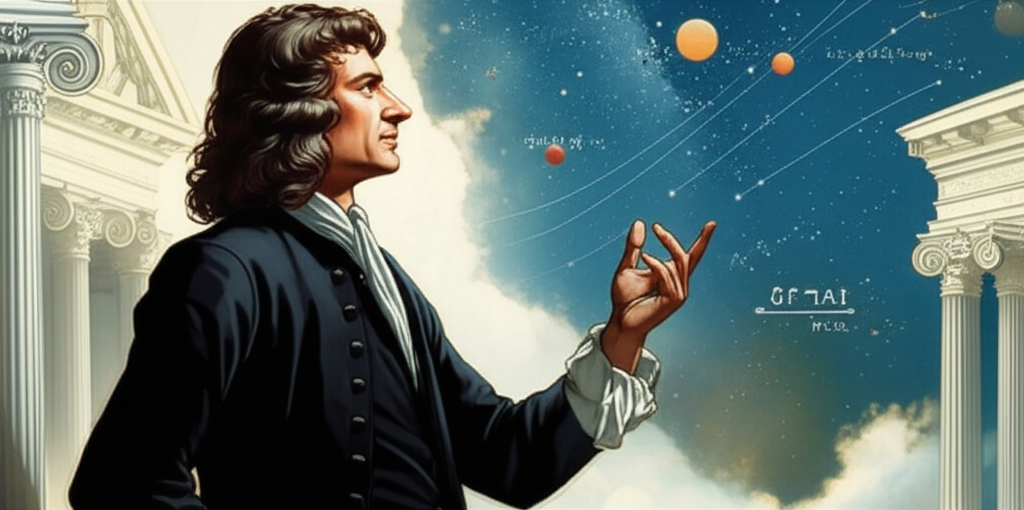
In his Philosophiæ Naturalis Principia Mathematica, Newton posited the existence of absolute, true, and mathematical time, which "of itself, and from its own nature, flows equably without relation to anything external." Similarly, he described absolute space as "in its own nature, without relation to anything external, always remaining similar and immovable." These concepts provided a universal, unchanging backdrop against which all physical events could be accurately measured and described using Mathematics. This absolute framework was crucial for his laws of motion and universal gravitation, allowing for precise calculations of trajectories, velocities, and forces across the cosmos.
The Philosophical Implications of Absolute Concepts
Newton's absolute Time and Space were not without their philosophical critics, notably Gottfried Leibniz. Leibniz argued that space and time were not independent entities but rather systems of relations between objects and events. Without objects, there is no space; without events, no time. This relational view challenged the notion of an empty container, raising questions about the very nature of existence and the meaning of Quantity when applied to non-existent 'voids'. The debate between absolutist and relationalist views continued for centuries, shaping our understanding of what it truly means to measure these fundamental aspects of reality.
YouTube: Leibniz Newton debate time space
Challenging the Absolutes: Relativity and the Continuum
The early 20th century witnessed a radical re-evaluation of Time and Space, spearheaded by Albert Einstein, which shattered the Newtonian absolute framework and introduced a new, interwoven understanding.
Einstein's Revolution: Spacetime and the Observer
Einstein's theories of special and general relativity, while not explicitly part of the original Great Books collection, represent the culmination of many philosophical and scientific inquiries contained within it. Einstein demonstrated that Time and Space are not independent, absolute entities but are instead relative to the observer's motion and the gravitational field. They are interwoven into a four-dimensional continuum known as spacetime. This revolutionary idea meant that the measurement of duration and distance could vary depending on the observer's frame of reference. The Quantity of time or space was no longer universal.
The Intertwined Nature of Time and Space
In Einstein's universe, mass and energy warp spacetime, and this warping dictates the paths of objects, including light. Gravitational forces are no longer mysterious actions at a distance but rather manifestations of the geometry of spacetime itself. Mathematics, particularly differential geometry, became the essential language for describing this dynamic, elastic continuum. The philosophical implication is profound: our very definition of measurement must account for the observer and the context. The "now" is relative, and simultaneity is not absolute.
The Philosophical Implications of Modern Measurement
The journey from Aristotle's "number of motion" to Einstein's spacetime continuum reveals a continuous interplay between empirical observation, mathematical abstraction, and philosophical interpretation.
Is Measurement Discovery or Construction?
One of the enduring philosophical questions arising from our attempts to measure Time and Space is whether we are discovering pre-existing properties of the universe or constructing conceptual frameworks that allow us to interact with and understand it. When we assign a Quantity to a duration or a distance, are we revealing an inherent truth, or are we imposing a human-made system of order onto a reality that might be fundamentally different? This question touches upon the very nature of scientific knowledge and the role of the human mind in shaping our understanding of the cosmos.
The Limits of Quantity in Defining Reality
While Mathematics provides unparalleled precision in measuring Time and Space, it also prompts us to consider the limits of Quantity. Can the entirety of Time and Space be reduced to numerical values? Do the qualitative aspects of time – its felt duration, its psychological impact, its role in memory and consciousness – escape purely quantitative assessment? Similarly, does reducing space to coordinates and distances diminish its experiential qualities, its sense of place, vastness, or confinement? The philosophical inquiry reminds us that while measurement is powerful, it may not encapsulate the full richness of these profound realities.
Conclusion
The measurement of Time and Space is a testament to humanity's relentless quest to understand the universe and its own place within it. From the ancient philosophical inquiries found in the Great Books of the Western World to the revolutionary insights of modern physics, our understanding has evolved from intuitive concepts to highly sophisticated mathematical models. What began as an attempt to quantify the observable world has led us to question the very nature of reality, revealing that Time and Space are far more intricate and interconnected than our senses initially perceive. The journey continues, pushing the boundaries of Mathematics and philosophy, as we strive to measure, and thus comprehend, the fundamental dimensions of our existence.
YouTube: Philosophy of Time and Space Explained
📹 Related Video: What is Philosophy?
Video by: The School of Life
💡 Want different videos? Search YouTube for: "The Measurement of Time and Space philosophy"