

The Elusive Metrics: Unpacking the Measurement of Time and Space
The seemingly mundane acts of glancing at a clock or pacing a room belie one of philosophy’s most enduring and profound inquiries: the measurement of Time and Space. What are these fundamental aspects of our existence, and how do we presume to quantify them? From the earliest musings of ancient Greek thinkers to the sophisticated equations of modern physics, the attempt to pin down these elusive concepts has driven both scientific progress and deep philosophical introspection. This article delves into the historical and conceptual challenges of measuring Time and Space, exploring the pivotal role of Quantity and Mathematics in our understanding, drawing insights from the rich tapestry of the Great Books of the Western World.
Time: The Flow and the Frame
Time is perhaps the most intimate yet enigmatic dimension of our experience. We feel its relentless march, mark its passage with calendars and clocks, yet struggle to define its essence. Philosophically, the measurement of time is fraught with questions: Is time an objective reality independent of events, or is it merely a product of change?
Key Philosophical Perspectives on Time:
- Aristotle, in his Physics, posited that time is "the number of motion in respect of 'before' and 'after'." For Aristotle, time does not exist independently; it is an attribute of change and movement. Without change, there is no time. This view links time intrinsically to events and their succession, making its quantity dependent on observable phenomena.
- St. Augustine, in his Confessions, famously grappled with the subjective nature of time: "What then is time? If no one asks me, I know; if I wish to explain it to one who asks, I know not." He explored how we measure past (memory), present (attention), and future (expectation), suggesting that time exists primarily in the mind. How, then, can something so internal be universally measured?
- Isaac Newton, in his Principia Mathematica, introduced the concept of absolute, true, and mathematical time, which "of itself, and from its own nature, flows equably without relation to anything external." This provided a foundation for classical physics, treating time as a uniform, measurable dimension, a container for events, independent of them.
The transition from a qualitative sense of duration to a precise quantitative measure required ingenious human invention, from sundials and water clocks to atomic clocks, each attempting to capture a more accurate "tick" of an unseen universal rhythm.
Space: Extension, Emptiness, and Existence
Just as we navigate the flow of time, we inhabit and traverse Space. Is it an empty void, a boundless container, or an inherent property of matter? The measurement of Space too has evolved from intuitive spatial awareness to rigorous geometric principles.
Conceptualizations of Space:
- Plato, particularly in Timaeus, describes space (the Chora) as a receptacle or "nurse" in which forms are imprinted, providing a locus for the physical world. It's a foundational, albeit abstract, concept for the arrangement of reality.
- Euclid's Elements provides the bedrock for our mathematical understanding of space. By defining points, lines, planes, and solids, Euclid established a system of quantity and relationship that allowed for precise measurement of distances, angles, and volumes. This geometric framework transformed space from a philosophical abstraction into a measurable entity.
- René Descartes, in his Meditations, identified extension as the primary attribute of physical substance, equating matter with extended space. This view, while later critiqued, solidified the idea that physical reality is fundamentally spatial and, therefore, measurable.
- Isaac Newton also posited absolute space, which "in its own nature, without regard to anything external, remains always similar and immoveable." Like absolute time, this offered a stable framework for his laws of motion, allowing for precise mathematical calculations of objects within it.
The challenges of measuring space involve grappling with its potential infinity, its dimensionality, and its relationship to the matter it contains. Is space truly empty, or is it a field of interactions? These questions continue to shape our understanding.
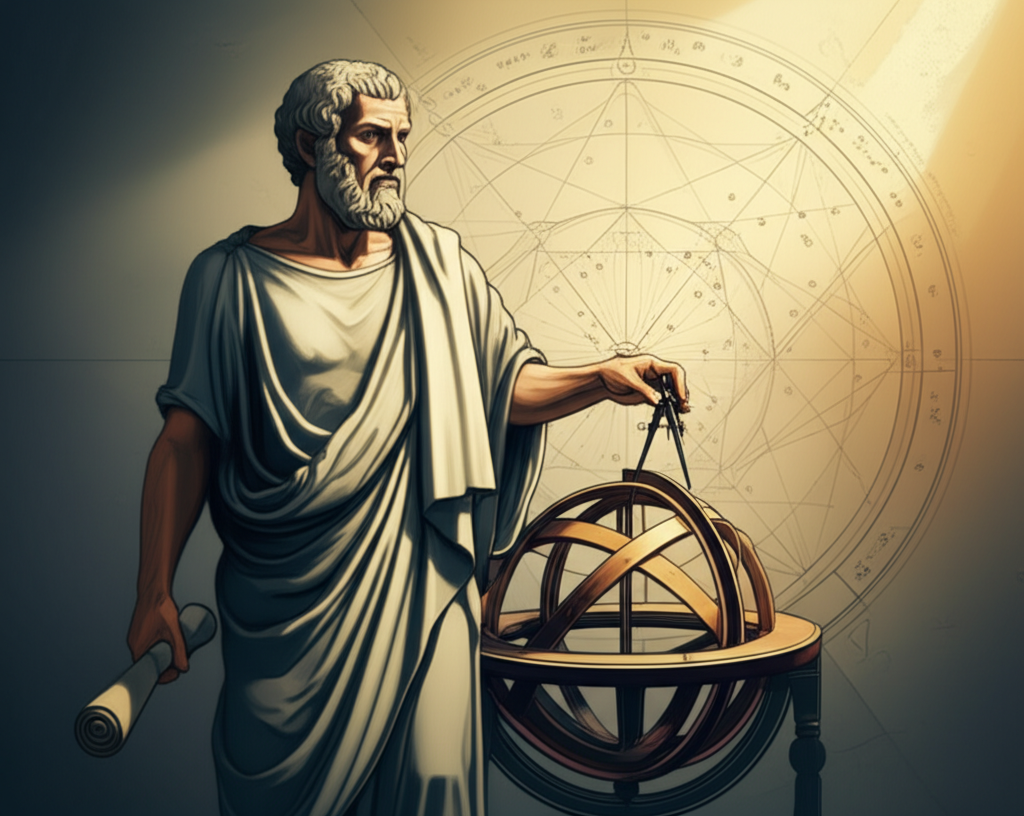
Quantity and the Mathematical Imperative
At the heart of measuring Time and Space lies the concept of Quantity and the indispensable language of Mathematics. How do we translate the qualitative experience of duration or extension into discrete, comparable units? This is where mathematics steps in, providing the tools for abstraction and comparison.
The Role of Mathematics:
- Abstracting Reality: Mathematics allows us to abstract properties from physical reality. A "meter" or a "second" are not inherent properties of the universe but human-defined quantities that allow for consistent measurement.
- Establishing Relationships: Geometry (from Euclid) provides the rules for spatial relationships, while algebra and calculus (developed by Newton and Leibniz) offer ways to describe change over time and continuous motion in space.
- Predictive Power: Once Time and Space can be quantified, Mathematics enables us to create models, make predictions, and develop technologies that interact with these dimensions. From predicting planetary orbits to designing architectural marvels, the power of mathematics in measuring and understanding our world is undeniable.
The philosophical implication here is profound: are we discovering the inherent mathematical structure of the universe, or are we imposing our mathematical frameworks onto a reality that might be fundamentally non-quantitative? The Great Books offer arguments for both perspectives, highlighting the ongoing tension between idealism and empiricism.
The Great Books Perspective: A Dialogue Through Eras
The discourse on the measurement of Time and Space is a continuous thread woven through the Great Books of the Western World.
- Plato's Timaeus offers a cosmological account where the structure of the universe, including its temporal and spatial dimensions, is ordered by divine reason and mathematical proportions.
- Aristotle's Physics meticulously dissects the nature of time and place, grounding them in the observation of change and motion, providing a robust empirical framework.
- Ptolemy's Almagest, building on Greek geometry, provides a mathematical model for the cosmos, demonstrating the practical application of measuring celestial space and time.
- Kant's Critique of Pure Reason radically reconfigures the debate, arguing that Time and Space are not external realities we perceive, but a priori forms of intuition, inherent structures of the human mind through which we experience the world. They are the conditions for any experience, making their quantity and measurement fundamentally linked to our cognitive apparatus.
- Newton's Principia Mathematica, as mentioned, formalized the concepts of absolute time and space, providing the mathematical backbone for classical mechanics and a universe governed by precise, measurable laws.
This intellectual lineage shows a gradual shift from purely philosophical speculation to scientifically rigorous quantification, always with an underlying philosophical debate about the nature of what is being measured.
Conclusion: An Ongoing Inquiry
The measurement of Time and Space remains a cornerstone of both philosophy and science. While our instruments become ever more precise, and our mathematical models ever more sophisticated, the fundamental questions persist: What are we truly measuring? Is Time a fourth dimension we travel through, or an emergent property of the universe? Is Space a boundless arena, or does it curve and warp in response to matter and energy, as Einstein's theories suggest?
The journey through the Great Books reveals that these are not merely technical problems but profound inquiries into the nature of reality itself. Our ability to apply Quantity and Mathematics to these concepts is a testament to human intellect, yet the philosophical underpinnings continue to challenge and inspire, urging us to look beyond the numbers to the very essence of existence.
📹 Related Video: What is Philosophy?
Video by: The School of Life
💡 Want different videos? Search YouTube for: ""philosophical debate on the nature of time" and "history of space concepts philosophy""