

The Elusive Metrology of Existence: Measuring Time and Space
The human endeavor to understand the cosmos often begins, and perhaps endlessly returns, to the most fundamental aspects of our experience: Time and Space. Far from being mere backdrops to events, these concepts present profound philosophical challenges, particularly when we attempt to impose upon them the rigorous discipline of Quantity and Mathematics. This article delves into the philosophical journey of measuring Time and Space, exploring how thinkers, from antiquity to modernity, have grappled with defining, quantifying, and ultimately comprehending these twin pillars of reality, drawing insights from the rich tapestry of the Great Books of the Western World.
The Philosophical Quanta: Grappling with Time
To speak of measuring Time is to immediately confront its ephemeral nature. Is Time a continuous flow, an endless river, or a series of discrete, indivisible moments? How do we assign a Quantity to something that, as St. Augustine famously pondered in his Confessions, we know perfectly well until someone asks us to define it?
The measurement of Time has historically been tied to observable phenomena – the cycles of the sun and moon, the swing of a pendulum, the decay of atoms. Yet, these are measures of Time, not Time itself. Aristotle, in his Physics, offers a foundational perspective, defining Time as "the number of motion in respect of 'before' and 'after'." This definition inherently links Time to change and sequence, suggesting that without motion, Time would cease to be measurable, perhaps even to exist in a perceptible sense.
The application of Mathematics to Time allows us to construct calendars, clocks, and chronologies, giving us a practical framework for ordering events. But does this mathematical framework truly capture the essence of Time? Does an hour, precisely measured, convey the subjective elasticity of experience – the fleeting joy or the protracted agony? This tension between objective Quantity and subjective experience remains a core philosophical dilemma.
The Vastness and Divisions: The Measurement of Space
If Time is elusive, Space presents its own set of paradoxes. Is Space an empty void, a container waiting to be filled, or is it a relational concept, defined only by the objects within it and their distances from one another? The measurement of Space seems, at first glance, more straightforward. We can use rulers, meters, and light-years – tools of Mathematics and geometry – to assign Quantity to distance, area, and volume.
Classical Greek thought, particularly Euclidean geometry, provided the foundational Mathematics for understanding Space. Plato, in his Timaeus, discusses the geometric forms underlying the cosmos, suggesting an inherent mathematical order to spatial reality. Aristotle, focusing on the concept of 'place' rather than abstract Space, considered it to be the innermost motionless boundary of what contains a body.
The scientific revolution, propelled by figures like Isaac Newton, introduced the concept of absolute Space – a fixed, infinite, and unchanging arena in which events unfold, independent of any objects within it. This absolute Space was perfectly amenable to Cartesian coordinates and the burgeoning calculus, allowing for precise mathematical description of motion and position. However, philosophers like Leibniz challenged this, arguing that Space is merely a system of relations between objects, not an independent entity. This debate underscores the profound philosophical implications of how we conceptualize and, consequently, measure Space.
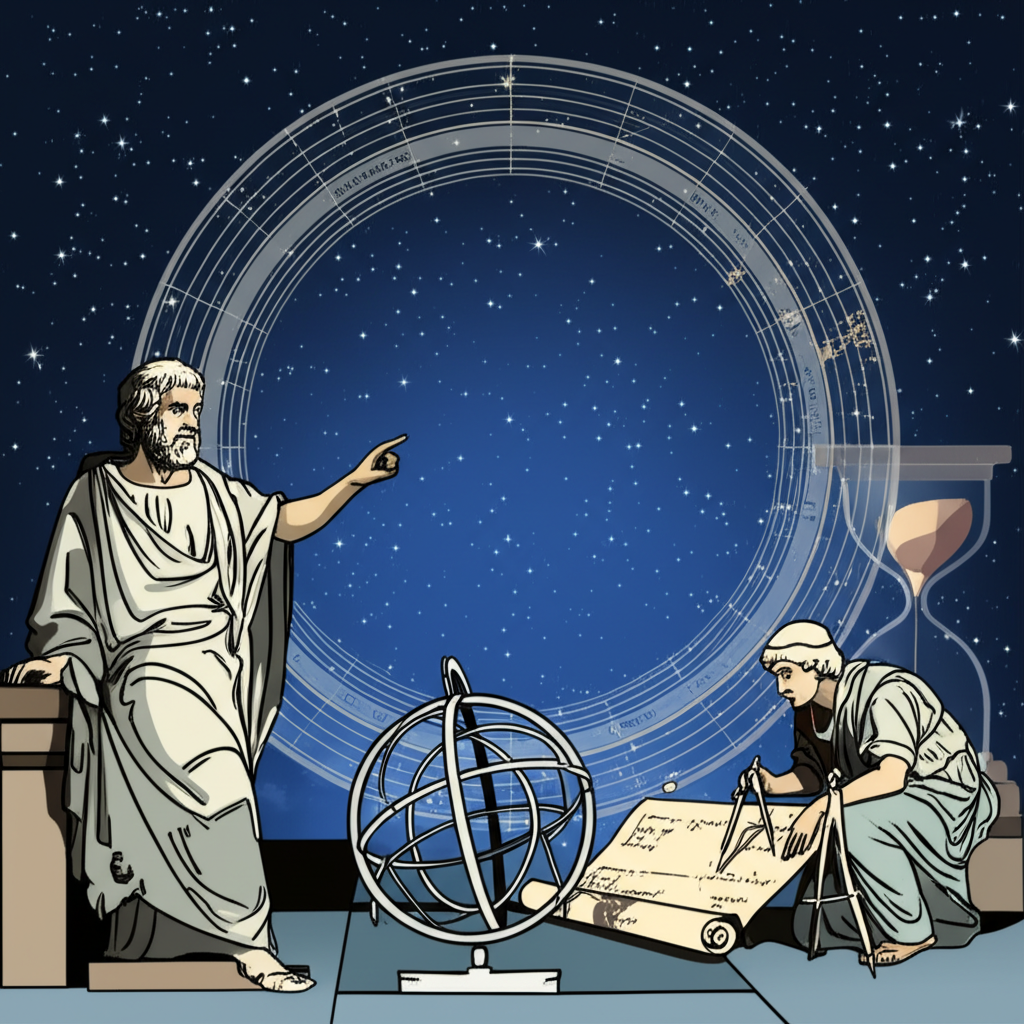
The Interplay of Quantity and Mathematics
The very act of measurement, whether of Time or Space, is an attempt to impose Quantity upon phenomena. It is the language of Mathematics that allows us to articulate these quantities, to compare, to predict, and to build models of reality. From the ancient astronomers charting celestial movements to the modern physicists exploring spacetime, Mathematics has been the indispensable tool.
Consider the following points regarding the role of Quantity and Mathematics:
- Standardization: Measurement requires agreed-upon units, which are themselves abstract mathematical constructs. The second, the meter – these are human conventions designed to quantify the unquantifiable.
- Abstraction: Mathematics allows us to abstract Time and Space from their concrete manifestations. We can speak of 'four dimensions' or 'curved spacetime' even if these are not directly perceivable in our everyday experience.
- Predictability: By quantifying Time and Space, we can develop laws of physics that predict future states and understand past events, thereby bringing order to the apparent chaos of existence.
- Limitations: Despite its power, Mathematics can only describe the quantitative aspects. It struggles with the subjective, qualitative, and experiential dimensions of Time and Space. The "flow" of Time or the "feeling" of vastness remain beyond its direct grasp.
Enduring Questions and Philosophical Horizons
The measurement of Time and Space is not a settled scientific question but an ongoing philosophical inquiry. The Great Books remind us that our understanding evolves, but the fundamental questions persist:
- Is Time truly linear, or are there other temporal dimensions?
- Is Space infinitely divisible, or does it have a fundamental, smallest unit?
- Are Time and Space objective realities, or are they constructs of the human mind, necessary categories for our perception?
- How do our chosen methods of measurement shape our understanding, rather than merely reflecting an external truth?
These are not trivial academic exercises but deeply human questions that touch upon our very place in the cosmos. As we continue to refine our instruments and our Mathematics, the philosophical challenge remains: to truly comprehend the nature of the existence we inhabit, beyond mere Quantity and measure.
📹 Related Video: What is Philosophy?
Video by: The School of Life
💡 Want different videos? Search YouTube for: ""Augustine on Time Philosophy""
📹 Related Video: ARISTOTLE ON: The Nicomachean Ethics
Video by: The School of Life
💡 Want different videos? Search YouTube for: ""Aristotle on Space and Place""