

The Grand Design: Unpacking the Measurement of Time and Space
Summary: The measurement of Time and Space represents one of humanity's most profound intellectual endeavors, a journey from qualitative intuition to precise quantitative analysis, deeply intertwined with Mathematics. This article explores the philosophical evolution of these concepts, from ancient Greek musings on their very nature to modern scientific frameworks, highlighting how our understanding of their measurability reflects our evolving grasp of reality itself. We delve into how thinkers have grappled with defining these fundamental dimensions, and the enduring questions that persist despite increasingly sophisticated methods of measurement.
The Elusive Nature of Existence: Why Measure Time and Space?
From the moment we open our eyes, we are immersed in Time and Space. We move through rooms, witness the sun's arc across the sky, and track the passage of seasons. These are not merely backdrops to our existence; they are the very fabric of it. Yet, when we attempt to grasp them, to define their boundaries or quantify their essence, they prove remarkably elusive. How do we measure something that feels both infinitely vast and intimately personal? This is not just a scientific problem, but a deeply philosophical one, a quest to understand the fundamental Quantity of reality.
For millennia, philosophers have pondered whether Time and Space are objective realities existing independently of us, or merely constructs of our minds. The shift from a purely qualitative understanding (e.g., "a long time ago," "far away") to a rigorous, mathematical framework for measurement marks a pivotal moment in intellectual history, allowing us to build the world we inhabit, from the smallest atom to the farthest galaxy.
Ancient Foundations: Aristotle's Number of Motion and Euclid's Geometry
The earliest systematic attempts to understand Time and Space as measurable entities often began with their observable manifestations.
- Aristotle and the "Number of Motion": In his Physics, Aristotle famously grappled with Time. He concluded that Time is not motion itself, but rather "the number of motion with respect to 'before' and 'after'." This is a crucial philosophical distinction: Time doesn't exist independently as a substance, but as a property or quantity derived from change. Without change, there is no Time. This perspective laid the groundwork for understanding Time not as an absolute, but as intrinsically linked to events and their succession.
- Space as "Place": For Aristotle, Space was often conceived as "place" (topos), defined by the inner surface of the containing body. This was a relational concept; a body's place was its boundary with what surrounded it, rather than an empty void. This view made Space a property of objects and their arrangement, rather than an independent, measurable continuum.
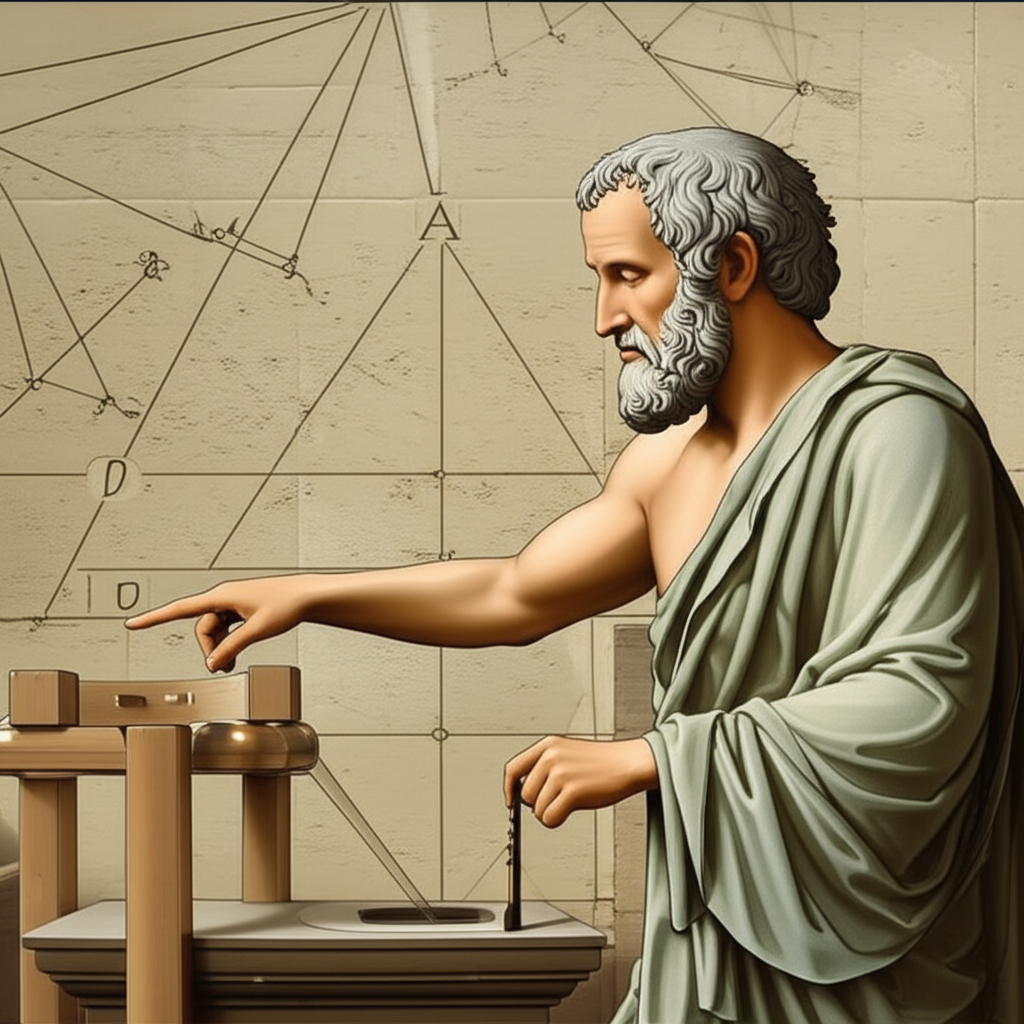
- Euclid's Geometric Revolution: While Aristotle focused on the nature of Time and Space, Euclid, in his Elements, provided the mathematical tools for their measurement, particularly for Space. By establishing axioms, postulates, and theorems, Euclid created a system for understanding geometric quantities – lines, angles, areas, and volumes. His work provided the conceptual framework for measuring distances, shapes, and sizes, effectively laying the groundwork for how we quantify spatial extension.
| Philosophical Concept | Key Thinker(s) | Approach to Measurement |
|---|---|---|
| Time as "Number of Motion" | Aristotle | Derived from observed change and succession |
| Space as "Place" | Aristotle | Relational, defined by boundaries of containing bodies |
| Geometric Quantity | Euclid | Axiomatic system for measuring extension, shapes |
The Modern Divide: Absolute Frameworks and the Mechanistic Universe
The Renaissance and Enlightenment brought a radical shift in how Time and Space were conceived and measured, moving towards more absolute and independent frameworks.
- Descartes' Res Extensa: René Descartes, in his Meditations, posited that the essence of matter (res extensa) is extension – pure Quantity. For Descartes, Space was not merely the absence of matter, but a continuum that could be infinitely divided and measured. This paved the way for a conception of Space as a measurable, geometric entity, independent of the objects within it.
- Newton's Absolute Time and Space: Isaac Newton, in his Principia Mathematica, formalized the concepts of absolute Time and absolute Space.
- Absolute, True, and Mathematical Time: "flows equably without relation to anything external, and by another name is called duration." This was a universal, unvarying Time, independent of observers or events, serving as a backdrop for all phenomena. Its measurement could be approximated by clocks, but the true Time was unseen and unchangeable.
- Absolute Space: "in its own nature, without relation to anything external, remains always similar and immovable." This was an infinite, homogeneous container, providing a fixed reference frame against which all motion could be measured.
Newton's framework provided the bedrock for classical physics, making Time and Space the stable, measurable dimensions upon which the universe operated, quantifiable through sophisticated mathematical equations.
Kant's Copernican Revolution: The Mind's Frameworks
Immanuel Kant, in his Critique of Pure Reason, introduced a profound challenge to both empiricist and rationalist views of Time and Space. He argued that they are not objective properties of the world in itself (Ding an sich), but rather a priori forms of intuition, inherent structures of the human mind.
- Necessity for Perception: For Kant, Time and Space are not concepts we derive from experience, but rather the necessary preconditions for any experience at all. We cannot perceive an object without perceiving it as being in Space, nor can we perceive events without perceiving them as occurring in Time.
- Impact on Measurement: This doesn't negate the possibility or utility of measurement. Instead, it reframes it. We measure phenomena as they appear to us within these innate mental frameworks. Our Mathematics and physics, built upon quantitative measurements of Time and Space, are therefore incredibly powerful for understanding the phenomenal world – the world as we experience it – even if they don't directly access the "things in themselves." Kant thus reasserted the philosophical significance of the observer in the act of measurement.
The Problem of Quantity and Subjectivity
Despite centuries of philosophical and scientific advancement, the measurement of Time and Space continues to present profound questions:
- Defining the Unit: How do we establish a universal unit for something as seemingly subjective as a "second" or a "meter"? The shift from arbitrary standards (e.g., the king's foot) to atomic clocks and the speed of light reflects a deep philosophical commitment to finding objective, reproducible quantities.
- Perception vs. Reality: Our subjective experience of Time (e.g., Time flying when having fun, dragging when bored) stands in stark contrast to the objective, uniform flow measured by clocks. Similarly, our perception of Space can be distorted (e.g., optical illusions), yet our measurements aim for an objective reality. This tension highlights the ongoing philosophical debate about the relationship between consciousness and the external world.
- The Role of Mathematics: From Euclid's geometry to the calculus of Newton and Leibniz, and the tensor Mathematics of Einstein, Mathematics has been the indispensable language for quantifying Time and Space. It allows us to abstract from messy reality, construct ideal models, and predict phenomena with astonishing accuracy. Yet, the question remains: Is Mathematics merely a descriptive tool, or does it reveal something fundamental about the structure of reality itself?
Beyond Classical Views: Relativity and the Dynamic Fabric
The 20th century, with Einstein's theories of relativity, fundamentally challenged the Newtonian absolute framework, pushing the philosophical boundaries of measurement even further.
- Time Dilation and Space Contraction: Einstein showed that Time and Space are not absolute but relative to the observer's motion and gravitational field. What one observer measures as a certain duration or length, another observer in a different frame of reference will measure differently. This means that Time and Space are not independent containers but are interwoven into a dynamic continuum called "spacetime."
- The Indispensability of Mathematics: These groundbreaking concepts are not merely qualitative ideas; they are precise mathematical predictions that have been empirically verified. The measurement of Time and Space at extreme velocities or near massive objects requires a sophisticated understanding of non-Euclidean geometries and advanced Mathematics, further cementing its role as the primary tool for understanding these fundamental dimensions.
Conclusion: The Enduring Philosophical Riddle
The measurement of Time and Space is a testament to humanity's relentless pursuit of understanding. From Aristotle's careful definitions to Newton's absolute frameworks, Kant's subjective intuitions, and Einstein's dynamic spacetime, each epoch has redefined our relationship with these fundamental dimensions. While science, powered by increasingly complex Mathematics, provides ever more precise quantities and models, the underlying philosophical questions persist: What is Time? What is Space? Are they real, or merely convenient fictions?
The Great Books of the Western World offer a rich tapestry of thought on these subjects, reminding us that the act of measurement is not just a scientific endeavor but a profound philosophical engagement with the very nature of reality. As we continue to refine our clocks and rulers, we simultaneously refine our understanding of ourselves within the grand design of the cosmos. The quest to quantify the unquantifiable continues, a journey where Mathematics serves as both our guide and our language in the boundless realms of Time and Space.
YouTube Video Suggestions:
-
📹 Related Video: What is Philosophy?
Video by: The School of Life
💡 Want different videos? Search YouTube for: ""Great Books Western World Time Space Philosophy""
2. ## 📹 Related Video: KANT ON: What is Enlightenment?
Video by: The School of Life
💡 Want different videos? Search YouTube for: ""Kant Time Space A Priori Intuitions Explained""