

Unpacking the Infinite: The Philosophical Quest for Measuring Time and Space
The very fabric of our existence, the stage upon which all phenomena unfold, is woven from time and space. Yet, despite their omnipresence and our intuitive grasp, the philosophical challenge of measuring these fundamental dimensions remains one of humanity's most profound intellectual endeavors. This article delves into the intricate relationship between philosophy, mathematics, and the concept of quantity as we attempt to pin down the elusive nature of time and space, exploring how thinkers from antiquity to the modern era have grappled with making the immeasurable, measurable.
The Elusive Dimensions: What Are We Truly Measuring?
Before we can speak of measurement, we must first confront the nature of time and space themselves. Are they objective realities, independent of our perception, or merely constructs of the human mind? This foundational question, explored extensively in the Great Books of the Western World, underpins all attempts to assign a quantity to them. Early philosophers, gazing at the cosmos, sought to understand not just how things moved, but where and when. The need to quantify became paramount, not merely for practical purposes, but for comprehending the order of the universe.
Time: From Flow to Fixed Points
The experience of time is one of continuous flow, a relentless succession of moments. How then, can something so ephemeral be measured? Philosophers and scientists have approached this challenge from various perspectives, often relying on mathematics to impose order on perceived chaos.
Aristotle's "Number of Motion"
In his Physics, Aristotle grappled with the definition of time, concluding that it is "the number of motion in respect of 'before' and 'after'." For Aristotle, time is not an independent entity but rather an attribute of change. We perceive time through motion – the rising and setting of the sun, the growth of a plant, the beating of a heart. To measure time, therefore, is to measure the quantity of motion, counting discrete units of change. This perspective grounds time firmly in the observable world, making it quantifiable through the observation of physical processes.
Newton's Absolute Time
Centuries later, Isaac Newton, in his Principia Mathematica, proposed a radically different concept: "Absolute, true and mathematical time, of itself, and from its own nature, flows equably without relation to anything external." For Newton, time was an independent, absolute dimension, a universal clock ticking uniformly throughout the cosmos, entirely separate from any observer or event. This absolute framework provided the bedrock for classical physics, allowing for precise mathematical calculations of motion and trajectories, where quantity of time was a universal, fixed value.
Methods of Quantifying Time:
- Astronomical Cycles: The most ancient and reliable methods, based on the regular movements of celestial bodies (days, months, years).
- Mechanical Devices: Clocks and watches, initially driven by pendulums, later by springs and gears, providing increasingly precise, human-made units of time.
- Atomic Clocks: Modern marvels that measure the oscillations of atoms, representing the pinnacle of precision in time quantity measurement, defining the second with astonishing accuracy.
Space: From Extension to Coordinates
Like time, space appears as a fundamental given, the expansive arena in which all matter exists. Yet, its measurement, too, has been a subject of intense philosophical debate, deeply intertwined with the development of mathematics.
Euclidean Foundations
The ancient Greek mathematician Euclid, in his Elements, laid the groundwork for our understanding of space. His axioms and postulates defined space as a three-dimensional continuum, characterized by points, lines, and planes. The quantity of space was understood through geometric properties: length, width, height, area, and volume. Euclidean geometry provided a robust mathematical framework for measuring distances and shapes, allowing for the quantification of physical extent and the construction of architecture and maps. This understanding of space as a fixed, flat, and infinite arena dominated thought for millennia.
Relativistic Space
The 20th century, however, brought a revolutionary shift. Albert Einstein's theories of relativity demonstrated that space is not an immutable, absolute background but is intimately connected with time and the distribution of matter and energy. Space can be curved, stretched, and compressed, meaning its quantity is not absolute but relative to the observer's motion and gravitational fields. This profound insight challenged the classical view, requiring a re-evaluation of how we measure and even conceive of spatial quantity.
Dimensions of Spatial Measurement:
| Dimension | Description | Key Measurement Units | Philosophical Implication |
|---|---|---|---|
| Length | The extent of something from end to end. | Meters, feet, miles, light-years | Defines separation and linear extent. |
| Area | The extent or measurement of a surface or piece of land. | Square meters, acres | Quantifies two-dimensional surfaces. |
| Volume | The amount of space that a substance or object occupies. | Cubic meters, liters, gallons | Quantifies three-dimensional occupancy. |
| Curvature | The degree to which a surface or line deviates from flatness. | Measured indirectly through geometric properties | Challenges Euclidean flatness, central to modern physics. |
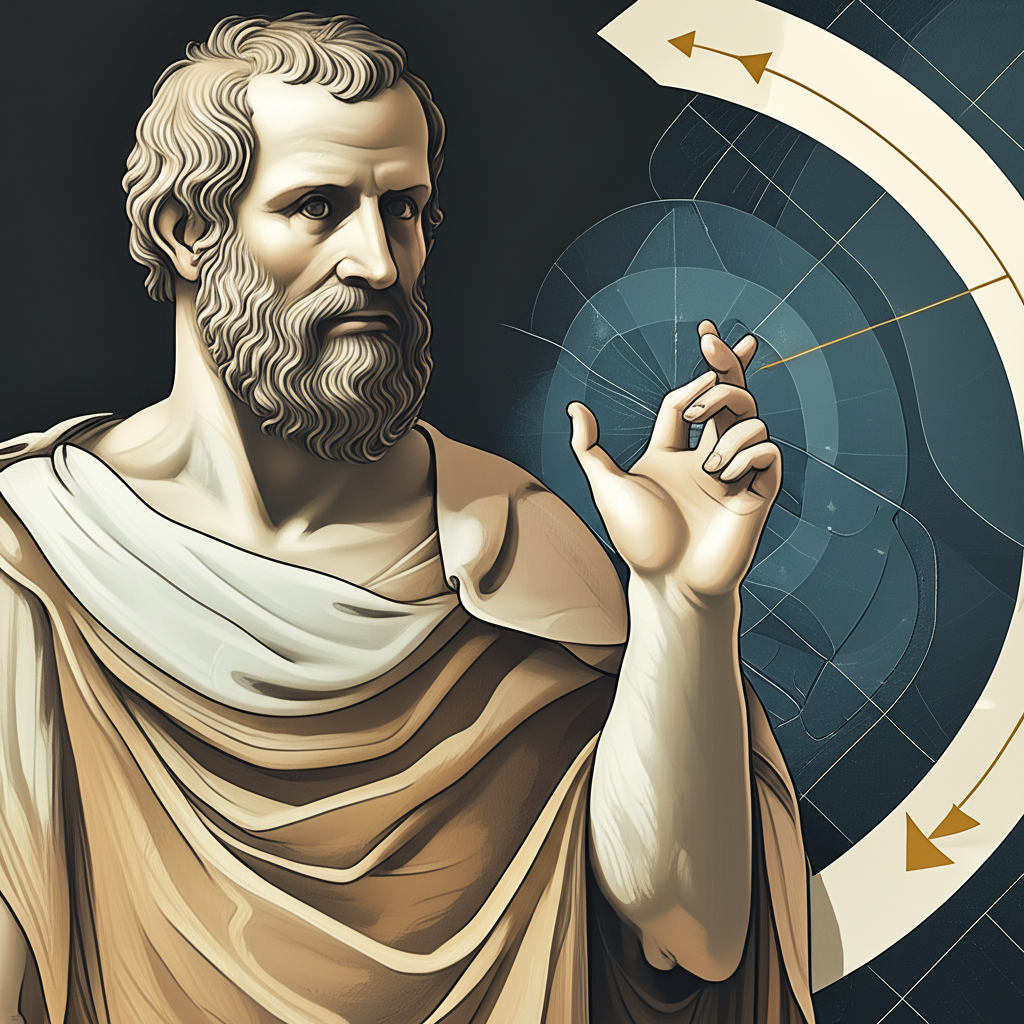 stands beside an armillary sphere, pointing towards the heavens, with a depiction of a flowing river representing time and a straight, infinite line representing Euclidean space. On the right, a more abstract, swirling representation of spacetime, with a distorted grid overlay, hinting at gravitational lensing and the interconnectedness of time and space, perhaps with a subtle nod to Einstein's theories. The overall image should convey the evolution of thought from discrete, observable measurements to a more integrated, relative understanding.)
The Philosophical Quandary of Measurement
While mathematics provides the indispensable tools for quantifying time and space, the philosophical questions persist. Is the quantity we measure an inherent property of reality, or is it a projection of our cognitive framework?
- The Problem of Infinitesimals: Zeno's paradoxes, for instance, challenged the very notion of infinitely divisible space and time, questioning how motion could ever begin or end if one had to traverse an infinite number of points. This highlights the limits of applying discrete mathematics to continuous phenomena.
- The Observer's Role: Quantum mechanics further complicates the picture, suggesting that the act of observation can influence the state of a system. Does this imply that our measurement of time and space is not merely passive observation but an active participation in their definition?
- Subjectivity vs. Objectivity: While scientific measurement strives for objectivity, our fundamental experience of time and space remains deeply subjective. A second can feel like an eternity, and a vast distance can seem negligible depending on our emotional state. Philosophy continues to explore the chasm between lived experience and quantifiable reality.
The ongoing philosophical quest for understanding the measurement of time and space reminds us that even our most precise scientific instruments are built upon conceptual foundations. It is through the rigorous inquiry of philosophy, drawing upon the insights of the Great Books of the Western World, that we continue to refine our understanding of these most fundamental dimensions, pushing the boundaries of what can be known and quantified.
📹 Related Video: ARISTOTLE ON: The Nicomachean Ethics
Video by: The School of Life
💡 Want different videos? Search YouTube for: ""Philosophical Theories of Time and Space Explained""
📹 Related Video: KANT ON: What is Enlightenment?
Video by: The School of Life
💡 Want different videos? Search YouTube for: ""Euclidean Geometry and Its Philosophical Implications""