

The Ineffable Quantity: Measuring Time and Space
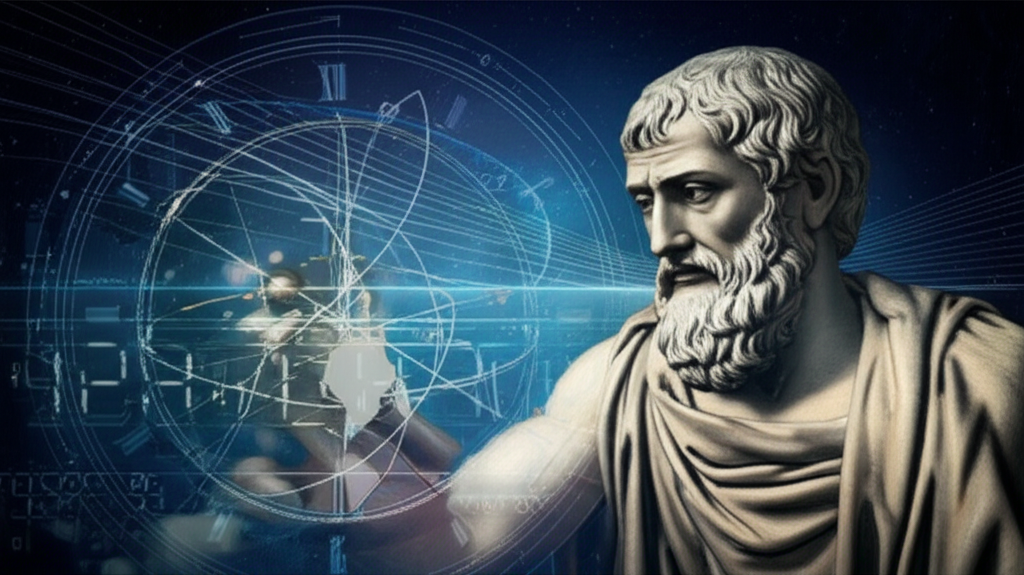
The human endeavor to comprehend Time and Space transcends mere observation; it is a profound philosophical journey into the very quantity of existence. From ancient cosmological observations to the intricate mathematics of modern physics, our attempts to measure these fundamental dimensions reveal as much about our conceptual frameworks as they do about the universe itself. This article explores the historical and philosophical challenges inherent in quantifying Time and Space, drawing upon seminal texts that have shaped our understanding.
The Elusive Quantity of Time: From Cosmic Cycles to Atomic Clocks
Our initial grasp of Time was inextricably linked to celestial mechanics—the rhythmic dance of the sun, moon, and stars. These predictable cycles provided the first natural units, allowing humanity to establish calendars and track seasons. Yet, the measurement of Time as a discrete quantity presented a deeper philosophical puzzle.
- Aristotle's Perspective: In his Physics, a cornerstone of the Great Books of the Western World, Aristotle famously defined Time not as motion itself, but as the "number of motion with respect to before and after." For him, Time was dependent on change and perception; if nothing changed, and no one observed it, Time would not exist as a measurable quantity. This relational view profoundly influenced subsequent thought.
- Newton's Absolute Time: Isaac Newton, whose Principia Mathematica also resides in the Great Books, posited "absolute, true, and mathematical Time, of itself, and from its own nature, flows equably without relation to anything external." This conception, independent of events or observers, provided a stable framework for his laws of motion, making Time a universal, unyielding quantity.
- Modern Revisions: Einstein's theories of relativity shattered Newton's absolute framework, demonstrating that Time is relative, its passage dependent on an observer's motion and gravitational field. The mathematics of spacetime revealed Time not as a separate entity, but as an integral dimension interwoven with Space. Today, atomic clocks, leveraging the precise quantity of atomic oscillations, measure Time with astonishing accuracy, yet the philosophical debate about its ultimate nature persists.
Key Philosophical Views on Time's Quantity
| Philosopher/Era | View on Time's Nature | Implication for Measurement |
|---|---|---|
| Aristotle | Relational, number of motion | Dependent on observable change |
| Newton | Absolute, independent flow | Universal, fixed quantity |
| Leibniz | Order of successive events | Quantity derived from relations |
| Kant | A priori intuition, form of inner sense | Not empirically derived, but a necessary framework for experience |
| Einstein | Relative, interwoven with Space | Quantity varies with observer and gravity |
Navigating the Quantity of Space: Euclidean Geometry and Beyond
If Time is the measure of sequence, Space is the measure of extension. Our understanding of Space as a measurable quantity began with practical concerns—surveying land, building structures—and quickly evolved into a sophisticated mathematics.
- Euclid's Foundation: Euclid's Elements, another essential text in the Great Books, codified the principles of geometry, providing the foundational mathematics for understanding Space. His axioms, such as "a straight line may be drawn between any two points," established Space as flat, infinite, and governed by predictable rules. The quantity of Space was understood in terms of points, lines, planes, and volumes, all precisely defined and measurable.
- Kant's A Priori Insight: Immanuel Kant, in his Critique of Pure Reason (also in the Great Books), argued that Space is not an empirical concept derived from experience, but an a priori intuition, a necessary "form of outer sense" that structures our perception of the world. We cannot conceive of objects without Space, suggesting its fundamental role in how we apprehend quantity and extension.
- The Rise of Non-Euclidean Geometries: The 19th century witnessed the development of non-Euclidean geometries by mathematicians like Lobachevsky and Riemann. These alternative mathematics described Space as curved, challenging the long-held assumption of Euclidean flatness. Philosophically, this opened the door to the idea that the quantity of Space might not be universally fixed, but rather dependent on its intrinsic curvature.
- Spacetime Curvature: Einstein's general relativity further cemented this idea, proposing that gravity is not a force but a manifestation of the curvature of spacetime caused by mass and energy. The quantity of Space (and Time) is therefore dynamic, shaped by the contents of the universe, and precisely calculable through advanced mathematics.
The Interplay of Mathematics and Reality: Do We Measure Reality, or Construct It?
The continuous refinement of our methods for measuring Time and Space highlights a crucial philosophical question: are we uncovering inherent quantities of the universe, or are we imposing our own mathematical constructs upon a reality that might be fundamentally different?
- Mathematics as Language: From the Pythagorean belief that "all is number" to Galileo's assertion that the book of nature is written in mathematical language, there's a strong tradition viewing mathematics not merely as a tool, but as the very grammar of reality. The precision with which mathematics describes the quantity of Time and Space seems to suggest a deep, intrinsic connection.
- The Problem of Abstraction: Yet, the abstract nature of mathematics raises doubts. When we speak of a "meter" or a "second," are these ideal quantities that exist independently, or are they human-defined units of measure, convenient for our understanding but not necessarily reflecting the raw, unquantified essence of Time and Space?
- The Limits of Measurement: The quantum realm presents another challenge. At the Planck scale, the very concepts of continuous Time and Space begin to break down, suggesting that below a certain quantity, our conventional measurements may cease to be meaningful. This pushes the philosophical boundary of what it even means to "measure" reality.
Ultimately, the quest to measure Time and Space is a testament to humanity's relentless curiosity. It is a journey guided by mathematics, driven by philosophical inquiry, and continuously refined by scientific discovery. As we gain ever more precise ways to quantify these fundamental aspects of existence, we are reminded that their true nature remains a profound and enduring mystery.
YouTube Video Suggestions:
-
📹 Related Video: ARISTOTLE ON: The Nicomachean Ethics
Video by: The School of Life
💡 Want different videos? Search YouTube for: "The Nature of Time - Aristotle vs Einstein Philosophy"
2. ## 📹 Related Video: KANT ON: What is Enlightenment?
Video by: The School of Life
💡 Want different videos? Search YouTube for: "What is Space? Brian Greene Euclid Einstein"