

Navigating the Cosmos: A Philosophical Journey Through the Measurement of Time and Space
The measurement of Time and Space is not merely a scientific endeavor; it is a profound philosophical quest that has shaped our understanding of reality itself. From ancient contemplations of Time as the measure of motion and Space as place, to the revolutionary insights of modern physics, our attempts to quantify these fundamental dimensions have continually challenged our perceptions. This article explores how Mathematics became the indispensable language for describing Quantity in the cosmos, revealing a universe far more intricate and dynamic than initially conceived, and leaving us with enduring questions about the true nature of existence.
The Unfolding Canvas: From Intuition to Quantification
How do we truly grasp Time? And what, precisely, is Space? These aren't just academic questions for the ivory tower; they are the bedrock upon which our entire experience of reality is built. For millennia, humanity has grappled with these concepts, initially through observation and intuitive understanding, and increasingly, through the rigorous lens of Mathematics. The journey from perceiving Time as the rhythm of seasons to understanding it as a dimension interwoven with Space is a testament to our relentless pursuit of knowledge.
Ancient Glimmers: Time as Motion, Space as Place
In the philosophical traditions that laid the groundwork for Western thought, particularly within the Great Books of the Western World, Time and Space were often understood in more qualitative terms. Aristotle, for instance, in his Physics, posited that Time is the number of motion with respect to "before" and "after". It wasn't an independent entity, but rather a property derived from change itself. Without change, there could be no Time. Similarly, Space was often conceived not as an empty void, but as "place" – the immediate boundary of a body, a container for existence.
- Aristotle's Perspective:
- Time: The measure of motion. Inseparable from the events occurring within it.
- Space: The "place" of a body, its inner boundary. Not an absolute void.
- Key Insight: This early view emphasized the relational aspect of Time and Space, deeply tied to the existence and movement of objects. The idea of Quantity here was nascent, emerging from the counting of changes or the delimitation of places.
This perspective, while perhaps less amenable to modern scientific measurement, offered a profound insight: Time and Space are not merely backdrops against which existence unfolds, but are intrinsically linked to the very act of existing and changing.
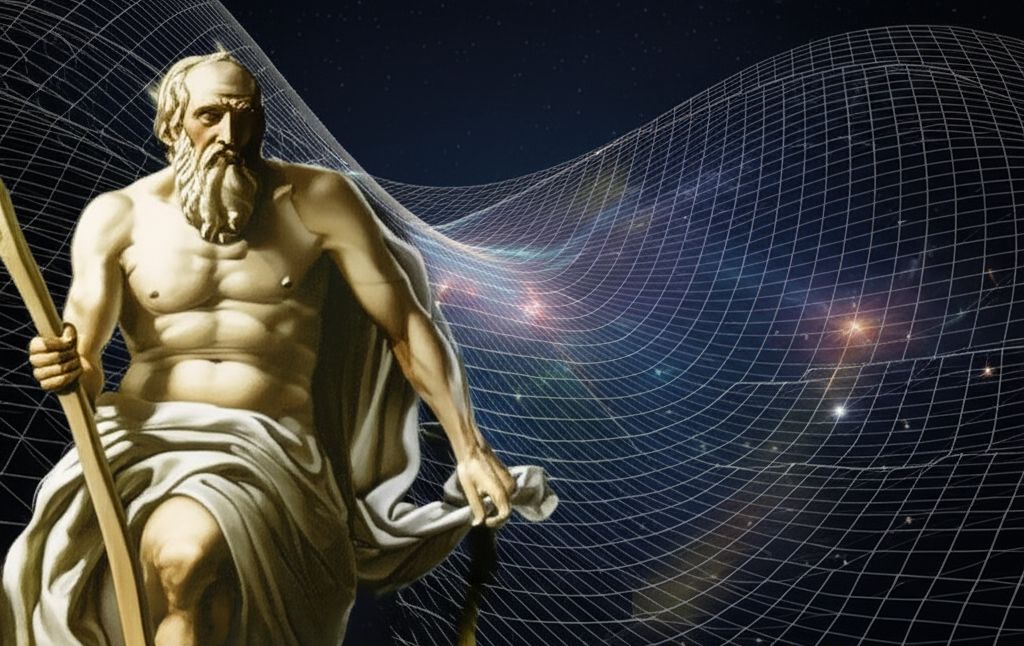
The Newtonian Revolution: Absolute Time and Space
The scientific revolution, profoundly influenced by figures like Isaac Newton, marked a pivotal shift in how we conceived of and measured Time and Space. Newton, in his Principia Mathematica, introduced the radical concepts of absolute, true, and mathematical Time, flowing equably without relation to anything external, and absolute Space, immutable and immovable, existing independently of any matter within it.
This was a profound departure. Time and Space were no longer merely relational properties of existing things; they became fundamental, objective frameworks. This conceptual leap paved the way for modern physics and the precise application of Mathematics to the cosmos.
The Power of Mathematics: Quantifying the Unseen
With Newton, Mathematics became the indispensable language for describing the universe. The laws of motion and universal gravitation relied on the precise Quantity of mass, distance, and duration.
- Absolute Time: Measured by clocks, independent of observer or event.
- Absolute Space: A three-dimensional coordinate system, providing a fixed reference.
- Mathematics as the Tool:
- Calculus: Essential for describing rates of change and accumulation over Time.
- Geometry: Provided the framework for measuring distances and positions in Space.
The ability to assign numerical values – quantities – to these abstract dimensions allowed for unprecedented predictive power and technological advancement. It was a testament to the idea that the universe was ordered, and its order could be expressed and understood through numerical relationships.
Einstein's Cosmic Reimagining: Relativity and Spacetime
Just when humanity thought it had a firm grasp on Time and Space, Albert Einstein, another towering figure whose works resonate through the Great Books, shattered the Newtonian paradigm. His theories of special and general relativity revealed that Time and Space are not absolute and separate entities, but rather relative and interwoven into a single, dynamic fabric known as spacetime.
The Interconnected Dimensions: A Unified Field
Einstein demonstrated that the measurement of Time and Space is dependent on the observer's relative motion. Time can dilate, and Space can contract. Gravity, far from being a force, is described as the curvature of spacetime caused by mass and energy.
- Key Relativistic Concepts:
- Time Dilation: Time passes differently for observers in relative motion.
- Length Contraction: Distances appear shorter for objects moving at high speeds.
- Spacetime Continuum: Time and Space are unified into a four-dimensional manifold.
- Mathematics' Evolving Role:
- Non-Euclidean Geometry: Essential for describing the curved spacetime.
- Tensor Calculus: The sophisticated mathematical language required to express the complex relationships within general relativity.
The philosophical implications are staggering: our intuitive, everyday experience of Time and Space is but a limited perspective on a much grander, more fluid reality. The Quantity of a second or a meter is no longer universally fixed but becomes context-dependent.
The Enduring Philosophical Quandary: What Does Measurement Truly Tell Us?
Despite the incredible precision afforded by modern Mathematics and physics, the philosophical questions surrounding the measurement of Time and Space persist. Are we measuring objective realities, or are we imposing human constructs onto the universe?
Philosophers like Immanuel Kant, exploring the limits of human understanding, argued that Time and Space are not properties of things-in-themselves, but rather a priori forms of our intuition – fundamental structures of the mind through which we perceive and organize experience. We can't know the world outside of these structures.
Questions for Reflection:
- Objectivity vs. Subjectivity: To what extent do our methods of measurement reveal an objective Quantity of Time and Space, versus reflecting the limitations and design of our cognitive faculties?
- The Nature of Reality: If Time and Space are relative, what does that imply about the "true" nature of reality independent of an observer?
- Beyond Mathematics? Can Mathematics, for all its power, ever fully capture the essence of Time and Space, or does it merely describe their measurable properties?
The journey from ancient philosophical contemplation to the cutting edge of theoretical physics highlights a continuous dialogue. Our ability to measure Time and Space with increasing accuracy, thanks to the elegant language of Mathematics, has profoundly deepened our understanding of the universe. Yet, each new discovery only seems to unveil further layers of mystery, reminding us that the fundamental nature of these dimensions remains a vibrant field for philosophical inquiry.
YouTube Video Suggestions:
-
📹 Related Video: ARISTOTLE ON: The Nicomachean Ethics
Video by: The School of Life
💡 Want different videos? Search YouTube for: ""Aristotle on Time and Motion Explained""
2. ## 📹 Related Video: ARISTOTLE ON: The Nicomachean Ethics
Video by: The School of Life
💡 Want different videos? Search YouTube for: ""Einstein's Relativity Explained Spacetime""