

The Enigmatic Language of Dreams: Decoding Sign and Symbol
Dreams are not merely random nocturnal phantasmagorias; they are a profound, often bewildering, expression of the human Mind, communicating through a unique lexicon of Sign and Symbol. This article explores how our Memory and Imagination coalesce with daily Experience to forge these symbolic narratives, offering a rich tapestry for philosophical inquiry into self-understanding and the deeper workings of consciousness. By distinguishing between the directness of a sign and the multi-layered depth of a symbol, we can begin to unlock the profound insights our dreams offer, revealing the hidden currents of our inner world.
The Foundation: Distinguishing Sign from Symbol
To truly appreciate the language of dreams, we must first establish a critical distinction, a cornerstone of semiotics and philosophy of language.
-
Signs: A sign is a direct, often conventional, indicator of something else. Its meaning is typically unambiguous and tied to a specific referent. Think of a traffic light: red means stop. In dreams, a sign might be a direct echo of a waking Experience – perhaps the specific sound of an alarm clock that means it's time to wake up, or a specific person's face representing that individual directly. The connection is largely one-to-one and functional.
-
Symbols: A symbol, by contrast, possesses a depth and resonance far beyond its immediate form. It represents something, often abstract or complex, and can carry multiple layers of meaning, drawing upon personal associations, cultural narratives, and even universal archetypes. A symbol invites interpretation rather than merely conveying information. For instance, water in a dream could symbolize emotion, purification, the subconscious, or life itself, depending on its context and the dreamer's Experience.
The dreaming Mind rarely operates in the straightforward realm of signs alone. Instead, it weaves intricate tapestries where familiar images and scenarios become potent symbols, rich with personal and universal significance.
Dreams: A Canvas for Memory and Imagination
Our nightly journeys into the dreamscape are a testament to the extraordinary power of our Memory and Imagination. The Mind, freed from the strictures of waking logic, actively processes and reconfigures the raw material of our daily Experience and stored memories.
-
Memory as Raw Material: Every sensation, conversation, emotion, and event from our waking lives contributes to a vast reservoir of memories. In dreams, these memories are not simply replayed; they are fragmented, recombined, and often distorted, serving as the building blocks for new narratives. A fleeting thought from yesterday, a childhood trauma, or an anticipated event can all resurface, transformed into symbolic representations.
-
Imagination as Architect: It is the Imagination that truly shapes these mnemonic fragments into coherent (or deliberately incoherent) dream sequences. This creative faculty allows for the juxtaposition of unrelated elements, the invention of impossible scenarios, and the personification of abstract concepts. The Mind uses imagination to craft metaphors and allegories, where an oppressive boss might appear as a menacing beast, or a looming deadline as an inescapable wall.
This interplay ensures that dream Sign and Symbol are deeply personal, yet often resonate with universal human themes.
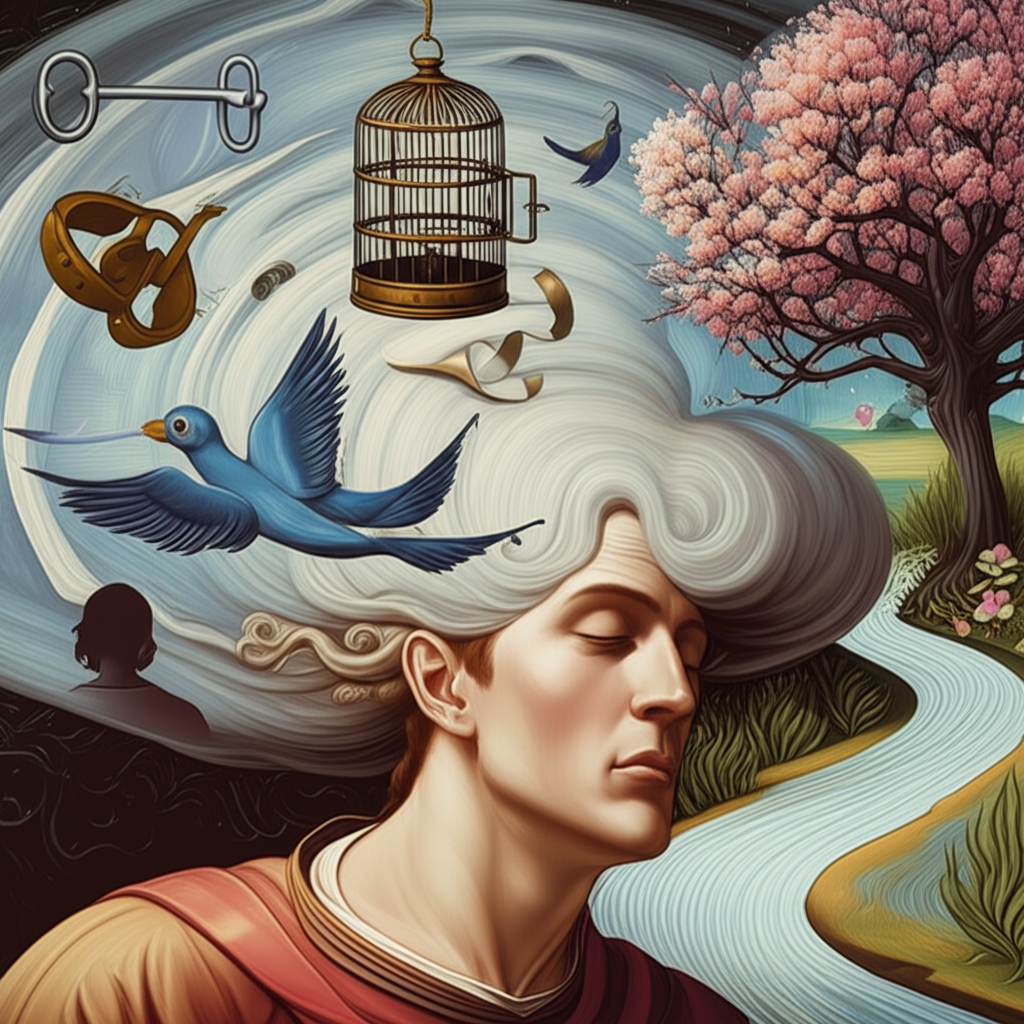
The Mind's Symbolic Language: Interpreting Dream Content
The philosophical tradition has long grappled with the meaning of dreams. From ancient Greek diviners to modern psychoanalysts, the quest to understand this nocturnal communication persists. Thinkers found in the Great Books of the Western World, from Aristotle's observations on the echoes of waking sensations to the later explorations of the subconscious, highlight the enduring fascination.
| Dream Element (Sign/Symbol) | Potential Interpretations (Symbolic) | Keywords Illustrated |
|---|---|---|
| Water (e.g., ocean, river, flood) | Emotions, the subconscious, purity, life, change, overwhelm | Sign and Symbol, Mind, Experience |
| Houses/Rooms (e.g., attic, basement) | Aspects of the self, the Mind's structure, personal space, hidden memories | Mind, Memory and Imagination |
| Animals (e.g., snake, bird, lion) | Instincts, traits (wisdom, freedom, courage), primal forces | Sign and Symbol, Experience |
| Journeys/Vehicles (e.g., car, train, flying) | Life path, progress, control, feeling of being stuck, escape | Experience, Imagination |
| Falling/Flying | Loss of control, freedom, aspiration, fear, vulnerability | Mind, Imagination |
These interpretations are not rigid rules, but rather starting points for a deeper self-reflection. The context of the dream, the dreamer's personal Experience, and their individual associations with the Sign and Symbol are paramount.
The Philosophical Quest for Meaning
Philosophers have often viewed dreams as a unique window into the human condition. For some, like Plato, dreams could be seen as a lower form of reality, mere shadows of true Forms. For others, particularly in later traditions influenced by figures like Freud and Jung, dreams became a crucial text for understanding the unconscious Mind, revealing repressed desires, anxieties, and universal human archetypes.
-
Freud's Perspective: Sigmund Freud, in The Interpretation of Dreams, distinguished between the "manifest content" (what the dream appears to be about) and the "latent content" (the hidden, symbolic meaning, often linked to repressed wishes). He saw dreams as a "royal road to the unconscious," where symbols acted as a disguise for unacceptable thoughts and desires.
-
Jung's Archetypes: Carl Jung expanded on this, introducing the concept of the "collective unconscious" and "archetypes" – universal patterns and images that appear across cultures and personal dreams. For Jung, symbols were not merely disguises but expressions of deeper truths, guiding the individual towards wholeness.
Both perspectives, though differing in their emphasis, underscore the profound importance of Sign and Symbol in dreams as a means by which the Mind communicates with itself, processing Experience and shaping identity through Memory and Imagination.
Conclusion: Embracing the Dream's Wisdom
The meaning of Sign and Symbol in dreams remains a fertile ground for philosophical exploration. Far from being random noise, our dreams offer a sophisticated, symbolic language through which our Mind processes Experience, synthesizes Memory and Imagination, and grapples with the fundamental questions of our existence. By engaging with this nocturnal dialogue, we not only gain insight into our individual selves but also connect with universal patterns of human thought and emotion, enriching our waking Experience and deepening our understanding of consciousness itself.
YouTube: "Freud Jung dream interpretation symbols"
YouTube: "Philosophy of Dreams ancient modern"
📹 Related Video: What is Philosophy?
Video by: The School of Life
💡 Want different videos? Search YouTube for: "The Meaning of Sign and Symbol in Dreams philosophy"