

The Nocturnal Language: Unpacking Sign and Symbol in Dreams
Dreams, those ephemeral experiences of the sleeping Mind, have long captivated philosophers and thinkers. They present a unique challenge to our understanding of consciousness, perception, and the very nature of reality. This article delves into the profound meaning of Sign and Symbol within the dreamscape, exploring how our Memory and Imagination coalesce into a tapestry of images drawn from our waking Experience. We will examine the philosophical underpinnings that help us distinguish between direct signs and rich, multi-layered symbols, ultimately seeking to illuminate the intricate workings of the human Mind as it constructs its nightly narratives.
The Labyrinthine Corridors of Consciousness: Dreams as Philosophical Inquiry
For millennia, from the ancient Greeks to the Enlightenment rationalists, the phenomenon of dreaming has been a fertile ground for philosophical exploration. Is a dream merely a physiological byproduct of a resting brain, or does it offer a privileged glimpse into deeper truths, perhaps even the soul itself? The "Great Books of the Western World" are replete with inquiries into the nature of perception, the distinction between reality and illusion, and the sources of human knowledge—all questions that resonate deeply when we consider the vivid yet often perplexing world of dreams. To truly grapple with their meaning, we must first understand the fundamental tools the Mind employs within them: signs and symbols.
Distinguishing Sign and Symbol in the Dreamscape
While often used interchangeably, the terms "sign" and "symbol" carry distinct philosophical weight, particularly when applied to dreams. Understanding this difference is crucial for any meaningful interpretation.
- Signs in dreams tend to be more direct, referential, and often tied to immediate waking Experience. They point to something specific, much like a road sign points to a destination. If you are worried about an upcoming exam and dream of a ticking clock, the clock might function as a sign of your anxiety about time running out. Their meaning is often more universal or context-dependent within your recent Experience.
- Symbols, by contrast, are richer, more complex, and carry a multiplicity of meanings. They often transcend individual Experience to tap into deeper, perhaps universal, human archetypes or profound personal significance. A dream of a vast, uncharted ocean could symbolize the unconscious Mind, the journey of life, or an overwhelming emotional state. Its meaning is not singular but resonates on many levels, inviting deeper reflection and personal connection.
The Mind, in its nocturnal activity, does not merely present raw data; it processes and transforms our Experience into these intricate forms.
| Feature | Sign in Dreams | Symbol in Dreams |
|---|---|---|
| Nature | Direct, referential, often context-specific | Indirect, multi-layered, evocative |
| Meaning | Points to a specific idea, event, or feeling | Represents a complex idea, emotion, or archetype |
| Origin | Often from recent waking Experience or clear associations | Can draw from deep Memory, cultural understanding, or universal human themes |
| Interpretation | More straightforward, often conscious connection | Requires deeper reflection, personal association, and intuition |
| Philosophical Link | Empiricist view (direct sensory input) | Idealist/Platonic view (deeper forms, universal truths) |
Memory, Imagination, and the Architecture of Dreams
The very fabric of our dreams is woven from the threads of Memory and Imagination. Aristotle, in his treatises on the soul, recognized that dreams are often composed of the "phantasms" or images left behind by sensory Experience. These residual impressions, stored in our Memory, are then actively recombined and reconfigured by the Imagination during sleep.
Consider Plato's allegory of the cave: just as the prisoners perceive shadows as reality, our dreams often present us with shadows of our waking world, distorted and recontextualized. The Mind, freed from the immediate constraints of external reality, uses its imaginative faculty to blend fragments of past events (memory) with novel scenarios and characters (imagination). This interplay allows for the creation of compelling narratives, even if they seem illogical upon waking. A dream might feature a person from your distant past, in a setting you've never visited, performing an action that combines several anxieties from your current Experience. Here, Memory provides the characters and elements, while Imagination crafts the surreal plot, using Sign and Symbol to convey underlying messages.
The Mind's Canvas: Experience and Interpretation
Our waking Experience is the raw material from which dreams are forged. John Locke, emphasizing empiricism, argued that all our ideas originate from Experience—either through sensation or reflection. In dreams, the Mind takes these simple ideas garnered from daily life and combines them into complex, often fantastic, new arrangements. A dream of flying might be a complex idea born from countless simple ideas of freedom, height, movement, and perhaps even a childhood story.
The challenge, as Descartes famously highlighted, lies in distinguishing the vividness of a dream from the clarity of waking reality. This philosophical quandary underscores the power of the Mind to construct entire worlds within itself, worlds that feel entirely real until we awaken. The interpretation of these dream worlds, therefore, becomes an act of philosophical reflection—an attempt to understand how our Mind structures Experience even in its most uninhibited state. By deciphering the Sign and Symbol presented to us in dreams, we gain insight into our deepest fears, desires, and unresolved conflicts, all filtered through the unique lens of our individual Experience.
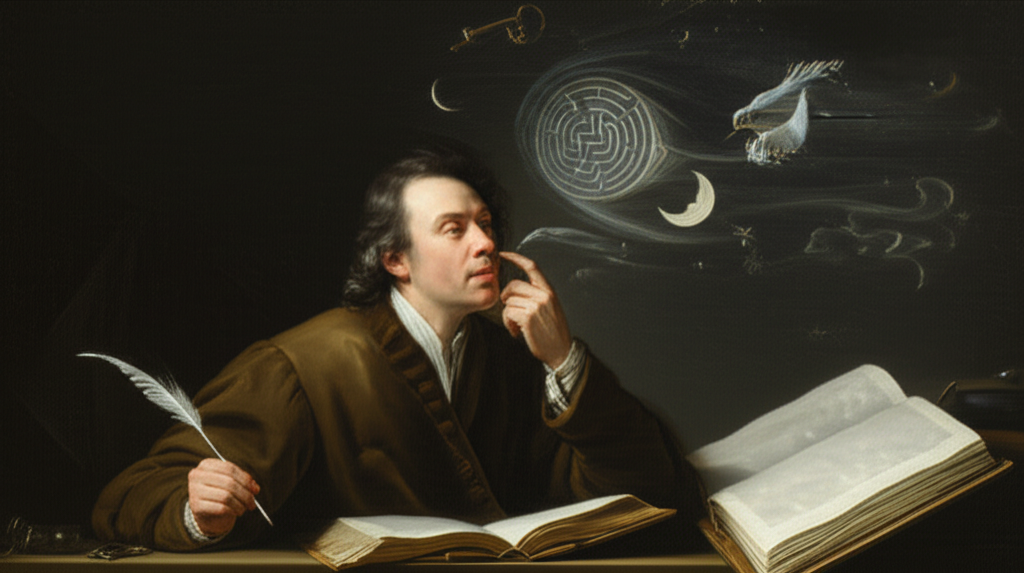
The Enduring Philosophical Inquiry
The study of Sign and Symbol in dreams remains a profound philosophical endeavor. It forces us to confront the boundaries of consciousness, the reliability of perception, and the intricate relationship between our inner and outer worlds. By paying attention to the unique language our Mind employs during sleep, we engage in a timeless quest for self-knowledge, echoing the inquiries of the great thinkers who sought to understand the full spectrum of human Experience. The dream is not merely a fleeting image; it is a complex philosophical text, written in the ancient script of Sign and Symbol, waiting for us to learn its meaning.
📹 Related Video: PLATO ON: The Allegory of the Cave
Video by: The School of Life
💡 Want different videos? Search YouTube for: ""Plato's Allegory of the Cave explained"
YouTube: "Aristotle on Memory and Imagination""