

Beyond the Surface: The Matter-Form Distinction and What It Means for How We See the World
Hey there, fellow truth-seekers! Ever stopped to truly ponder what makes up the physical objects around us? Is a chair just wood, or is there something more? Is a human being merely a collection of biological components? This isn't just a whimsical thought experiment; it's a profound philosophical inquiry that lies at the heart of how we understand reality. Today, we're diving into one of the most foundational concepts from the annals of philosophy, particularly from the Great Books of the Western World: the matter-form distinction. This idea, championed by Aristotle, offers a powerful lens through which to analyze the very fabric of physical existence, bridging the gap between what things are made of and what they are. It’s a concept that, while ancient, continues to resonate in both physics and metaphysics, providing an enduring framework for understanding change, identity, and substance.
The Ancient Genesis: Aristotle and Hylomorphism
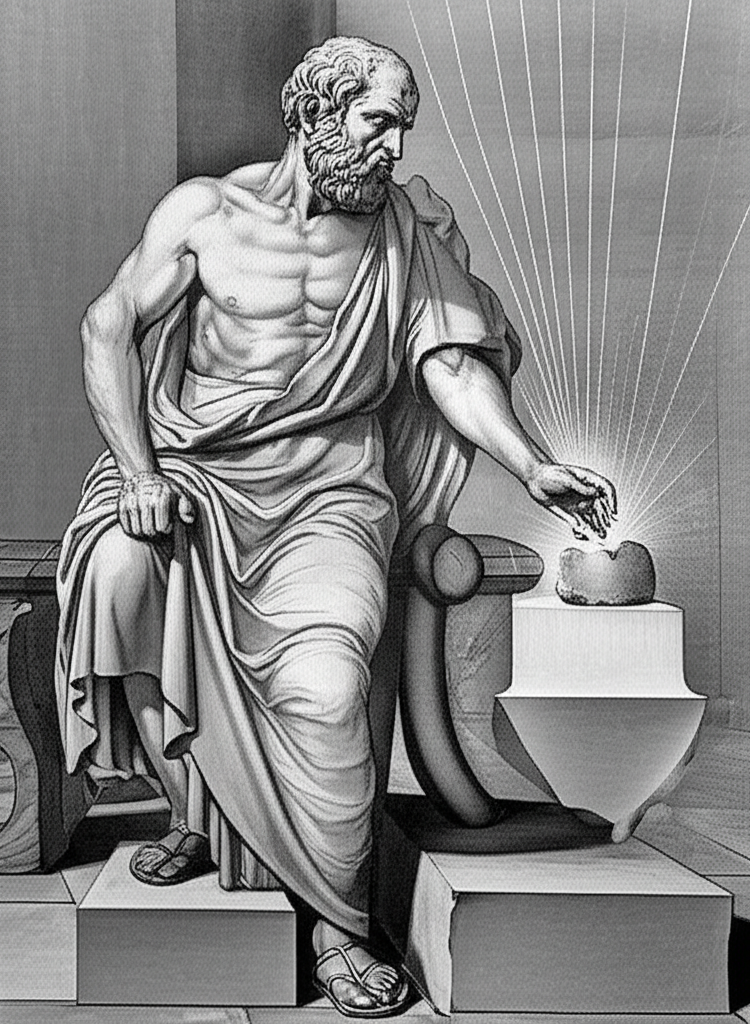
Our journey begins, as so many philosophical explorations do, with Aristotle. Within the pages of the Great Books of the Western World, particularly in works like Physics and Metaphysics, Aristotle introduces the concept of hylomorphism – a term derived from the Greek words hyle (matter) and morphe (form). For Aristotle, every individual physical object is a composite of these two inseparable principles: matter and form.
Imagine a lump of clay. It’s just... clay. But when a sculptor shapes it into a statue, that clay takes on a form. It’s still clay, but now it's formed clay, a statue. Aristotle argued that this isn't just an analogy for art; it's how all physical things exist. They possess underlying matter (the potential, the stuff) and an organizing form (the actuality, the structure, the essence).
Deconstructing Reality: What are Matter and Form?
To truly grasp this distinction, let's break down each component:
What is Matter?
In the Aristotelian sense, matter isn't merely the "stuff" we can touch and feel, like wood or metal. It refers to the potentiality within an object – its capacity to be structured in various ways.
- Prime Matter: This is a purely theoretical concept, the ultimate substratum that has no form of its own, but is the pure potentiality for all forms. It's never found in isolation; it only exists as actualized by form. Think of it as the ultimate "raw material" of the universe.
- Proximate Matter: This is what we typically encounter. It's matter that already has some form but can take on another. For example, bronze is the proximate matter for a statue, and wood is the proximate matter for a chair. Bronze itself has its own form, but it's matter relative to the form of a statue.
What is Form?
Form, on the other hand, is the actuality of an object. It's what makes a thing what it is. It's the organizing principle, the structure, the essence that gives matter its specific identity and function.
- Substantial Form: This is the most crucial type of form. It's what defines a thing's fundamental nature or essence, making it a member of a particular species. For instance, the substantial form of a human being is what makes us human, distinct from a cat or a tree. It's not just our shape, but our capacity for reason, our specific biological organization. This form dictates what an object is.
- Accidental Form: These are properties that an object can gain or lose without changing its fundamental nature. For example, a human can be tall or short, happy or sad, have dark hair or light hair. These are accidental forms; they describe how a thing is, but don't change what it is.
The Inseparable Duo: How Matter and Form Intersect
It's vital to understand that in any physical object, matter and form are not separate entities that can exist independently. They are two co-principles that are always found together. You can't have matter without some form, and you can't have a form of a physical object without matter to actualize it. They are like two sides of the same coin, or perhaps more accurately, like the specific arrangement (form) of bricks (matter) that creates a house. The house isn't just a pile of bricks, nor is it an abstract idea of a house; it's the bricks arranged in the form of a house.
This dynamic interplay is what allows for change. When an object undergoes change (e.g., a tree becomes a table), its matter persists (the wood), but its form changes (from tree-form to table-form). This provides a coherent explanation for how things can change yet retain some underlying continuity.
Relevance Beyond Antiquity: Physics, Metaphysics, and Modern Echoes
The matter-form distinction isn't just a historical curiosity; its influence extends deeply into subsequent philosophical and scientific thought.
- In Physics: While modern physics operates on different principles (quantum mechanics, relativity), Aristotle's concern with change and the composition of things laid foundational groundwork. His questions about what persists and what changes are still central, even if the answers are vastly different. The idea of fundamental particles (matter) combining into complex structures (forms) has a distant, conceptual echo of hylomorphism.
- In Metaphysics: This distinction is absolutely central to understanding questions of substance, identity, and being. What makes a thing this thing and not another? How does something maintain its identity over time despite undergoing change? The matter-form composite offers a robust answer, suggesting that identity is tied to the substantial form, which organizes and actualizes the matter. It helps us differentiate between a collection of parts and a unified, coherent whole.
Consider the following table to visualize the distinction:
| Feature | Matter (Hyle) | Form (Morphe) |
|---|---|---|
| Nature | Potentiality, raw stuff, substratum | Actuality, organizing principle, essence, structure |
| Role | That out of which something is made | That by virtue of which something is what it is |
| Examples | Wood for a table, bronze for a statue, flesh/bones for a human | The design of a table, the shape of a statue, the soul/rationality of a human |
| Change | Persists through change | Is gained or lost during substantial change |
| Existence | Never exists without form (except Prime Matter) | Never exists without matter (for physical objects) |
Conclusion: A Timeless Framework for Understanding
The matter-form distinction, as articulated by Aristotle and studied within the Great Books of the Western World, provides an incredibly powerful and elegant framework for understanding the physical world. It helps us move beyond merely seeing objects as collections of parts, instead recognizing them as unified wholes where the "what it is" (form) is inextricably linked to the "what it's made of" (matter). From the simplest stone to the most complex living organism, this ancient wisdom continues to offer profound insights into the nature of reality, reminding us that there's always more to things than meets the eye.
📹 Related Video: ARISTOTLE ON: The Nicomachean Ethics
Video by: The School of Life
💡 Want different videos? Search YouTube for: "Aristotle Matter and Form Explained"
📹 Related Video: What is Philosophy?
Video by: The School of Life
💡 Want different videos? Search YouTube for: "Hylomorphism Philosophy Simple Explanation"