

The Enduring Dance of Being: Unpacking the Matter-Form Distinction in Physical Objects
Have you ever looked at something – say, a sturdy oak table – and wondered what truly makes it what it is? Is it the wood itself, or the way the wood is shaped and organized? This isn't just a casual thought; it's a question that lies at the heart of one of philosophy's most profound and enduring insights: the matter-form distinction. Originating with Aristotle, this concept offers a powerful framework for understanding the very fabric of physical reality, positing that every tangible object is an inseparable composite of two fundamental principles: its underlying matter and its defining form. It’s a distinction that delves into both Physics – how things are put together – and Metaphysics – what they essentially are.
Unveiling the Aristotelian Foundation
To truly grasp the matter-form distinction, we must journey back to the ancient Greek philosopher, Aristotle. In his seminal works, particularly Physics and Metaphysics, he grappled with the problem of change and identity. How can something change, yet remain the same thing? His brilliant solution was to propose that everything in the sensible world is a hylomorphic compound – a composite of hyle (matter) and morphe (form).
This wasn't just an abstract idea; it was a way to make sense of the world around us, from the growth of a plant to the construction of a house. It allowed for a coherent understanding of how things come into being, persist, and pass away.
What is Matter? The Principle of Potentiality
When we talk about matter in this philosophical sense, we're not simply referring to the stuff that physicists study, though that's certainly related. For Aristotle, matter is the potentiality for something to be. It is the raw, indeterminate substratum that receives and supports form. Think of it as the 'what-it-is-made-of' aspect:
- Indeterminate: By itself, matter is formless and undifferentiated. It lacks specific characteristics.
- Receptive: It is the capacity to take on various forms. Clay, for instance, is matter that can become a pot, a brick, or a sculpture.
- Potentiality: Matter is what can be something. A block of marble has the potential to be a statue.
- Substratum: It is the underlying stuff that persists through change. When a tree is cut down and made into a table, the wood (matter) remains, but its form changes.
Without form, matter is merely pure potentiality – something we can only conceive of, but never actually encounter in isolation in the physical world.
What is Form? The Principle of Actuality
If matter is potentiality, then form is actuality. Form is what makes something what it is. It is the organizing principle, the essence, the structure, and the purpose (telos) that actualizes the potentiality of matter.
- Definitive: Form provides the specific characteristics and boundaries of an object. The form of a table is what makes it a table, not a chair or a lump of wood.
- Actualizing: It brings matter into a determinate state. The form of a statue actualizes the potential within the marble.
- Essence: Form defines the "whatness" (quiddity) of a thing. It’s what allows us to identify and categorize objects.
- Structure and Organization: It dictates how the matter is arranged and functions. The form of a living organism, for example, is its soul or animating principle, organizing its biological matter into a coherent, functioning whole.
Consider the following examples:
| Object | Matter (Potentiality) | Form (Actuality) |
|---|---|---|
| Bronze Statue | Bronze (metal) | The specific shape, design, and artistic intent |
| Human Being | Flesh, bones, organs | Rational soul, specific biological organization |
| Wooden Chair | Wood (cellulose, fibers) | The design, structure, and function of a chair |
| Water | Hydrogen and Oxygen atoms | The specific molecular structure (H₂O) |
The Inseparable Union: Hylomorphism
The crucial point of the matter-form distinction is that, in physical objects, matter and form are not typically found in isolation. They are inextricably linked, forming a composite whole. You never encounter pure form floating around, nor do you encounter pure matter without some kind of form. An uncarved block of marble still has the form of "block of marble"; it's just a less specific form than that of a statue.
This union, known as hylomorphism, explains both the stability and the changeability of the world. An object maintains its identity (its form) even as its material components might slightly alter, and it can undergo significant change by acquiring a new form from its existing matter.
Beyond the Physical: Metaphysical Implications
While rooted in observations of the natural world, the matter-form distinction quickly branches into profound Metaphysics. It provides a framework for understanding:
- Substance: Aristotle considered the composite of matter and form to be the primary substance.
- Causality: Form often functions as the formal cause (what something is) and the final cause (its purpose), while matter serves as the material cause (what it's made of).
- Identity: It helps explain how an individual can persist through time despite continuous material change (e.g., cell turnover in a human body). The form of "human being" remains, even as the matter changes.
- Knowledge: To know something fully is to grasp both its material components and its defining form.
A Timeless Framework for Understanding Reality
The matter-form distinction, though ancient, continues to resonate. While modern Physics has delved into subatomic particles and quantum fields, offering incredibly detailed insights into the material composition of the universe, the philosophical question of how these components are organized into coherent, identifiable objects, and what gives them their specific nature, remains a vital area of inquiry. It reminds us that understanding reality isn't just about dissecting the parts, but also about appreciating the unifying principles that bring them to life.
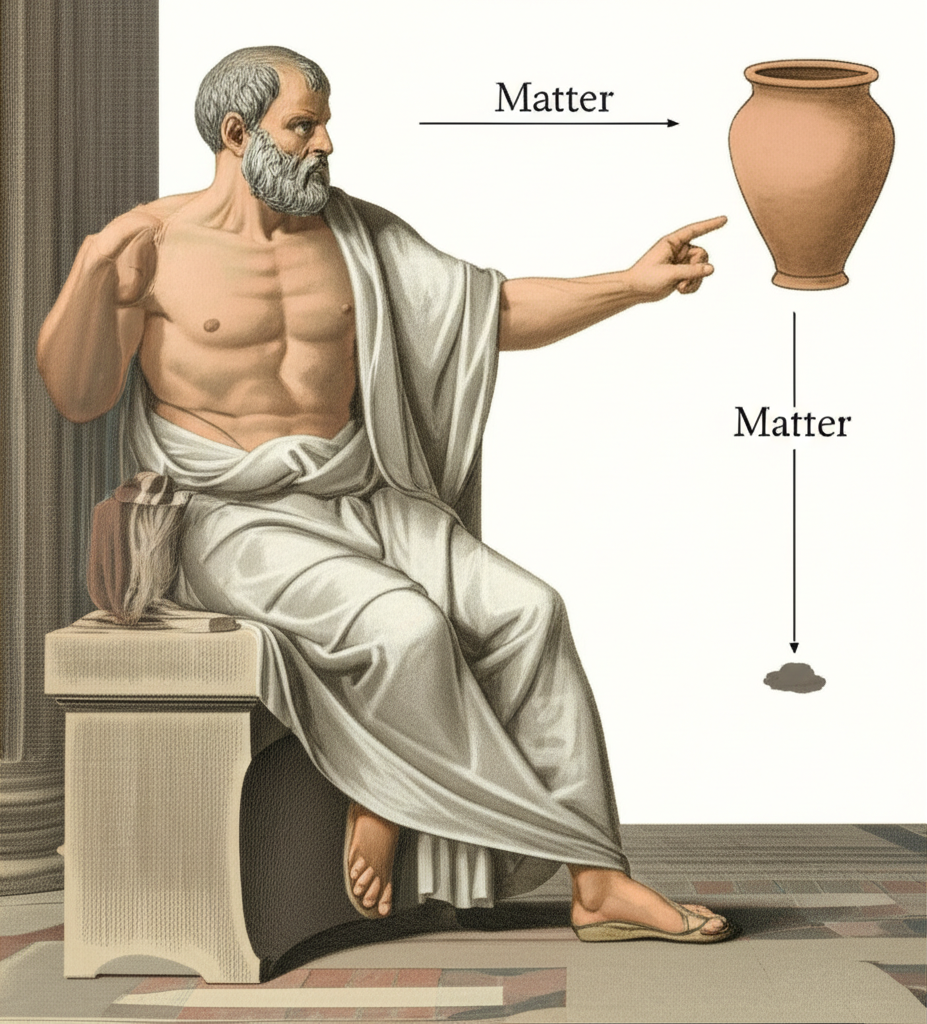 and another arrow pointing to the distinct shape and structure of the pot (labeled "Form"). The background could feature elements of an ancient library or academy.)
Explore Further:
To deepen your understanding of this foundational concept, consider exploring these topics:
-
📹 Related Video: ARISTOTLE ON: The Nicomachean Ethics
Video by: The School of Life
💡 Want different videos? Search YouTube for: "Aristotle Hylomorphism Explained"
-
📹 Related Video: ARISTOTLE ON: The Nicomachean Ethics
Video by: The School of Life
💡 Want different videos? Search YouTube for: "Matter and Form in Metaphysics - An Introduction"