

Unpacking Reality: The Matter-Form Distinction in Physical Objects
The Building Blocks of Being: An Essential Philosophical Insight
Have you ever stopped to truly ponder what makes a physical object what it is? Why is a lump of clay different from a statue, even though both are made of clay? This isn't just a whimsical question; it's a fundamental inquiry that lies at the heart of classical metaphysics, giving rise to one of philosophy's most enduring and insightful concepts: the matter-form distinction. In essence, this idea, most prominently articulated by Aristotle, posits that every physical object is a composite of two inseparable principles: its matter (what it's made of) and its form (what makes it that specific thing). This distinction is not merely an academic exercise; it provides a profound framework for understanding change, identity, and the very nature of reality, bridging ancient thought with our modern understanding of physics.
The Dual Nature of Existence: Matter and Form Defined
To truly grasp the world around us, we must look beyond the surface. Ancient philosophers, particularly Aristotle, recognized that physical objects aren't just undifferentiated stuff. They possess an inherent structure and purpose.
What is Matter?
- Matter, in this philosophical sense, refers to the indeterminate substratum, the raw potentiality from which a thing is made. Think of it as the 'stuff' or 'material cause'. It's what can be something, but isn't yet.
- Examples: The bronze of a statue, the wood of a table, the biological tissues of a human body.
- Aristotle posited a concept of "prime matter" – a purely indeterminate, featureless substratum that underlies all physical reality. It's never found in isolation, always actualized by some form.
What is Form?
- Form, on the other hand, is the organizing principle, the essence, the structure, or the 'whatness' of a thing. It's what makes the matter this particular thing rather than something else. It's the 'formal cause'.
- Examples: The specific shape and design of the statue, the blueprint and function of the table, the soul (as the animating principle) of a human being.
- The form provides actuality to the matter, giving it its specific characteristics, properties, and purpose. It's not just shape; it's the essence that defines the object's kind.
Think of it this way: You can have a pile of bricks (matter), but it's only when those bricks are arranged according to a specific design (form) that you get a house. The bricks are the potentiality; the house's structure is the actuality.
Aristotle's Hylomorphism: A Unified Vision
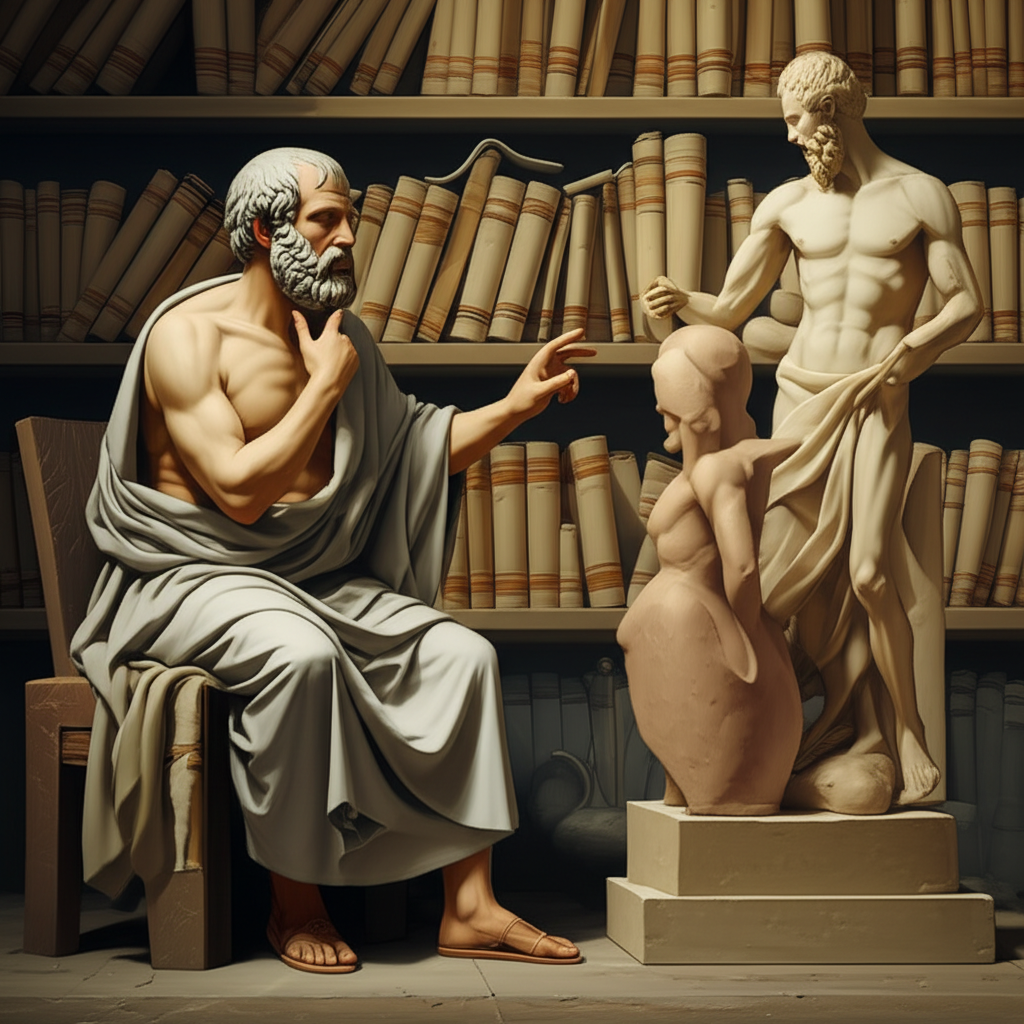
The brilliance of Aristotle's contribution, often termed hylomorphism (from the Greek hyle for matter and morphe for form), lies in his assertion that matter and form are not separate entities floating independently (as Plato's Forms sometimes suggested), but rather co-principles that are inseparable in any concrete physical object. A statue cannot exist without bronze, and bronze, once formed into a statue, is no longer just raw bronze; it's bronze-in-the-form-of-a-statue.
This insight from the Great Books of the Western World, particularly Aristotle's Physics and Metaphysics, provided a powerful solution to the age-old philosophical problem of change. How can something change (acquire new forms) yet remain the same thing (retain its underlying matter)? The matter-form distinction offers a coherent explanation.
The Enduring Relevance: Physics, Metaphysics, and Identity
The matter-form distinction isn't confined to ancient texts; its implications resonate through various fields of inquiry, from the fundamental questions of metaphysics to the practical observations of physics.
Key Implications:
- Understanding Change: When an object changes, it often involves a change of form while the underlying matter persists. A tree grows from a seed: the matter (nutrients, water) is constantly being re-formed into the structure of the tree. When a statue melts, its form is lost, but the bronze matter remains.
- Establishing Identity: What makes a human being a human being, and not merely a collection of biological components? It's the specific form that organizes that matter into a living, thinking organism. The form dictates the kind of thing it is.
- Scientific Inquiry: While modern physics delves into the most minute particles, the philosophical concept of form still underpins our understanding of how those particles arrange themselves into stable structures, molecules, and complex systems. The laws of physics themselves can be seen as descriptions of the forms that matter can take.
- Art and Creation: Every act of creation, from sculpting to coding, involves imposing a form upon matter (or information).
Matter vs. Form: A Comparison
| Feature | Matter | Form |
|---|---|---|
| Nature | Potentiality, Indeterminate, Substratum | Actuality, Determinate, Essence, Organizing Principle |
| Role | What a thing is made of | What makes a thing what it is |
| Change | Persists through change (often) | Can be acquired or lost |
| Perception | Perceived indirectly (as something formed) | Perceived directly (the shape, structure, function) |
| Examples | Clay, wood, atoms, biological compounds | Statue's shape, table's design, human soul, species |
The Enduring Philosophical Quest
The matter-form distinction invites us to look beyond superficial appearances and delve into the deeper principles that govern existence. It challenges us to consider not just what things are made of, but how they are organized and what makes them uniquely themselves. This fundamental insight, cultivated by ancient Greek philosophers, remains a cornerstone of philosophical inquiry, reminding us that reality is a dynamic interplay of potentiality and actuality, of the raw stuff and the defining essence. It's a lens through which we can better understand everything from the smallest particle to the grandest cosmos.
YouTube Suggestions:
- "Aristotle's Hylomorphism Explained"
- "Matter and Form in Metaphysics"
📹 Related Video: What is Philosophy?
Video by: The School of Life
💡 Want different videos? Search YouTube for: "The Matter-Form Distinction in Physical Objects philosophy"