

The Enduring Dance of Potential and Actuality: Understanding the Matter-Form Distinction in Physical Objects
At the heart of understanding the very fabric of reality lies a distinction as ancient as philosophy itself: the interplay between matter and form. This foundational concept, deeply rooted in the works of Aristotle and explored extensively throughout the Great Books of the Western World, offers a profound lens through which to examine physical objects, their identity, and their changes. Far from being a mere historical curiosity, the matter-form distinction, or hylomorphism, provides a powerful framework that continues to resonate in contemporary physics and metaphysics, helping us grapple with fundamental questions about substance, potentiality, and actuality.
Unpacking the Hylomorphic Core
To truly grasp the significance of matter and form, we must turn to its most articulate proponent: Aristotle. In his seminal works, particularly Physics and Metaphysics, Aristotle introduced this distinction as a way to explain how things come into being, persist, and change. He observed that everything in the sensible world is a composite, not a simple unity.
Matter: The Principle of Potentiality
Matter (from the Greek hyle) can be understood as the underlying substratum, the raw material, or the potentiality of a thing. It is that out of which something is made. Consider a bronze statue: the bronze itself is the matter. Before it takes the shape of a hero or a deity, the bronze exists as pure potential for many forms. It lacks definition and specific identity on its own, serving as the receptive principle.
Key Characteristics of Aristotelian Matter:
- Indeterminate: Lacks specific shape, size, or qualities until informed.
- Potentiality: The capacity to become something specific.
- Substratum: That which underlies change; it persists through change.
- Relative: What is matter for one thing might be form for another (e.g., bricks are matter for a house, but each brick has its own matter and form).
Form: The Principle of Actuality
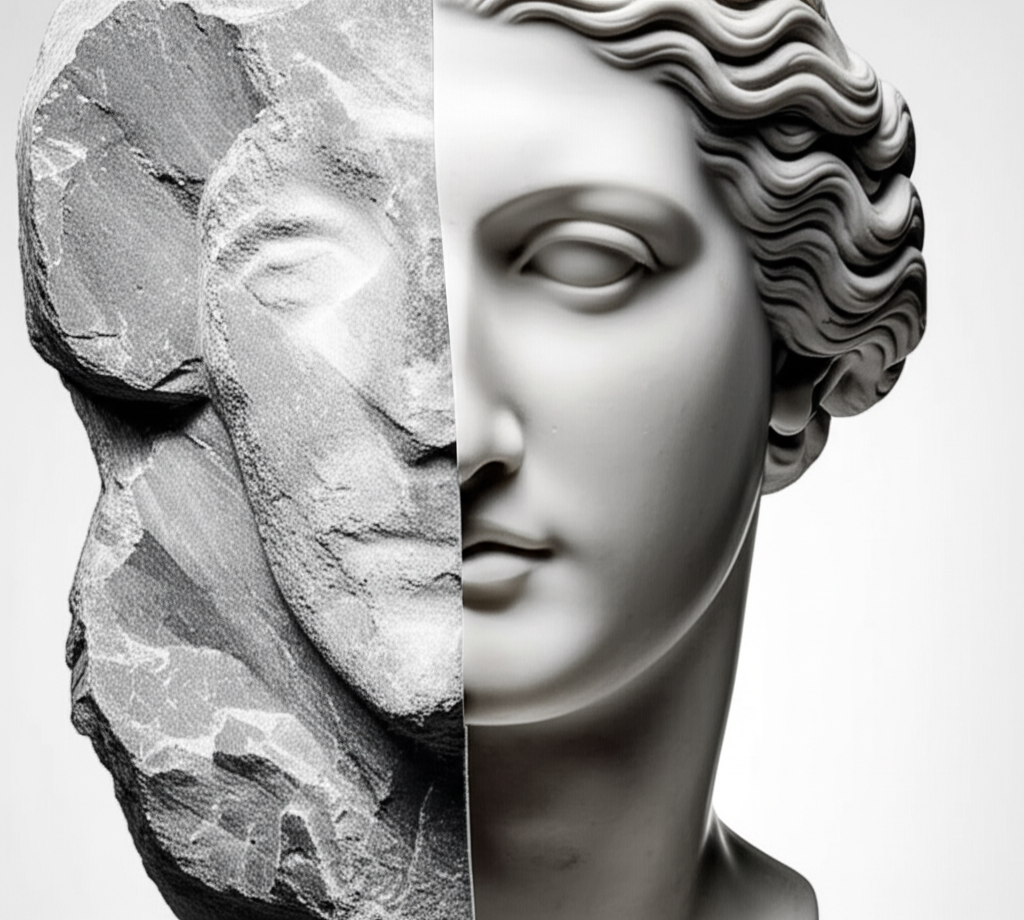
Form (from the Greek morphe or eidos) is what gives matter its specific identity, structure, and essence. It is the whatness of a thing, its organizing principle that actualizes the potential inherent in matter. For our bronze statue, the form is the specific shape of the hero, the design that transforms the undifferentiated bronze into a recognizable, functional, and meaningful object. This form makes it this particular statue, rather than a lump of bronze or a different statue.
Key Characteristics of Aristotelian Form:
- Determinate: Provides specific qualities, structure, and essence.
- Actuality: Makes something what it actually is.
- Essence: Defines the nature of the object.
- Organizing Principle: Gives coherence and purpose to matter.
The Distinction in Physical Objects: Everyday Examples
The beauty of the matter-form distinction lies in its intuitive applicability to the world around us.
| Object | Matter (Potentiality) | Form (Actuality) |
|---|---|---|
| House | Bricks, wood, cement, glass | Architectural design, layout, "houseness" |
| Human Being | Flesh, bones, organs, chemical compounds | Rational soul, specific individual identity, consciousness |
| Tree | Cellulose, water, minerals | Species-specific structure (e.g., oakness), growth pattern |
| Chair | Wood, plastic, metal | Design, function (for sitting), "chairness" |
In each case, the matter is the stuff that can be organized, and the form is the organization that makes it a specific kind of thing. Change, from this perspective, is often understood as the same matter taking on a new form, or a different matter embodying the same form. For instance, a sculptor might melt down a bronze statue (changing its form) but retain the same bronze matter.
Enduring Relevance in Physics and Metaphysics
While originating in ancient Greece, the matter-form distinction continues to inform discussions in contemporary physics and metaphysics.
Modern Physics and Emergent Properties
In physics, we might not speak of "matter" and "form" in the same explicit philosophical terms, but analogous concepts persist. Consider the fundamental particles that constitute all matter. These particles (quarks, leptons, bosons) are the "matter" in a sense, but it is their specific arrangements, interactions, and fields ("form") that give rise to the complex structures we observe: atoms, molecules, and ultimately, macroscopic objects with emergent properties. The "form" of a water molecule (H2O) gives it properties entirely different from its constituent hydrogen and oxygen atoms.
Metaphysics: Identity, Change, and Substance
In metaphysics, the matter-form distinction remains crucial for understanding:
- Identity: What makes an object the same object over time, despite changes to its matter (e.g., a ship whose planks are replaced over decades)? The persistence of its form often plays a key role.
- Change: How can something change and yet remain the same thing? Aristotle's solution was that the matter persists while the form changes (e.g., an acorn's matter takes on the form of an oak tree).
- Substance: What constitutes a fundamental "substance"? For Aristotle, a primary substance is an individual composite of matter and form, an ensouled body in the case of living things, or a specific object like a statue.
The profound insight of the matter-form distinction is its ability to bridge the gap between the chaotic potential of the undifferentiated and the ordered actuality of the particular. It reminds us that reality is not merely a collection of inert particles, but a dynamic interplay where structure, purpose, and essence are as fundamental as the stuff they organize. It is a testament to the enduring power of these ancient ideas that they continue to offer valuable insights into the very nature of existence itself.
YouTube: "Aristotle Hylomorphism Explained"
YouTube: "Matter and Form in Metaphysics"
📹 Related Video: What is Philosophy?
Video by: The School of Life
💡 Want different videos? Search YouTube for: "The Matter-Form Distinction in Physical Objects philosophy"