

The Unseen Architect: How Mathematics Unlocks the Secrets of Space and Geometry
From the intricate spirals of a seashell to the vast, curving fabric of spacetime, Mathematics serves as the profound language through which we comprehend Space and Geometry. It is the discipline that allows us to quantify the world, to describe its Form, and to uncover the underlying order that governs all existence. This pillar page delves into the timeless journey of human thought, exploring how philosophers and mathematicians, from ancient Greece to the modern era, have used the power of numbers and abstract reasoning to map, measure, and ultimately understand the very fabric of our universe. We will explore how the concepts of Quantity and Form have been refined through centuries, revealing the deep, often mystical, connection between the human mind and the cosmos it inhabits.
Echoes of Eternity: Ancient Philosophers and the Mathematical Cosmos
The idea that the universe is fundamentally mathematical is not new; it resonates from the earliest philosophical inquiries. The ancients, particularly the Greeks, were captivated by the harmonious order they perceived in nature and sought to express it through numerical relationships and geometric principles.
-
The Pythagorean Harmony: Numbers as the Essence of Reality
Long before Plato, Pythagoras and his followers believed that "all is number." For them, Mathematics was not merely a tool for counting but the very essence of reality. They observed numerical ratios in musical harmony, planetary movements, and the Forms of geometric shapes, concluding that the cosmos was an intricate symphony governed by Quantity. This deep conviction laid the groundwork for understanding the universe as a rational, ordered system, accessible through mathematical insight. -
Plato's Forms and Geometric Ideals: The Realm of Perfect Quantity
Plato, influenced by the Pythagoreans, elevated Mathematics to a supreme position in his philosophy. In his Timaeus, he describes the cosmos as being constructed by a divine craftsman using ideal Forms – perfect, eternal blueprints existing in a realm beyond our senses. These Forms, particularly the geometric solids (tetrahedron, octahedron, icosahedron, cube, dodecahedron), were believed to constitute the fundamental building blocks of matter and Space. For Plato, the study of Geometry was not just about earthly shapes but a pathway to apprehending these eternal Forms, the true Quantity and structure of reality. He famously inscribed above the entrance to his Academy: “Let no one ignorant of geometry enter here.”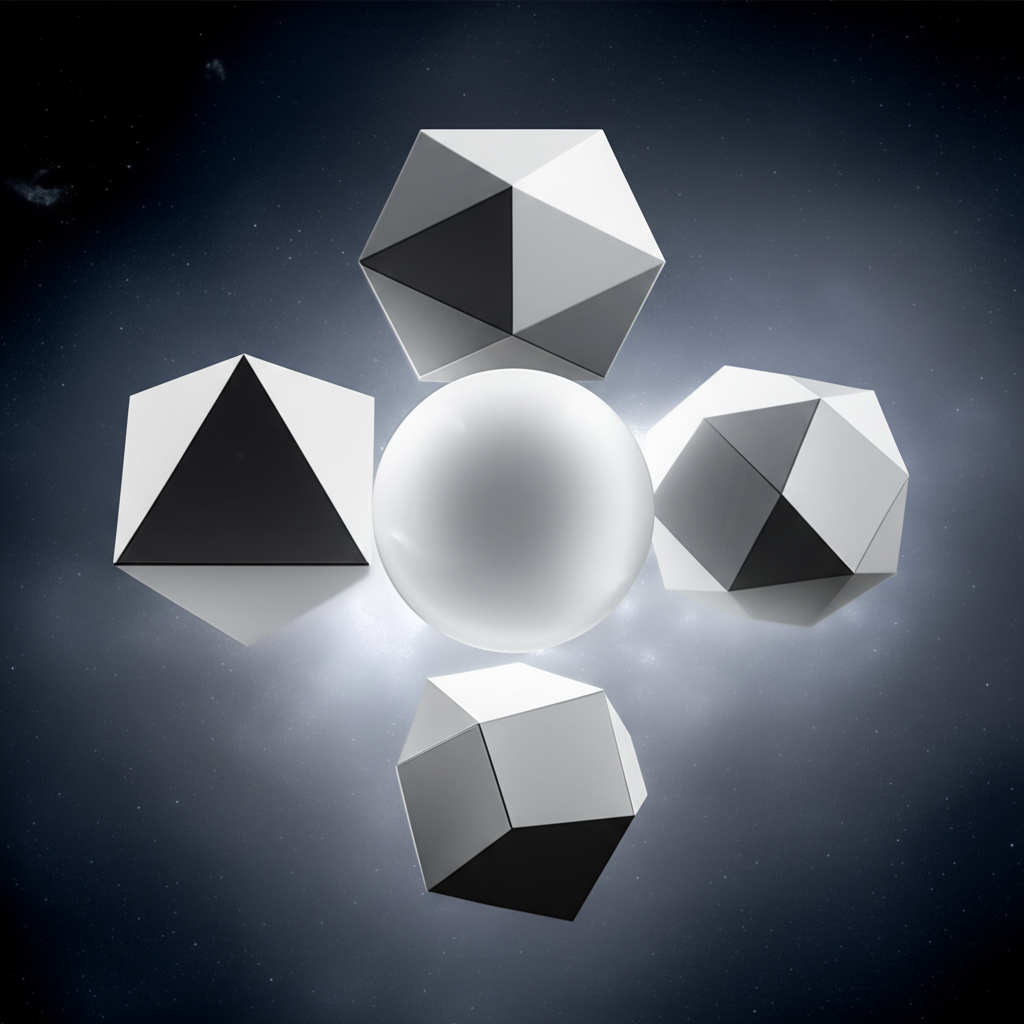
Euclid's Legacy: Building the Logical Framework of Space
If Plato provided the philosophical justification for the mathematical nature of reality, Euclid provided the systematic framework. His Elements, written around 300 BCE, stands as one of the most influential texts in intellectual history, laying down the foundational principles of Geometry and deductive reasoning.
-
Axioms, Postulates, and Proofs: The Deductive Power of Geometry
Euclid's genius lay in his ability to derive a vast system of geometric truths from a small set of self-evident axioms and postulates. He meticulously defined points, lines, planes, and solids, then demonstrated their relationships through rigorous logical proofs. This monumental work codified our understanding of three-dimensional Euclidean Space, establishing a universal language for describing Form and Quantity in a consistent and verifiable manner. His method became the gold standard for scientific and mathematical inquiry, showing how complex knowledge could be built upon simple, undeniable truths.Euclidean Concept Description Philosophical Significance Point Position without magnitude. The ultimate indivisible unit, a foundational Quantity. Line Breadthless length. The simplest connection between points, defining direction in Space. Plane A surface with length and breadth, but no thickness. The two-dimensional canvas upon which many geometric Forms are drawn. Solid A body with length, breadth, and depth. The tangible, three-dimensional Form of objects in Space. Axiom/Postulate Self-evident truth, accepted without proof. The starting points of logical deduction, revealing assumed truths about Space.
From Perspective to Relativity: Evolving Geometries of Space
While Euclid's geometry dominated thought for over two millennia, the human understanding of Space and its mathematical description continued to evolve, often driven by new philosophical insights and scientific observations.
-
Descartes and Analytical Geometry: Bridging Algebra and Geometry
The 17th century saw a revolutionary leap with René Descartes' development of analytical geometry. By introducing coordinate systems, Descartes showed how geometric Forms could be expressed through algebraic equations, and vice-versa. This powerful synthesis united Quantity (numbers) with Form (shapes), transforming the study of Space from static diagrams into dynamic calculations. It provided a new mathematical lens through which to analyze curves, surfaces, and the relationships between points in space, paving the way for calculus and modern physics. -
Non-Euclidean Geometries: Challenging the Absolute Nature of Space
Perhaps one of the most profound challenges to our intuitive understanding of Space came in the 19th century with the development of non-Euclidean geometries by mathematicians like Bernhard Riemann and Nikolai Lobachevsky. These geometries questioned Euclid's fifth postulate (the parallel postulate) and demonstrated that alternative, internally consistent geometries were possible. In these spaces, parallel lines can converge or diverge, and the sum of angles in a triangle is not necessarily 180 degrees. This intellectual breakthrough showed that Space itself was not necessarily flat and absolute, but could possess different Forms of curvature. It was a stunning realization: the Mathematics of Space was more diverse than previously imagined, hinting at a universe far stranger than Euclidean intuition suggested.
The Unseen Architect: Mathematics as the Blueprint of Reality
The journey from ancient philosophy to modern physics underscores a persistent question: why is Mathematics so extraordinarily effective at describing the universe? Is it a human invention, or a fundamental discovery?
-
Why Mathematics Works: The Philosophical Question
This question lies at the heart of the philosophy of Mathematics. Some argue that mathematical structures are inherent to the fabric of reality, simply waiting to be discovered by the human mind. Others believe that Mathematics is a powerful human construct, a language we invent to organize our perceptions of Quantity and Form. Regardless, its uncanny ability to predict phenomena, from planetary orbits to quantum mechanics, suggests a deep resonance between our rational faculties and the cosmos. The universe, it seems, speaks in numbers, and Geometry is its grammar. -
Modern Physics and the Geometry of Spacetime
The ultimate triumph of non-Euclidean geometry arrived with Albert Einstein's theories of relativity. Einstein demonstrated that gravity is not a force in the traditional sense, but a manifestation of the curvature of spacetime itself. Massive objects warp the Space and time around them, dictating the paths of other objects. Here, Mathematics provides the essential framework for understanding how Space is dynamic, how Form is influenced by mass and energy, and how Quantity (mass, energy, velocity) reshapes the very stage of existence. The universe, in Einstein's view, is a grand geometric sculpture, constantly being reshaped by its own contents.
Beyond the Numbers: Philosophical Reflections on Mathematical Space
The profound connection between Mathematics, Space, Quantity, and Form invites us to ponder deeper philosophical questions.
-
Order, Beauty, and Truth: The Aesthetic Dimension of Geometry
There is an undeniable aesthetic quality to Mathematics and Geometry. The elegance of a proof, the symmetry of a crystal, the fractal beauty of a coastline – these exemplify an inherent order that many find beautiful. This beauty often points towards a deeper truth, suggesting that the universe's underlying structure is not chaotic but harmonious, accessible through rational inquiry. The pursuit of mathematical understanding is, in many ways, a quest for cosmic beauty and truth. -
The Limits of Mathematical Description: What Lies Beyond Quantity?
While Mathematics provides an unparalleled lens through which to understand the physical universe, it also prompts us to consider its limits. Can all aspects of reality be reduced to Quantity and Form? What about consciousness, meaning, or subjective experience? While Mathematics illuminates the objective structure of Space, philosophy continues to grapple with what lies beyond its measurable dimensions, reminding us that reality is multi-faceted, and the numerical description is but one, albeit profound, avenue of understanding.
Conclusion
The journey through the Mathematics of Space and Geometry is a testament to humanity's enduring quest for understanding. From the Pythagorean belief that numbers are the soul of the cosmos, to Euclid's logical construction of space, Descartes' analytical bridge, and Einstein's curved spacetime, Mathematics has consistently proven itself to be the indispensable tool for deciphering the universe's most profound secrets. It reveals the intricate Quantity and elegant Form that define our existence, guiding us ever closer to the unseen architect of reality. To truly grasp the world around us is to appreciate the silent, eloquent language of numbers and shapes that underpins everything we perceive and experience.
YouTube Video Suggestions:
-
📹 Related Video: PLATO ON: The Allegory of the Cave
Video by: The School of Life
💡 Want different videos? Search YouTube for: ""Plato Timaeus geometry cosmos""
2. ## 📹 Related Video: KANT ON: What is Enlightenment?
Video by: The School of Life
💡 Want different videos? Search YouTube for: ""Non-Euclidean geometry explained" or "Einstein General Relativity geometry of space""