

The Unseen Architecture: Unveiling the Mathematics of Space and Geometry
The universe, in its breathtaking vastness and intricate detail, often presents itself as a grand mystery. Yet, beneath the surface of phenomena, a profound order whispers – a language of Mathematics that describes the very fabric of Space and the elegant dance of Form. This pillar page delves into the philosophical journey of understanding how mathematical principles not only describe but, in many ways, define the spatial reality we inhabit. From ancient Greek ideals to modern cosmological theories, we explore the deep, often symbiotic, relationship between abstract numbers and the concrete dimensions of existence, questioning how our minds grasp the infinite and the infinitesimal through the lens of Quantity and geometric structure.
The Genesis of Form: Ancient Philosophy and the Birth of Geometry
Long before telescopes peered into distant galaxies, thinkers pondered the nature of reality. For many, particularly those within the Western philosophical tradition documented in the Great Books, the key to understanding lay in the immutable principles of Mathematics.
Plato's Ideal Forms and Geometric Perfection
Plato, a towering figure in the Great Books of the Western World, famously posited a realm of perfect, unchanging Forms, accessible only through reason. For him, geometric shapes – the perfect circle, the ideal triangle – were not mere human inventions, but reflections of these eternal Forms. Our physical world, with its imperfect circles and wobbly lines, was but a shadow of this ultimate reality.
- The Cave Allegory: Just as prisoners mistook shadows for reality, we often mistake the physical manifestations of geometric Form for their true, ideal counterparts.
- Mathematical Training: Plato believed that the study of geometry was essential for preparing the mind to grasp these higher Forms, acting as a bridge between the sensory world and intellectual truth.
- The Timaeus: In this dialogue, Plato describes the cosmos as being constructed according to precise mathematical ratios and geometric shapes, particularly the Platonic solids, suggesting a divine architect whose blueprint was pure Mathematics.
Euclid's Elements: Axioms of Space
Perhaps no single work has shaped our understanding of Space and Geometry more profoundly than Euclid's Elements. Also a cornerstone of the Great Books, this monumental treatise systematized nearly all known mathematical knowledge of its time, establishing a rigorous axiomatic approach.
Euclid presented geometry as a deductive system, starting with a few self-evident truths (axioms or postulates) and logically deriving complex theorems. His five postulates, especially the controversial fifth (the parallel postulate), defined what we now call Euclidean geometry – the geometry of flat, two-dimensional planes and three-dimensional Space as we intuitively perceive it.
Key Euclidean Concepts for Understanding Space:
- Points: Locations without Quantity or dimension.
- Lines: One-dimensional extensions connecting points.
- Planes: Two-dimensional surfaces.
- Solids: Three-dimensional objects, possessing volume and Form.
Euclid's work provided a language, a set of rules, for describing the Quantity and Form of objects in Space, becoming the bedrock for centuries of scientific and philosophical inquiry.
From Quantity to Form: The Mathematical Language of Reality
At its heart, Mathematics is the science of Quantity and Form. When applied to Space, it provides the framework for measuring, describing, and even predicting its properties.
The Essence of Quantity and its Spatial Manifestations
Quantity is fundamental to our experience of Space. How far? How big? How many? These questions are intrinsically mathematical.
- Measurement: Length, width, height, volume – these are all expressions of Quantity that define the extent of Space occupied by an object.
- Proportion and Ratio: The harmonious arrangement of parts, often expressed through mathematical ratios, has been admired since antiquity (e.g., the golden ratio in art and nature).
- Number as Foundation: Every coordinate, every dimension, every scalar value associated with Space relies on the concept of number, the most basic unit of Quantity.
Geometry as the Study of Form
Geometry, literally "earth measurement," evolved into the study of shapes, sizes, positions, and other properties of figures in Space. It is the ultimate discipline for understanding Form.
Fundamental Geometric Forms and Their Philosophical Significance:
| Geometric Form | Description | Philosophical Implication |
|---|---|---|
| Point | A location without dimension or Quantity. | The origin, the indivisible unit, the singularity. |
| Line | An infinite series of points, one-dimensional. | Direction, connection, trajectory, continuity. |
| **Plane | A flat, two-dimensional surface. | Surface, boundary, the canvas upon which forms interact. |
| Sphere | A perfectly symmetrical 3D object, all points equidistant from the center. | Perfection, totality, infinity, the cosmic egg. |
| Cube | A regular hexahedron with six square faces. | Stability, structure, the foundation, the tangible. |
| Torus | A doughnut-shaped surface of revolution. | Cyclicality, interconnectedness, non-orientable surfaces (in topology). |
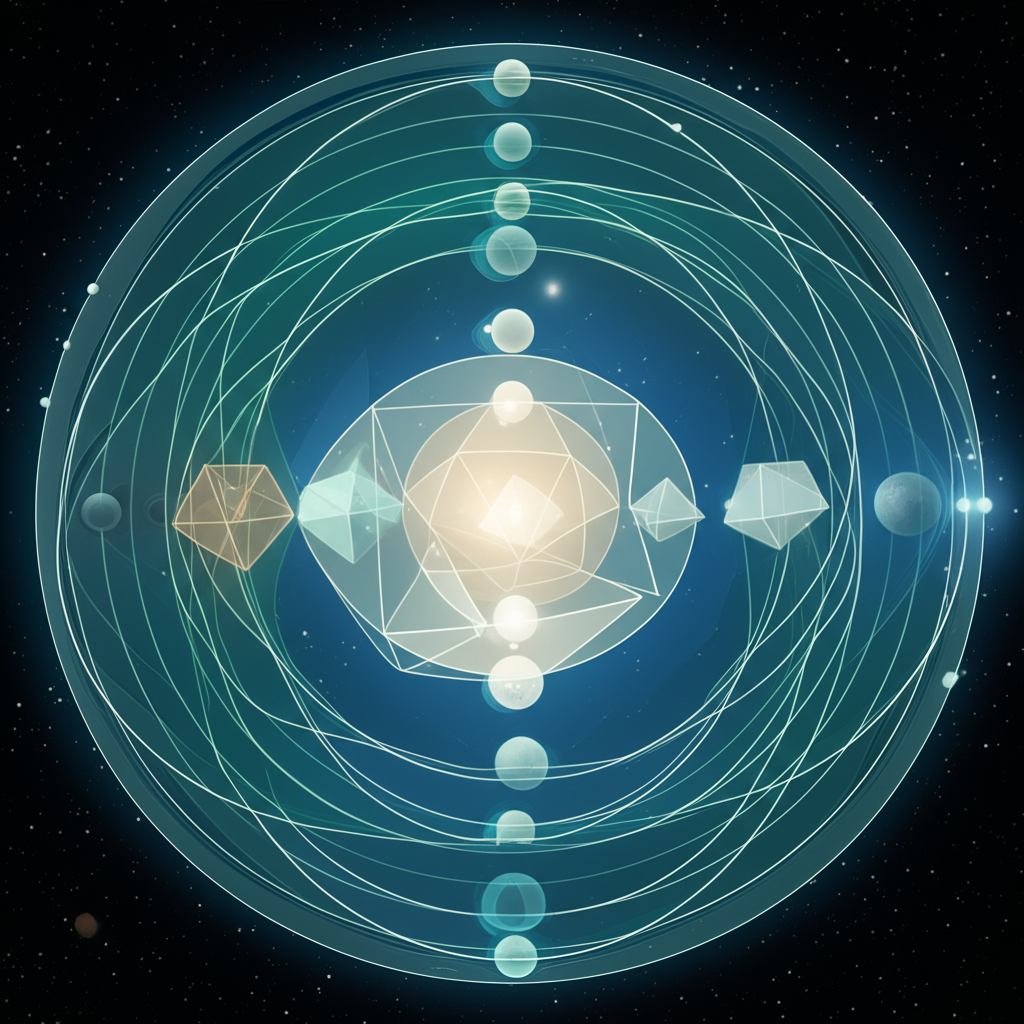 subtly integrated into the cosmic architecture, symbolizing the mathematical and geometric underpinnings of the universe.)
Beyond Euclidean Boundaries: Non-Euclidean Geometries
For millennia, Euclid's geometry was considered the only true description of Space. However, in the 19th century, mathematicians dared to challenge the fifth postulate, leading to revolutionary insights.
Challenging the Fifth Postulate
The parallel postulate states that through a point not on a given line, there is exactly one line parallel to the given line. Mathematicians like Lobachevsky, Bolyai, and Riemann explored what would happen if this postulate were altered.
- Hyperbolic Geometry: Assumes that through a point not on a given line, there are at least two lines parallel to the given line. This results in a "saddle-shaped" Space where the sum of angles in a triangle is less than 180 degrees.
- Elliptic Geometry: Assumes that through a point not on a given line, there are no lines parallel to the given line. This describes a "spherical" Space (like the surface of the Earth), where the sum of angles in a triangle is greater than 180 degrees.
New Conceptions of Space
These non-Euclidean geometries were initially seen as abstract mathematical curiosities. However, they profoundly expanded our understanding of what Space could be. They demonstrated that the Mathematics of Space was not singular but plural, opening doors to describing realities beyond our immediate intuition.
Philosophically, this challenged the Kantian notion that Euclidean Space was an inherent, a priori structure of the human mind. If other geometries were possible and even consistent, then our understanding of Space might be more contingent than previously thought.
Space, Time, and Relativity: Modern Perspectives
The 20th century witnessed an even more radical transformation in our understanding of Space, largely driven by Albert Einstein's theories of relativity. Here, Mathematics became the indispensable tool for describing a dynamic, interconnected cosmos.
Minkowski Spacetime
Einstein, building on the work of Hermann Minkowski, showed that Space and time are not separate entities but are interwoven into a single four-dimensional continuum called spacetime. Events in this spacetime are described by coordinates that include time as a fourth dimension. This conceptual leap required sophisticated Mathematics, particularly tensor calculus, to describe the Quantity and Form of this unified reality.
Philosophical Implications of Curved Space
General Relativity further proposed that gravity is not a force but a manifestation of the curvature of spacetime caused by mass and energy. Massive objects, like stars and planets, literally warp the Space around them, dictating the paths of other objects.
- Relativity of Space: There is no absolute, fixed background Space. Its properties are dynamic and depend on the distribution of matter and energy.
- Mathematics as Reality's Blueprint: The equations of General Relativity (Einstein field equations) are not merely descriptions; they are the framework that defines the universe's geometric structure and evolution.
- Cosmological Models: The Mathematics of curved Space allows us to model the entire universe, from its expansion to the behavior of black holes, revealing a cosmos whose Form is far more complex and beautiful than previously imagined.
The Unifying Language: Mathematics as the Bridge
From the ideal Forms of Plato to the curved spacetime of Einstein, Mathematics has served as the indispensable language for comprehending Space and Geometry. It allows us to move beyond mere observation to a deeper, more rigorous understanding of the universe's fundamental structure. It bridges the gap between the abstract and the concrete, between the ideal and the physical.
The exploration of Quantity and Form through mathematical lenses is not just a scientific endeavor; it is a profound philosophical quest to understand the very nature of existence itself. The universe, in its grand design, reveals itself as a mathematical masterpiece, waiting for us to decipher its elegant equations.
Further Exploration
To delve deeper into the fascinating interplay between philosophy, Mathematics, and the nature of Space, consider exploring these topics:
-
📹 Related Video: KANT ON: What is Enlightenment?
Video by: The School of Life
💡 Want different videos? Search YouTube for: "Philosophy of Mathematics Space Geometry Euclid Kant"
-
📹 Related Video: PLATO ON: The Allegory of the Cave
Video by: The School of Life
💡 Want different videos? Search YouTube for: "General Relativity Spacetime Curvature Explained"