

The Mathematics of Astronomical Quantity: A Philosophical Inquiry into the Cosmos
The universe, in its breathtaking expanse and intricate order, has always been a profound subject for both scientific investigation and philosophical contemplation. At the heart of our attempt to comprehend this vastness lies mathematics, the indispensable language through which we measure, model, and ultimately make sense of astronomical quantity. From the ancient stargazers who sought divine patterns to modern cosmologists grappling with dark energy, the interplay between numbers, celestial bodies, and the very fabric of space has consistently pushed the boundaries of human thought, revealing not just the how but also prompting deep questions about the why. This pillar page delves into this fundamental relationship, exploring how mathematical inquiry has shaped our understanding of the cosmos and, by extension, our place within it.
Ancient Roots: From Cosmos to Calculation
Our journey into the mathematics of astronomical quantity begins with the ancients, particularly the Greeks, whose philosophical inquiries laid much of the groundwork. For thinkers like Pythagoras and Plato, mathematics was not merely a tool for measurement but a divine key to understanding the harmonious order of the universe.
The Pythagorean Harmony and Plato's Forms
The Pythagoreans believed that "all is number," extending this philosophy to the celestial realm. They posited a "music of the spheres," where the ratios of planetary orbits produced a celestial harmony, a profound connection between quantity and cosmic beauty. This early attempt to quantify the heavens, though speculative by modern standards, underscored a deep intuition: that the universe operates according to intelligible, mathematical principles.
Plato, in his Timaeus, further elaborated on this, suggesting that the cosmos was crafted by a divine artisan using geometric forms and mathematical ratios. For Plato, the visible world of space and matter was but an imperfect reflection of perfect, eternal Forms, accessible only through reason and mathematics. The regular, circular motions of the planets were seen as manifestations of these ideal forms, embodying a perfect quantity and order. Aristotle, while diverging from Plato's idealism, still posited a geocentric cosmos of crystalline spheres, a highly structured, though qualitatively different, mathematical model of the universe.
- Early Philosophical Contributions to Astronomical Quantity:
- Pythagoras: "All is number," cosmic harmony through numerical ratios.
- Plato: Geometric forms and mathematical ratios as blueprints for the cosmos.
- Aristotle: Geocentric model with concentric spheres, a structured, albeit flawed, quantification of celestial motion.
These early philosophical systems, found within the foundational texts of the Great Books of the Western World, established mathematics as the primary means of describing and understanding the quantity and arrangement of objects in space, setting the stage for centuries of astronomical inquiry.
The Renaissance and the Dawn of Modern Cosmology
The Renaissance marked a pivotal shift, moving from philosophical speculation to empirical observation, yet still firmly rooted in mathematical rigor. This era witnessed a profound revolution in our understanding of astronomy and the quantity of the universe.
Kepler's Laws and the Precision of Planetary Motion
Nicolaus Copernicus bravely challenged the geocentric model, proposing a heliocentric system that, while mathematically elegant, still employed perfect circles. It was Johannes Kepler, however, who truly revolutionized our understanding of planetary motion by combining meticulous observation with profound mathematical insight. After years of painstaking calculations based on Tycho Brahe's data, Kepler articulated his three laws of planetary motion:
- Planets move in elliptical orbits with the Sun at one focus.
- A line segment joining a planet and the Sun sweeps out equal areas during equal intervals of time.
- The square of the orbital period of a planet is proportional to the cube of the semi-major axis of its orbit (P² ∝ a³).
These laws were a monumental triumph for mathematics in astronomy. They demonstrated that the seemingly complex motions of the planets could be described with astonishing precision using relatively simple mathematical relationships. Kepler's laws provided the first accurate quantification of planetary orbits, distances, and periods, transforming the qualitative descriptions of ancient space into a quantitative, predictive science. The sheer quantity of data Brahe collected, and Kepler's mathematical genius in interpreting it, irrevocably altered our cosmic perspective.
Newton's Universe: Gravity, Calculus, and Infinite Space
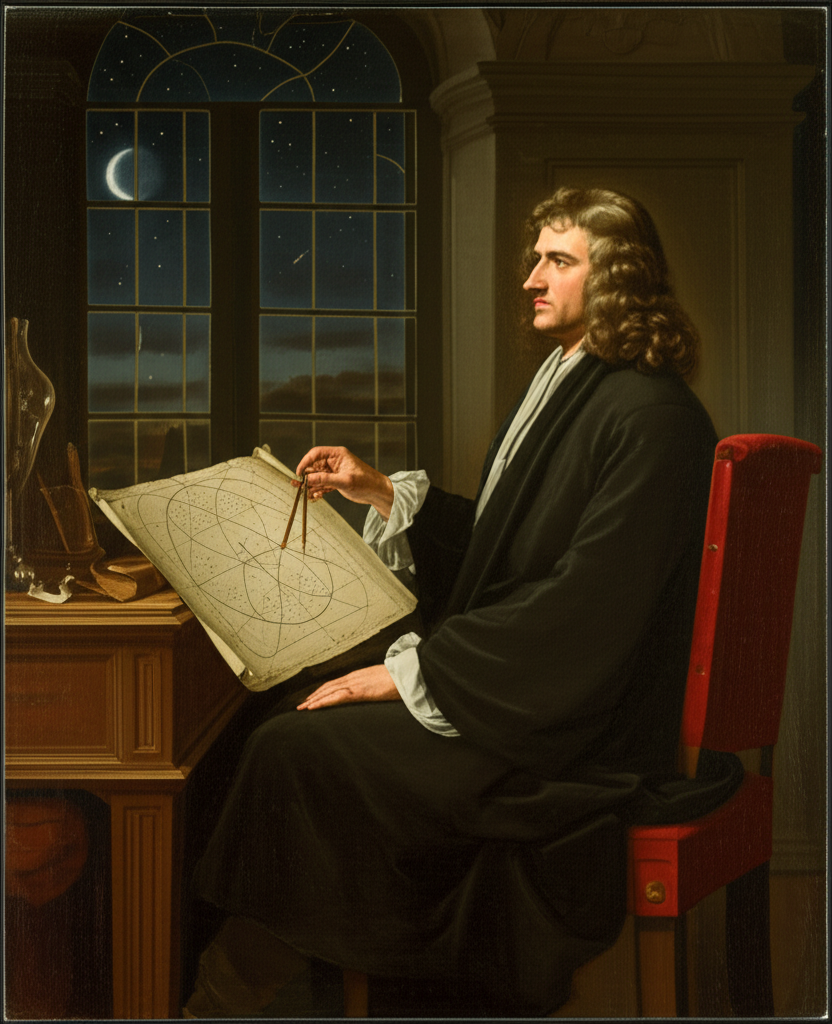
If Kepler provided the how of planetary motion, Isaac Newton provided the why. His work synthesized the terrestrial and celestial realms under a single, overarching mathematical law, fundamentally altering our perception of space, quantity, and the universe itself.
Universal Gravitation and the Calculus of Cosmic Scale
Newton's theory of universal gravitation, detailed in his Principia Mathematica, proposed that every particle of matter attracts every other particle with a force proportional to the product of their masses and inversely proportional to the square of the distance between their centers. This elegant mathematical formula explained not only the fall of an apple but also the orbits of planets, the tides, and the motion of comets. It demonstrated that the same physical laws govern both Earth and the heavens, unifying the cosmos under a single, quantifiable framework.
To develop his theories, Newton (concurrently with Leibniz) invented calculus, a revolutionary mathematical tool for understanding change and motion. Calculus allowed for the precise calculation of velocities, accelerations, and forces acting on objects in continuous motion across vast stretches of space. It provided the means to grapple with the dynamic quantity of the universe, from the infinitesimal to the infinite. Newton's universe was one of infinite space, filled with countless stars, each exerting gravitational influence, a truly awe-inspiring quantity that stretched the human imagination.
Modern Cosmology: Expanding Horizons and Unfathomable Quantities
The 20th and 21st centuries have witnessed an explosion in our understanding of astronomy, driven by new mathematical frameworks and increasingly sophisticated observational technologies. The quantity of what we know, and the quantity of what we still don't, has grown exponentially.
From Galaxies to the Multiverse: Quantifying the Unseen
Albert Einstein's theories of special and general relativity fundamentally reshaped our understanding of space, time, gravity, and energy. His equations, particularly E=mc², demonstrated the deep mathematical interconnectedness of these concepts, revealing a dynamic, elastic space-time rather than Newton's static backdrop. This new mathematical language became essential for understanding phenomena at cosmic scales, such as the bending of light by gravity and the expansion of the universe.
The discovery of galaxies beyond our own, pioneered by Edwin Hubble, revealed that our Milky Way was just one of billions, each containing billions of stars. This sheer quantity of celestial objects pushed the limits of our comprehension. Furthermore, the realization that the universe is expanding, and that this expansion is accelerating, led to the concepts of dark matter and dark energy – mysterious components that constitute the vast majority of the universe's mass and energy, yet remain largely unseen and poorly understood. These concepts challenge our current mathematical models and our ability to fully quantify the universe's composition and fate.
Today, theoretical mathematics delves into concepts like multiverses, string theory, and extra dimensions, grappling with quantities and spaces that are utterly alien to our everyday experience. The universe, through the lens of modern mathematics and astronomy, is far vaster and stranger than any ancient philosopher could have imagined.
📹 Related Video: ARISTOTLE ON: The Nicomachean Ethics
Video by: The School of Life
💡 Want different videos? Search YouTube for: ""The Scale of the Universe Explained Philosophically""
The Philosophical Resonance of Astronomical Quantity
Beyond the scientific and mathematical triumphs, the journey to quantify the cosmos has always carried profound philosophical weight. The vastness of astronomical quantity forces us to confront fundamental questions about existence, meaning, and our place in the universe.
Beyond Numbers: The Human Place in a Quantified Universe
The realization of the immense quantity of stars, galaxies, and the sheer scale of cosmic space can evoke a sense of overwhelming insignificance. Yet, paradoxically, it also highlights the extraordinary capacity of the human mind to comprehend such grandeur. Through the abstract elegance of mathematics, we, finite beings on a small planet, are able to glimpse the infinite.
This constant push to quantify the universe is not just about measuring distances or counting stars; it is an enduring philosophical quest. It's about seeking order in chaos, finding patterns in the seemingly random, and imposing intellectual structure on the boundless. The numbers and equations of astronomy serve not only to describe the universe but also to expand our consciousness, prompting wonder, humility, and a renewed appreciation for the intricate beauty of existence. The universe, in its quantifiable vastness, remains a mirror reflecting our deepest inquiries.
📹 Related Video: What is Philosophy?
Video by: The School of Life
💡 Want different videos? Search YouTube for: ""Philosophy of Science: Cosmology and the Human Condition""
In conclusion, the relationship between mathematics, astronomy, and the concept of quantity is a cornerstone of human intellectual endeavor. From the ancient contemplation of harmonious spheres to the modern pursuit of dark energy, mathematics has been the indispensable tool, the universal language, through which we have sought to understand the boundless space we inhabit. This ongoing quest to quantify the cosmos continues to shape our scientific understanding, challenge our philosophical assumptions, and inspire a profound sense of awe at the sheer scale and intricate order of the universe.