

The Cosmic Calculus: Unveiling the Mathematics of Astronomical Quantity
The human mind, ever since it first gazed skyward, has grappled with the unfathomable expanse above. How do we comprehend the sheer quantity of space? How do we measure the distances to stars, chart the paths of planets, or even begin to grasp the age and size of the universe? The answer lies in mathematics. From ancient geometry to modern calculus and beyond, mathematics has been the indispensable language through which astronomy translates raw observation into intelligible understanding, profoundly shaping our philosophical worldview. This pillar page explores the historical and conceptual journey of how mathematical thought has allowed us to quantify and qualify the cosmos, transforming our perception of our place within it.
The Infinite Canvas of Space and the Human Mind
The night sky presents a spectacle of bewildering beauty and overwhelming scale. For millennia, humanity has sought to impose order upon this celestial chaos, to understand the forces at play and the quantities involved. This quest is not merely scientific; it is deeply philosophical. To measure the space between us and the stars, to calculate the orbits of planets, or to estimate the age of the cosmos, is to confront fundamental questions about existence, knowledge, and our own significance.
Mathematics serves as the bridge between the observed phenomena of astronomy and our intellectual comprehension. It provides the tools to move beyond mere wonder to systematic inquiry, turning qualitative awe into quantitative insight. As we delve into the history of astronomical thought, we find that every significant leap in understanding the universe’s quantity has been predicated on a corresponding advancement in mathematical reasoning. This journey is one of increasing precision, ever-expanding horizons, and a continually evolving philosophy of the cosmos.
Ancient Roots: Geometry, Spheres, and the Music of the Spheres
Long before telescopes peered into deep space, ancient civilizations recognized patterns in the heavens. Yet, it was the Greeks who began to apply rigorous mathematical principles to understand these astronomical observations.
Early Attempts to Measure the Heavens
The Pythagoreans, with their mystical reverence for numbers, believed the cosmos was governed by mathematical ratios, giving rise to the idea of the "music of the spheres." For Plato, as detailed in Timaeus, the universe was a divinely ordered creation, its structure comprehensible through geometry and perfect forms. Aristotle, while emphasizing empirical observation, still placed Earth at the center of a series of concentric, crystalline spheres, a model that, while incorrect, provided a coherent mathematical framework for explaining planetary motion.
Perhaps one of the most remarkable early achievements in understanding astronomical quantity was Eratosthenes' calculation of the Earth's circumference in the 3rd century BCE. By using simple geometry and two well-chosen observation points, he demonstrated the power of mathematics to measure immense quantities with surprising accuracy.
- Ptolemy's Almagest: This monumental work, written in the 2nd century CE, codified the geocentric view of the universe. Ptolemy employed an intricate system of epicycles, deferents, and equants – sophisticated mathematical devices – to explain the observed retrograde motion of planets. While his fundamental premise was flawed, his mathematical models were astonishingly effective at predicting planetary positions, showcasing the predictive power of mathematics even within an incorrect paradigm. The Almagest stood as the authoritative astronomical and mathematical text for over 1400 years, a testament to its quantitative rigor.
The philosophical implications of these early mathematical endeavors were profound. They suggested an ordered, rational cosmos, one amenable to human reason, often reflecting divine harmony or intelligent design. The vast space above, though seemingly chaotic, was revealed to possess an underlying mathematical structure.
The Copernican Revolution and the Dawn of Modern Cosmology
The medieval period largely adhered to the Ptolemaic system, but the Renaissance brought a renewed spirit of inquiry and a critical re-examination of established astronomical models.
Shifting Perspectives: From Earth-Centered to Sun-Centered
Nicolaus Copernicus, a Polish astronomer, proposed a radical alternative in his De revolutionibus orbium coelestium (1543). His heliocentric model, placing the Sun at the center of the solar system, offered a simpler mathematical explanation for planetary motions, even if it initially required epicycles of its own. Philosophically, this was a seismic shift, displacing humanity from the cosmic center.
The ensuing century saw a flurry of groundbreaking work:
- Tycho Brahe's Meticulous Observations: Brahe, an eccentric Danish nobleman, conducted incredibly precise, naked-eye astronomical observations. His vast collection of quantitative data, gathered over decades, became the raw material for the next major mathematical breakthrough.
- Kepler's Laws of Planetary Motion: Johannes Kepler, Brahe's assistant, inherited this invaluable data. Through painstaking mathematical analysis, he abandoned the ancient obsession with perfect circles, formulating three laws that described planetary orbits as ellipses. These laws, derived from empirical quantity, were revolutionary:
- Planets move in elliptical orbits with the Sun at one focus.
- A line connecting a planet and the Sun sweeps out equal areas in equal times.
- The square of a planet's orbital period is proportional to the cube of the semi-major axis of its orbit.
Kepler's laws provided a precisely mathematical description of astronomical motion, moving beyond mere description to predictive power, profoundly changing our understanding of the quantity of celestial mechanics.
- Galileo Galilei's Telescopic Discoveries: Galileo's improvements to the telescope allowed him to see celestial bodies with unprecedented detail. His observations of the phases of Venus, the moons of Jupiter orbiting another body, and the mountains on the Moon provided compelling empirical evidence supporting the Copernican model and revealing new quantities within the solar system. He also applied mathematics to terrestrial motion, laying groundwork for dynamics.
The philosophical impact of these discoveries was immense. The universe was no longer a realm of perfect, unchanging spheres but a dynamic system governed by observable, mathematical laws, further expanding our understanding of space and its constituent quantities.
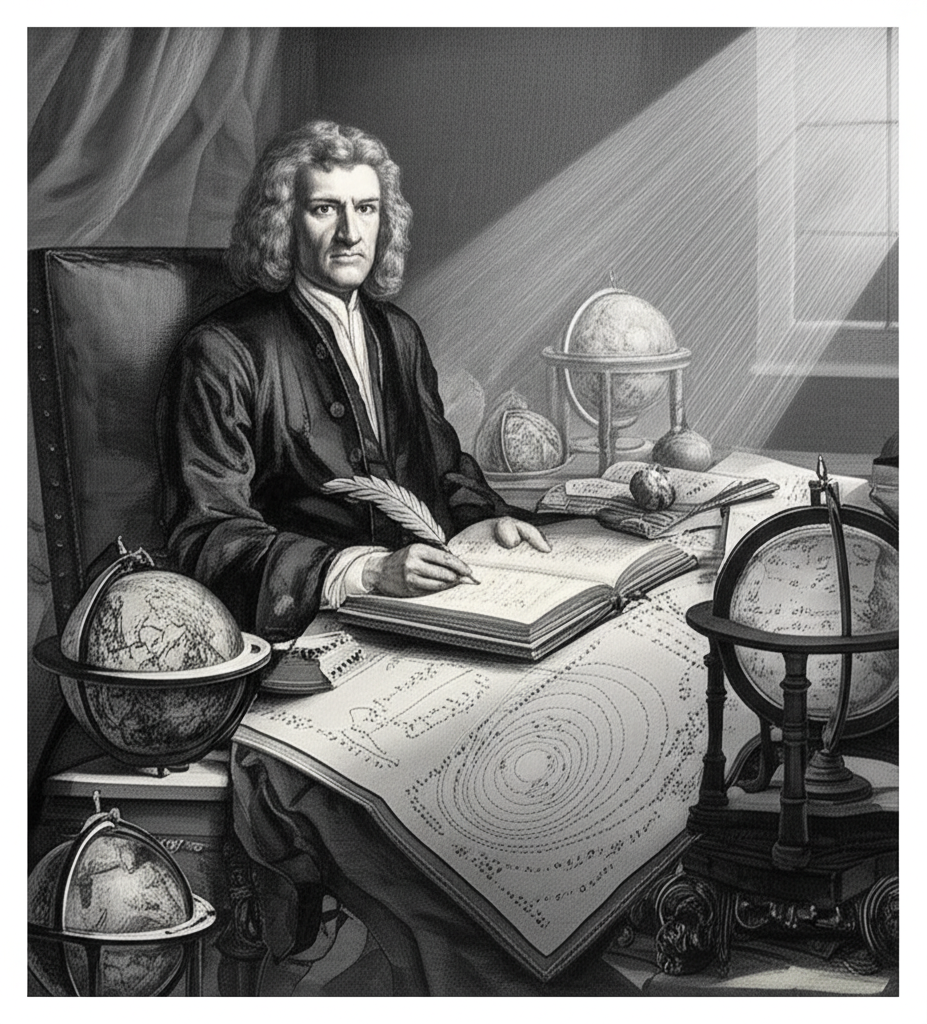
Newton's Universe: Gravity, Calculus, and Infinite Space
The scattered insights of Copernicus, Brahe, Kepler, and Galileo were finally unified by Isaac Newton, whose work represented the zenith of classical mathematical astronomy.
The Grand Unification: Universal Laws and the Calculus of the Cosmos
Newton's Philosophiæ Naturalis Principia Mathematica (1687) is arguably the single most important scientific work ever published. In it, Newton presented his Law of Universal Gravitation, a single mathematical formula that explained both the fall of an apple on Earth and the orbits of planets in space. This was an unprecedented achievement, demonstrating that the same mathematical laws governed both terrestrial and celestial mechanics.
Crucially, to articulate these laws and describe continuous motion, change, and the forces acting across vast space, Newton (independently of Leibniz) developed calculus. This new branch of mathematics was perfectly suited to describe dynamic systems, making it indispensable for astronomy:
- Differential Calculus: For understanding instantaneous rates of change, velocity, and acceleration.
- Integral Calculus: For summing infinitesimal changes to determine total quantity, such as the area under a curve or the total force exerted over a period.
Newton's universe was a grand, deterministic clockwork, operating according to precise mathematical laws. This view had profound philosophical implications, suggesting a rational, predictable cosmos that could be fully understood through human reason and mathematics. The concept of infinite space became more plausible, governed by universal forces acting across immense quantities.
Beyond the Solar System: Stellar Distances and Cosmic Expansion
As mathematics and observational technology advanced, astronomy began to extend its gaze far beyond the confines of our solar system, confronting truly immense quantities of space.
Measuring the Unfathomable: Parallax, Redshift, and the Expanding Universe
Measuring the distance to stars was a long-standing challenge. The breakthrough came with the successful measurement of stellar parallax in the 19th century. This mathematical technique uses the Earth's orbit around the Sun as a baseline to triangulate the distance to nearby stars, finally putting a quantity to interstellar space.
The 20th century brought even more revolutionary discoveries, further expanding our understanding of cosmic quantity:
- Standard Candles: Henrietta Swan Leavitt's discovery of the period-luminosity relationship for Cepheid variable stars provided a crucial "standard candle." By observing the pulsation period of these stars, astronomers could determine their intrinsic brightness, and thus, using the inverse square law of light, calculate their distance. This mathematical relationship allowed for the measurement of vastly greater astronomical quantities of space.
- Spectroscopy and Redshift: The analysis of starlight through spectroscopy revealed that light from distant galaxies is "redshifted," meaning its wavelengths are stretched. Edwin Hubble, building on the work of Vesto Slipher, used this phenomenon, applying mathematical relationships, to conclude that galaxies are moving away from us, and the farther away they are, the faster they recede. This led to the monumental discovery of the expanding universe. Hubble's Law, a simple linear mathematical relationship, quantified the rate of cosmic expansion.
- Einstein's Relativity: Albert Einstein's theories of Special and General Relativity revolutionized our understanding of space, time, gravity, and quantity. General Relativity, in particular, presented a new mathematical framework where gravity is described not as a force, but as the curvature of spacetime caused by mass and energy. This profound mathematical insight led to predictions like gravitational lensing and black holes, fundamentally altering our perception of the geometry and quantity of space itself.
The philosophical implications of an expanding, evolving universe are immense. It challenges notions of a static cosmos, prompts questions about its origin and ultimate fate, and continually pushes the boundaries of what we can quantify and comprehend.
Here are some key milestones in humanity's journey to measure cosmic quantity:
- c. 240 BCE: Eratosthenes – Calculates Earth's circumference using geometry.
- 1543 CE: Nicolaus Copernicus – Proposes a heliocentric model, simplifying mathematical descriptions of planetary orbits.
- 1609-1619 CE: Johannes Kepler – Derives his three laws of planetary motion, providing precise mathematical descriptions of elliptical orbits.
- 1687 CE: Isaac Newton – Publishes Principia Mathematica, uniting celestial and terrestrial mechanics with universal gravitation and calculus.
- 1912 CE: Henrietta Swan Leavitt – Discovers the period-luminosity relationship of Cepheid variables, enabling distance measurements to distant galaxies.
- 1929 CE: Edwin Hubble – Formulates Hubble's Law, quantifying the expansion of the universe based on galactic redshift.
The Enduring Quest for Cosmic Comprehension
From the ancient Greeks' geometrical spheres to Einstein's curved spacetime, mathematics has been the unwavering bedrock of astronomy. It has allowed us to move from philosophical speculation to empirical measurement, from qualitative observation to quantitative understanding of space and its contents. Each new mathematical tool and theoretical framework has not only expanded our knowledge of the universe's quantity but has also fundamentally reshaped our philosophical understanding of existence, causality, and our place within the grand cosmic tapestry.
Today, mathematics continues to be at the forefront of astronomical discovery. Theories of dark matter and dark energy, the mysteries of black holes, the search for gravitational waves, and the development of multiverse hypotheses all rely on sophisticated mathematical models to describe phenomena that defy direct observation. The quest to quantify and qualify the cosmos is an ongoing testament to the power of human reason and the enduring allure of the heavens. As we continue to push the boundaries of mathematical understanding, we simultaneously expand the horizons of our philosophical inquiry into the nature of reality itself.
📹 Related Video: PLATO ON: The Allegory of the Cave
Video by: The School of Life
💡 Want different videos? Search YouTube for: ""Plato Timaeus cosmology mathematics""
📹 Related Video: What is Philosophy?
Video by: The School of Life
💡 Want different videos? Search YouTube for: ""Newtonian physics and the universe philosophy""