

The Mathematics of Astronomical Quantity: A Philosophical Inquiry into the Infinite Cosmos
Summary
The universe, in its dizzying quantity and profound space, presents humanity with one of its greatest intellectual and philosophical challenges. From the earliest observations of the night sky to the cutting-edge instruments of modern cosmology, mathematics has served as our indispensable lens, translating the raw data of astronomy into comprehensible structures and profound insights. This pillar page explores how the quantitative understanding of the cosmos, driven by mathematical innovation, has not only expanded our scientific knowledge but fundamentally reshaped our philosophical perspective on existence, our place within the vast space, and the very nature of reality itself. We journey from ancient geometric models to the relativistic equations of the present, revealing how numbers illuminate the infinite and challenge the finite mind.
Introduction: The Cosmos as a Canvas for Quantity
Since time immemorial, the human gaze has been drawn upwards, to the glittering tapestry of stars that adorns the night. This celestial spectacle, seemingly boundless and eternal, has always evoked a dual response: wonder and a profound urge to understand. How far away are those distant points of light? How large are they? How do they move? These are questions of quantity, questions that compel us to transcend mere observation and engage in the rigorous discipline of mathematics.
For the philosopher, the mathematical quantification of astronomy is more than just a scientific exercise; it is a profound act of intellectual courage, pushing the boundaries of human comprehension. It forces us to confront the immense scale of space, to grapple with numbers that dwarf all earthly experience, and to question our intuitive understanding of existence. This journey, chronicled in the "Great Books of the Western World," reveals how our attempts to measure the cosmos have invariably led to deeper reflections on knowledge, reality, and our own finite existence within an apparently infinite space.
I. Ancient Foundations: Geometry, Spheres, and the First Measures of the Heavens
The earliest civilizations, from the Babylonians to the Egyptians, meticulously tracked celestial movements, driven by practical needs like agriculture and navigation, but also by a deep sense of cosmic order. However, it was the ancient Greeks who truly embarked on a philosophical and mathematical quest to model the heavens.
A. Plato's Ideal Forms and the Celestial Sphere
In Plato's Timaeus, the cosmos is presented as a divinely crafted entity, governed by mathematical principles. The perfect circular motions of celestial bodies reflect ideal forms, suggesting an inherent harmony and order. While speculative, Plato’s vision laid the groundwork for a universe comprehensible through reason and geometry. The concept of the celestial sphere, with Earth at its center, became the dominant model for centuries, allowing for the mathematical prediction of planetary positions.
B. Aristotle, Ptolemy, and the Geocentric Cosmos
Aristotle, in works like On the Heavens, provided a comprehensive cosmological system, solidifying the geocentric view. His universe was a series of concentric spheres, each carrying a celestial body, moving in perfect circles. This qualitative description was given rigorous mathematical quantity by Claudius Ptolemy in his monumental Almagest (c. 150 CE). Ptolemy's work, a cornerstone of astronomy for over 1400 years, used complex geometric models—epicycles, deferents, and equants—to explain the apparent retrograde motion of planets. This elaborate mathematical framework, despite its incorrect premise, demonstrated the power of mathematics to accurately predict astronomical phenomena, even if the underlying physical reality was misunderstood.
- Key Ancient Contributions to Astronomical Quantity:
- Pythagoreans: Harmony of the spheres, numerical ratios governing celestial bodies.
- Eratosthenes: Remarkably accurate calculation of Earth's circumference using geometric principles.
- Hipparchus: Developed trigonometry for astronomical calculations, cataloged stars, and discovered precession.
| Figure | Era | Key Contribution to Astronomical Quantity | Philosophical Implication |
|---|---|---|---|
| Plato | 4th Century BCE | Cosmos governed by mathematical ideals; perfect circular motion. | Reality is fundamentally mathematical and ordered. |
| Aristotle | 4th Century BCE | Comprehensive geocentric cosmology; qualitative description of spheres. | Universe is finite, hierarchical, and purposeful. |
| Ptolemy | 2nd Century CE | Quantitative mathematical models (epicycles) for planetary motion. | Mathematics can predict celestial events, even if the physical model is flawed. |
II. The Copernican Revolution: Expanding the Quantity of Space
The geocentric model, though mathematically sophisticated, eventually buckled under the weight of accumulated observations and its increasing complexity. The 16th century witnessed a paradigm shift, driven by new mathematical insights and a bolder vision of space.
A. Copernicus and the Heliocentric Hypothesis
Nicolaus Copernicus, in De revolutionibus orbium coelestium (1543), proposed a heliocentric model, placing the Sun at the center of the solar system. This was not merely a change of center; it was a profound reorientation of our perceived place in the cosmos. Philosophically, it challenged anthropocentrism and opened the door to a much larger universe. Mathematically, it offered a simpler, more elegant explanation for planetary motions, drastically simplifying the required quantity of epicycles.
B. Kepler's Laws and the Harmony of Numbers
Johannes Kepler, building on Tycho Brahe's meticulous observations, used mathematics to describe planetary motion with unprecedented accuracy. His three laws, published in Astronomia nova (1609) and Harmonices Mundi (1619), revealed that planets move in ellipses, not perfect circles, and their speeds vary. Kepler's work was a triumph of mathematics over ingrained dogma, demonstrating that the harmony of the spheres was not based on perfect circles but on precise numerical relationships. He showed that the quantity of planetary motion could be described by elegant, predictive equations.
- Kepler's Laws and their Impact:
- Planets orbit the Sun in ellipses, with the Sun at one focus. (Challenged Platonic perfect circles).
- A line connecting a planet to the Sun sweeps out equal areas in equal times. (Introduced variable speed, quantifiable).
- The square of a planet's orbital period is proportional to the cube of its average distance from the Sun. (A profound mathematical relationship, quantifying cosmic scale).
C. Galileo and the Empirical Turn
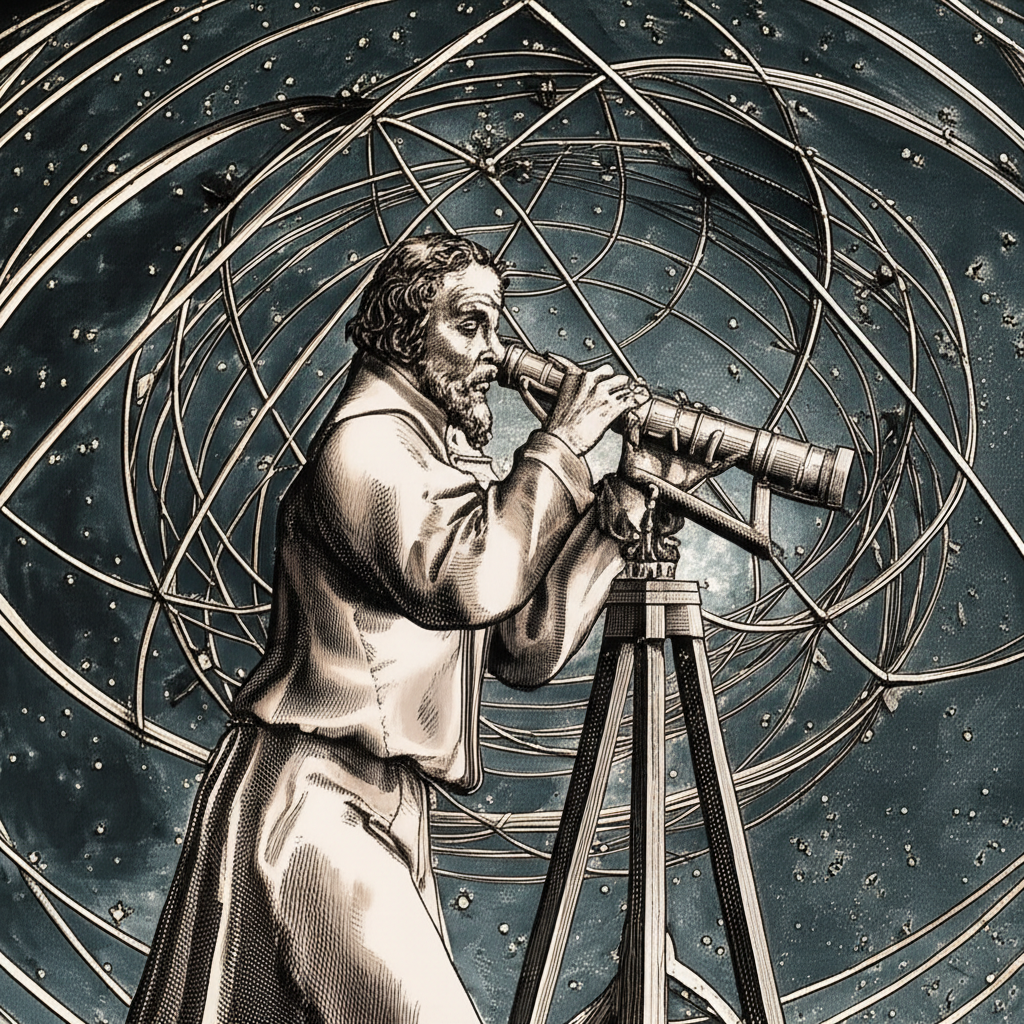
Galileo Galilei's use of the telescope, detailed in Sidereus Nuncius (1610), provided empirical evidence supporting the Copernican model. His observations of Jupiter's moons, the phases of Venus, and the multitude of stars invisible to the naked eye shattered ancient cosmological assumptions. Philosophically, Galileo emphasized observation and mathematical analysis over pure reason or authority, ushering in the era of empirical science. The sheer quantity of stars revealed by his telescope hinted at a universe far vaster than previously imagined.
III. Newton's Universe: Calculus, Gravity, and Infinite Space
The culmination of these revolutionary insights came with Isaac Newton, whose Philosophiæ Naturalis Principia Mathematica (1687) presented a unified, mathematical description of the universe.
A. The Law of Universal Gravitation
Newton's genius lay in recognizing that the same force that causes an apple to fall to Earth also governs the orbits of planets. His Law of Universal Gravitation, expressed through simple yet powerful mathematical equations, explained Kepler's laws and predicted new phenomena. This universal law applied throughout all space, implying a homogenous, infinite cosmos.
B. The Invention of Calculus
Crucially, to describe the continuous changes in motion and gravitational forces, Newton (and independently Leibniz) developed calculus. This new branch of mathematics provided the tools to analyze rates of change and accumulation, essential for understanding dynamic systems like planetary orbits. Calculus allowed for the precise quantification of forces acting across vast distances and over time, fundamentally altering our ability to measure and predict astronomical quantity.
C. Philosophical Implications of a Clockwork Universe
Newton's universe was a grand, deterministic machine, operating according to immutable mathematical laws. This vision profoundly influenced Enlightenment thought, suggesting a rational, ordered cosmos accessible to human reason. While offering comfort in its predictability, it also raised questions about free will and the role of a divine creator in a self-regulating universe. The concept of absolute space and time, infinite and uniform, became a cornerstone of this worldview, pushing the boundaries of human comprehension of quantity.
IV. Modern Cosmology: Relativistic Space-Time and Unfathomable Numbers
The 20th century brought further seismic shifts in our understanding of astronomy and the role of mathematics, particularly with Einstein's theories of relativity.
A. Einstein's Relativity and the Curvature of Space-Time
Albert Einstein's theories of special (1905) and general (1915) relativity revolutionized our concepts of space, time, gravity, and quantity. General relativity describes gravity not as a force, but as the curvature of space-time caused by mass and energy. The universe is no longer a static, infinite backdrop but a dynamic, evolving entity where space and time are intertwined. The mathematics involved—tensor calculus and differential geometry—are far more complex than Newton's, necessary to quantify the warping of space.
B. The Expanding Universe and Dark Energy
Edwin Hubble's observations (1920s), supported by Einstein's equations, revealed that the universe is expanding. This discovery introduced a new dimension of quantity: the observable universe is vast, and its expansion implies a beginning (the Big Bang). Modern astronomy continues to grapple with phenomena like dark matter and dark energy, which constitute the vast majority of the universe's mass-energy content. These concepts are primarily understood through their gravitational effects, requiring sophisticated mathematical models to infer their existence and quantity.
C. The Unfathomable Quantity of the Cosmos
Today, the numbers associated with astronomy are mind-boggling:
- Distance: Billions of light-years to the edge of the observable universe.
- Stars: Hundreds of billions of galaxies, each containing hundreds of billions of stars.
- Time: The universe is estimated to be 13.8 billion years old.
These incredible quantities challenge our intuition and demand an abstract, mathematical comprehension. Philosophically, they force us to confront our cosmic insignificance and the profound mystery that still permeates the vastness of space. The universe, far from being a simple clockwork, is a dynamic, evolving entity whose full quantity and nature remain largely unknown.
V. Philosophical Reflections on Astronomical Quantity
The journey through the mathematics of astronomy is ultimately a journey into philosophy. The numbers, the distances, the sheer scale of quantity compel us to ask fundamental questions:
- The Nature of Reality: Is the universe fundamentally mathematical, as Pythagoras and Plato suggested? Do the elegance and predictive power of mathematics in astronomy imply an inherent mathematical structure to reality itself?
- Human Comprehension: How can finite minds grasp infinite or near-infinite quantity and space? Does mathematics extend our cognitive reach beyond what our senses or imagination can provide?
- Our Place in the Cosmos: The shift from a geocentric to a heliocentric, and then to a universe of billions of galaxies, has profoundly impacted our sense of self-importance. Does the vast quantity of space diminish human significance, or does our capacity to understand it elevate us?
- The Limits of Knowledge: Despite our advanced mathematics and observational tools, vast swathes of the cosmos (dark matter, dark energy, the origin of the universe) remain mysteries. What does this tell us about the limits of human inquiry and the enduring mystery of space and its quantity?
These are questions that transcend mere scientific measurement, inviting us into the deeper philosophical waters of epistemology, metaphysics, and existentialism.
Conclusion: The Enduring Quest for Cosmic Quantity
From the geometric spheres of ancient Greece to the warped space-time of modern cosmology, the story of astronomy is inextricably linked with the development and application of mathematics. Our capacity to quantify the immense space and measure the unfathomable quantity of the cosmos has not only advanced our scientific understanding but has continually reshaped our philosophical outlook.
The mathematics of astronomical quantity is a testament to the power of human reason and abstraction. It allows us to transcend our immediate perceptions, to model realities far beyond our direct experience, and to grapple with scales that defy intuitive comprehension. Yet, with every new discovery and every refined equation, the universe reveals itself to be even more complex, more mysterious, and more profound. The quest to measure the stars is, in essence, a quest to measure ourselves against the backdrop of infinity, a journey that promises to remain at the heart of both scientific inquiry and philosophical contemplation for as long as we gaze upon the night sky.
YouTube Video Suggestions:
- YouTube: "The Philosophical Implications of the Expanding Universe"
- YouTube: "Great Books Western World Astronomy Mathematics"
📹 Related Video: What is Philosophy?
Video by: The School of Life
💡 Want different videos? Search YouTube for: "The Mathematics of Astronomical Quantity philosophy"