

The Cosmic Calculus: Unveiling the Mathematics of Astronomical Quantity
This pillar page explores the profound and often humbling relationship between Mathematics and Astronomy, specifically focusing on how we have come to comprehend the vast Quantity of celestial phenomena and the boundless expanse of Space. From the ancient stargazers charting planetary movements to modern cosmologists mapping the expanding universe, this journey reveals how mathematical tools have not only measured the cosmos but also shaped our philosophical understanding of our place within it. We will delve into historical perspectives, key scientific breakthroughs, and the enduring philosophical questions that arise when confronting the immeasurable.
Ancient Roots: The Quest for Cosmic Order
For millennia, humanity has gazed upon the night sky, seeking patterns, meaning, and a sense of order. Before telescopes and sophisticated instruments, the primary tools for understanding the cosmos were observation, logic, and a burgeoning sense of Mathematics. The earliest astronomers, often indistinguishable from philosophers, sought to impose numerical harmony on the seemingly erratic dance of the planets.
From Geocentric Spheres to Platonic Solids
The ancient Greeks, as documented in works like Plato’s Timaeus, believed in a geocentric universe, where Earth resided at the center, encircled by crystalline spheres carrying the sun, moon, and planets. Plato himself posited that the universe's structure could be understood through perfect mathematical forms – the five Platonic solids. He attempted to link these geometric shapes to the elements and, by extension, to the very fabric of the cosmos. This wasn't merely a geometric exercise; it was a philosophical statement about the inherent order and beauty of the universe, accessible through rational thought and numerical principles.
Aristotle's Cosmos and the Limits of Observation
Aristotle, in On the Heavens, provided a comprehensive model of the universe, also geocentric, but driven by a more empirical (though still largely philosophical) approach. He meticulously categorized celestial motions and argued for a perfect, unchanging superlunary realm governed by different laws than the terrestrial one. While his system lacked the predictive power of later models, it was a monumental effort to explain observed quantity and movement within a coherent, albeit flawed, philosophical and physical framework. The sheer number of stars, though not precisely quantifiable by the ancients, already hinted at a scale that challenged human intuition, prompting philosophical reflections on infinity and finitude.
The Renaissance of Measurement: Unlocking Celestial Mechanics
The Scientific Revolution marked a pivotal shift, moving beyond purely philosophical or observational models to embrace rigorous mathematical analysis and empirical verification. The universe was no longer just a subject for contemplation; it became a problem to be solved with numbers.
Copernicus, Kepler, and the Harmony of Numbers
The publication of Nicolaus Copernicus's De revolutionibus orbium coelestium (On the Revolutions of the Heavenly Spheres) in 1543 dared to place the Sun, not the Earth, at the center of the universe. This heliocentric model, initially a mathematical simplification to better calculate planetary positions, profoundly altered humanity's perception of Space.
Johannes Kepler, building upon Tycho Brahe's meticulous observations, then applied rigorous mathematics to demonstrate that planets moved not in perfect circles, but in ellipses. His three laws of planetary motion, published in works like Harmonices Mundi (Harmonies of the World), are triumphs of numerical analysis, revealing a deep mathematical harmony underlying celestial mechanics. Kepler, deeply influenced by Pythagorean ideas, believed he was uncovering the divine mathematical blueprint of creation, transforming abstract quantity into predictable cosmic rhythms.
Galileo's Telescope and the Empirical Revolution
Galileo Galilei's telescopic observations, detailed in Sidereus Nuncius (Starry Messenger, 1610), provided empirical evidence that supported the Copernican model and shattered long-held Aristotelian notions. The discovery of Jupiter's moons, the phases of Venus, and the countless stars invisible to the naked eye dramatically expanded the perceived quantity and complexity of the cosmos. Galileo's work underscored the power of observation combined with mathematical interpretation, paving the way for a new era of Astronomy where instruments and calculations would reveal truths beyond immediate human perception.
Newton's Universe: Gravity, Calculus, and Infinite Space
The culmination of this Renaissance quest for cosmic understanding arrived with Isaac Newton, whose work fundamentally unified terrestrial and celestial mechanics through the universal law of gravitation.
Unifying Terrestrial and Celestial Mechanics
In his monumental Philosophiæ Naturalis Principia Mathematica (Mathematical Principles of Natural Philosophy, 1687), Newton presented a universe governed by universal laws expressible through mathematics. His law of universal gravitation explained why an apple falls to Earth and why planets orbit the Sun, providing a single, elegant mathematical framework for all motion. This achievement linked seemingly disparate phenomena, demonstrating that the quantity of force, mass, and distance could be precisely calculated across the entire cosmos.
Newton's development of calculus (alongside Leibniz) was not merely a tool for Astronomy; it was a revolution in mathematical thought that allowed for the precise description of change and motion, essential for understanding the dynamics of celestial bodies. The cosmos was no longer a collection of static spheres but a dynamic system whose every interaction could be quantified.
The Birth of Modern Astronomical Quantity
Newton's universe was vast, orderly, and, crucially, potentially infinite in Space. The ability to calculate the masses of planets, their orbital periods, and the forces acting between them gave rise to a new appreciation for the staggering quantity of cosmic phenomena. The concept of an infinite universe, though philosophically debated since antiquity, gained new scientific footing through a mathematical system that could, in principle, extend indefinitely. This shift profoundly influenced philosophical thought, prompting questions about the nature of infinity, the possibility of other worlds, and the scale of divine creation.
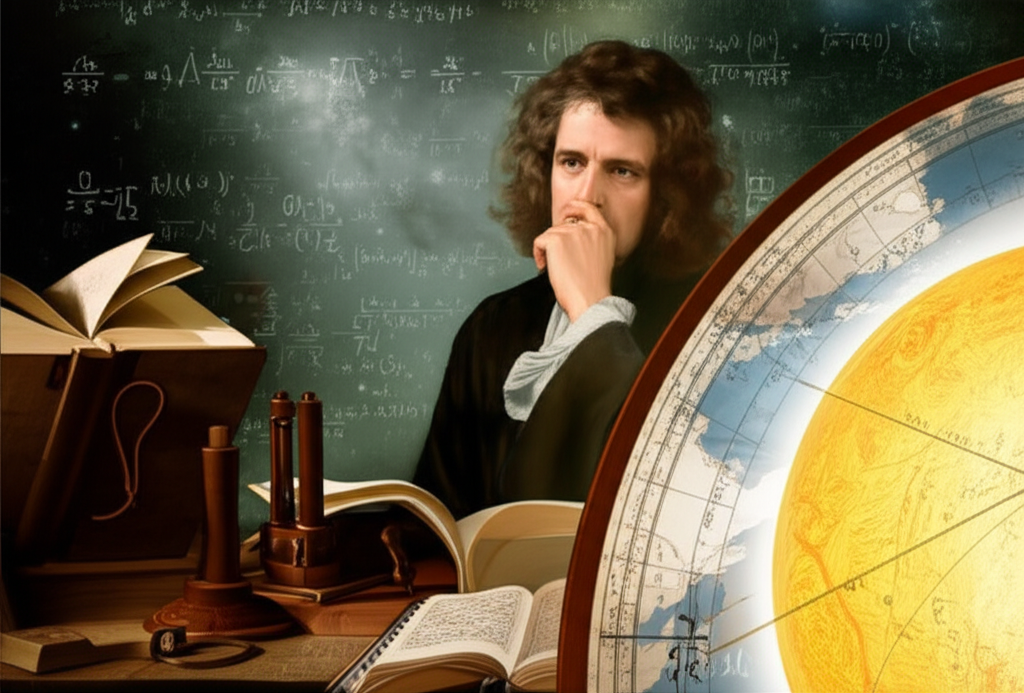
Beyond the Visible: Modern Cosmology and the Immeasurable
The legacy of Newton's mathematical universe continues to this day, with modern Astronomy pushing the boundaries of what can be observed and quantified.
Expanding Universe and Dark Mysteries
The 20th century brought further revolutionary insights. Edwin Hubble's observations, combined with Einstein's theory of relativity, revealed that the universe is not static but expanding. This discovery introduced new dimensions of quantity – the age of the universe, the rate of its expansion, and the vast distances between galaxies, measured in billions of light-years. Concepts like "dark matter" and "dark energy" emerged from mathematical models attempting to explain observed galactic rotations and the accelerating expansion of Space, highlighting how mathematics now guides our understanding even of things we cannot directly perceive.
The Philosophical Implications of Infinite Space and Time
The ongoing quest to understand the universe's origin (the Big Bang), its ultimate fate, and the nature of Space and time continues to challenge our philosophical frameworks. Is Space truly infinite, or merely unbound? What does it mean for us, as finite beings, to contemplate such immense quantity and scale? Modern cosmology, deeply reliant on advanced mathematics, forces us to reconsider our intuitions about reality, causality, and existence itself. The mathematics of Astronomy doesn't just measure the cosmos; it expands our consciousness of what is possible and what remains eternally mysterious.
Key Takeaways: The Unending Dialogue
The journey through the Mathematics of Astronomical Quantity reveals an enduring and fertile dialogue between scientific inquiry and philosophical contemplation. From ancient attempts to find order in the celestial spheres to modern theories grappling with the very fabric of Space and time, mathematics has consistently served as the indispensable language of the cosmos. It allows us to measure the immeasurable, to conceive of the inconceivable, and to confront the profound philosophical questions posed by the sheer quantity and scale of the universe. Our understanding of Astronomy is, at its heart, a testament to the power of human reason and its most potent tool: mathematics.
📹 Related Video: What is Philosophy?
Video by: The School of Life
💡 Want different videos? Search YouTube for: ""The Philosophy of Cosmology: Infinite Universe or Finite Reality?""
📹 Related Video: ARISTOTLE ON: The Nicomachean Ethics
Video by: The School of Life
💡 Want different videos? Search YouTube for: ""Great Books of Science: From Ptolemy to Newton's Principia Mathematica""