

Unpacking the Blueprint: The Logical Structure of Scientific Hypotheses
The journey of scientific discovery, often perceived as a series of experiments and observations, is fundamentally underpinned by a rigorous logical architecture. At its heart lies the scientific hypothesis—a proposed explanation for a phenomenon that is both testable and falsifiable. This article delves into the essential reasoning that structures these foundational statements, illustrating how logic provides the unseen blueprint for science's most profound insights, ensuring that our pursuit of knowledge is not merely speculative but systematically grounded.
The Unseen Architecture of Discovery: Logic's Role in Science
When we speak of science, we often conjure images of laboratories, complex equations, and groundbreaking technologies. Yet, before any experiment is conducted, or any data analyzed, there’s a crucial intellectual process at play: the formation of a hypothesis. This isn't a mere guess; it's a carefully constructed proposition, a tentative explanation that must adhere to specific logical principles to be considered scientific. Without a sound logical structure, a hypothesis would be untestable, unfalsifiable, and ultimately, unproductive for the advancement of knowledge. It is the application of logic that transforms a curious observation into a coherent, verifiable research question, bridging the gap between raw experience and systematic understanding.
What is a Hypothesis, Really? More Than Just a Guess
A hypothesis in science is a precise, testable statement about the relationship between two or more variables. It's a proposed explanation for an observed phenomenon, a preliminary answer to a specific question, or a prediction about the outcome of an experiment. Unlike a simple conjecture, a scientific hypothesis is born from existing knowledge, observations, or theoretical frameworks. It serves as the starting point for further investigation, guiding the design of experiments and the collection of data.
The distinction between a casual guess and a scientific hypothesis lies squarely in its logical formulation. A true hypothesis is:
- Testable: It must be possible to conduct an experiment or make an observation that could either support or refute it.
- Falsifiable: There must be a conceivable outcome of an experiment or observation that would demonstrate the hypothesis to be false. This critical concept, popularized by Karl Popper, underscores the empirical nature of science.
- Specific: It clearly defines the variables involved and the predicted relationship between them.
- Grounded in Reasoning: It emerges from a process of inductive reasoning (from specific observations to general principles) and often leads to deductive reasoning (from general principles to specific predictions for testing).
The Bedrock of Reasoning: Logic in Hypothesis Formation
The construction of a scientific hypothesis is a prime example of applied logic. It involves both inductive and deductive reasoning, often in a cyclical fashion.
Induction and Deduction: Two Sides of the Scientific Coin
-
Inductive Reasoning: The Path to Hypothesis Generation
- Inductive reasoning moves from specific observations to broader generalizations. When a scientist observes a consistent pattern in nature—for example, that all observed swans are white—they might induce the hypothesis that "all swans are white." This process generates potential explanations. While inductive reasoning can never guarantee the absolute truth of a generalization (a black swan might always appear), it is essential for formulating testable hypotheses.
-
Deductive Reasoning: The Path to Hypothesis Testing
- Once a hypothesis is formulated, deductive reasoning comes into play. This type of logic moves from a general statement (the hypothesis) to specific, testable predictions. If the hypothesis "all swans are white" is true, then the deductive prediction would be: "If I observe a new swan, it will be white." Experiments are then designed to test these deductive predictions. If the prediction holds true, the hypothesis gains support; if it fails (e.g., a black swan is found), the hypothesis is refuted, or at least modified.
The "If...Then..." Framework: Logic's Concrete Expression
Many scientific hypotheses are explicitly structured using an "If...then..." statement, which is a direct reflection of deductive logic.
- If [specific action is taken or condition exists], then [a particular, measurable outcome will occur].
For example:
- If plants are exposed to increased levels of CO2, then their growth rate will increase.
- If a specific drug is administered to patients with Condition X, then their symptoms will decrease by Y percentage.
This structure forces clarity and testability, making the logical connection between cause and effect explicit and providing a clear path for empirical verification or falsification.
Crafting a Testable Hypothesis: Criteria for Scientific Rigour
A well-formulated hypothesis isn't just a statement; it's a strategic tool for scientific inquiry. Its logical integrity is paramount. Here are key characteristics:
- Falsifiability: As mentioned, this is non-negotiable. A hypothesis must be open to being proven false. A statement like "Invisible unicorns exist that cannot be detected by any means" is not a scientific hypothesis because it cannot be falsified.
- Specificity and Clarity: Vague statements hinder testing. A hypothesis must define its terms and variables clearly. Instead of "Drug A helps people," a better hypothesis is "Drug A reduces blood pressure in adult males by at least 10 mmHg within two weeks."
- Empirical Testability: The hypothesis must relate to observable phenomena and be verifiable or refutable through empirical evidence, not just abstract philosophical argument.
- Parsimony (Ockham's Razor): While not strictly a logical structure, the principle of parsimony suggests that, given multiple hypotheses that explain the same phenomenon, the simplest one (requiring the fewest assumptions) is generally preferred.
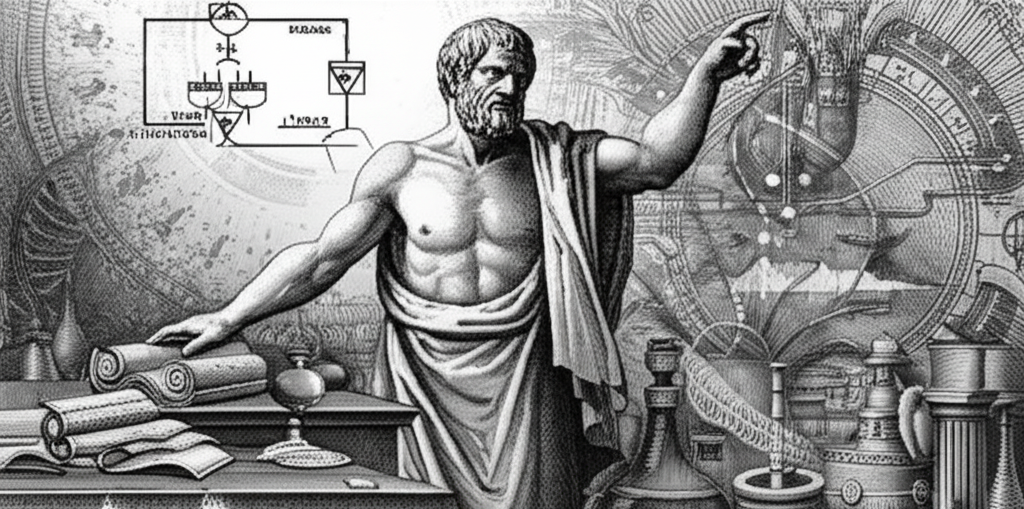
From Conjecture to Consensus: The Journey of Scientific Logic
A single hypothesis rarely stands alone. Science progresses through a cycle of observation, hypothesis formation, deductive prediction, experimentation, and analysis. If a hypothesis is repeatedly supported by evidence from various experiments, it may eventually contribute to a broader scientific theory. A theory is not a mere guess; it is a well-substantiated explanation of some aspect of the natural world, based on a body of facts that have been repeatedly confirmed through observation and experiment. The logical framework of hypotheses ensures that this journey from initial conjecture to established theory is robust, transparent, and open to continuous scrutiny and refinement.
Echoes of the Ancients: Logic's Enduring Legacy in Science
The very foundation of systematic reasoning in science has deep roots in philosophy, particularly within the works compiled in the Great Books of the Western World. Think of Aristotle's Organon, which meticulously laid out the principles of logic, including syllogistic reasoning—a form of deductive logic that still informs how we structure arguments and test propositions. Later, Francis Bacon, in his Novum Organum, championed inductive reasoning as the engine for scientific discovery, moving science away from purely speculative philosophy towards empirical investigation. René Descartes, in his Discourse on Method, emphasized clear and distinct ideas, further strengthening the need for rigorous, logical steps in inquiry. These philosophical giants, long before the advent of modern science, provided the intellectual scaffolding upon which the logical structure of scientific hypotheses would eventually be built. Their insights into logic and reasoning remain profoundly relevant, reminding us that science is not just about facts, but about the coherent, logical framework that allows us to interpret and understand them.
Conclusion: The Enduring Power of Logical Inquiry
The logical structure of scientific hypotheses is far more than an academic exercise; it is the vital framework that empowers science to advance. By demanding clarity, testability, and falsifiability, logic ensures that our explanations of the world are not arbitrary but systematically grounded in evidence and reasoning. From the initial spark of an idea to the rigorous testing of a prediction, logic guides every step, ensuring that the progress of science is a testament to humanity's capacity for ordered thought and persistent inquiry.
📹 Related Video: ARISTOTLE ON: The Nicomachean Ethics
Video by: The School of Life
💡 Want different videos? Search YouTube for: ""Karl Popper Falsifiability Explained""
📹 Related Video: KANT ON: What is Enlightenment?
Video by: The School of Life
💡 Want different videos? Search YouTube for: ""Inductive vs Deductive Reasoning in Science""