

The Logical Structure of Scientific Hypotheses: A Foundation for Understanding
The pursuit of knowledge, particularly within the realm of Science, is fundamentally underpinned by a rigorous and often subtle application of Logic. At the heart of scientific inquiry lies the Hypothesis – not merely a guess, but a carefully constructed, testable proposition. This article delves into the indispensable Logical framework that defines, shapes, and validates scientific hypotheses, exploring how various forms of Reasoning contribute to their formation and evaluation. We will examine the critical role of structured thought in transforming observation into understanding, drawing connections to the enduring philosophical traditions that inform our approach to knowledge itself. Understanding the Logic of hypotheses is key to appreciating the very engine of scientific progress.
Introduction: The Bedrock of Inquiry
From the ancient Greek philosophers pondering the cosmos to modern physicists probing the quantum realm, the quest to understand the world has always relied on more than just observation; it demands Reasoning. Science, in its most robust form, is not a collection of facts, but a method – a systematic approach to asking questions and seeking answers. Central to this method is the Hypothesis: a proposed explanation for a phenomenon, which, crucially, must be testable. Without a sound Logical structure, a hypothesis remains an unsubstantiated claim, incapable of advancing our understanding. The journey from curiosity to comprehension is paved with the careful construction and rigorous examination of these logical propositions.
Defining the Scientific Hypothesis: More Than an Educated Guess
A scientific Hypothesis is often described as an "educated guess," but this simplification can obscure its true complexity and Logical sophistication. It is, in fact, a precise, testable statement about the relationship between variables.
- Beyond a Mere Guess: Unlike a casual assumption, a scientific hypothesis is grounded in existing knowledge, prior observations, or theoretical frameworks. It doesn't emerge from a vacuum but from a context of inquiry. It represents a tentative explanation that aims to account for observed facts or predict new ones.
- The Role of Observation and Theory: Hypotheses are typically formulated after initial observations spark a question. For instance, noticing that certain plants grow taller in one type of soil than another might lead to a hypothesis about the effect of soil composition on plant growth. This initial observation is then filtered through existing scientific theories or principles, providing the "educated" component of the guess. It's a bridge between the known and the unknown.
The Logical Architecture of a Hypothesis
The very essence of a scientific Hypothesis lies in its Logical structure, which dictates how it can be tested and evaluated. This structure often employs various forms of Reasoning.
1. If-Then Statements and Deductive Reasoning
The classic form of a scientific hypothesis is an "If-Then" statement, which inherently lends itself to Deductive Reasoning.
- Structure: "If [independent variable changes], then [dependent variable will change]."
- Example: If a plant receives more sunlight (independent variable), then it will grow taller (dependent variable).
- Deductive Logic in Testing: When we test such a hypothesis, we are essentially using a form of deduction.
- Premise 1 (Hypothesis): If P, then Q. (If more sunlight, then taller growth.)
- Premise 2 (Observation/Experiment): P is true. (We give a plant more sunlight.)
- Conclusion (Prediction): Therefore, Q should be true. (The plant should grow taller.)
If the predicted outcome (Q) does not occur, then the hypothesis (If P, then Q) is weakened or potentially falsified. This direct, top-down Reasoning from a general statement to a specific prediction is fundamental to hypothesis testing.
2. Inductive Reasoning: The Path to Hypothesis Formation
While testing often involves deduction, the initial formation of a Hypothesis frequently relies on Inductive Reasoning. This involves moving from specific observations to broader generalizations.
- Process:
- Observation 1: Plant A with nutrient X grows well.
- Observation 2: Plant B with nutrient X grows well.
- Observation 3: Plant C with nutrient X grows well.
- Inductive Hypothesis: Therefore, nutrient X promotes plant growth in general.
- Limitations: While crucial for generating hypotheses, Inductive Reasoning does not guarantee the truth of the conclusion. Future observations might contradict the generalization. As philosophers from Aristotle to Hume have explored, induction provides probability, not certainty.
3. Abductive Reasoning: Inference to the Best Explanation
A third, often overlooked, form of Reasoning in hypothesis generation is abduction. This involves forming a hypothesis that offers the best explanation for a set of observations, even if it's not deductively or inductively certain.
- Process:
- Observation: The grass is wet.
- Possible Explanations: It rained; the sprinklers were on; there was heavy dew.
- Abductive Hypothesis: Given the time of day and weather forecast, "it rained" is the most plausible explanation.
- Role in Science: Abduction is vital in fields like medicine (diagnosing a disease from symptoms), forensics, and theoretical physics (proposing new particles to explain experimental anomalies). It generates hypotheses that are then subjected to deductive and inductive testing.
Table 1: Types of Reasoning in Scientific Inquiry
| Reasoning Type | Direction of Logic | Primary Role in Hypothesis | Certainty of Conclusion |
|---|---|---|---|
| Deductive | General to Specific | Testing, Prediction | High (if premises true) |
| Inductive | Specific to General | Hypothesis Formation | Probabilistic |
| Abductive | Observation to Best Explanation | Hypothesis Generation | Plausible, but tentative |
Testing Hypotheses: Falsification and Verification
Once a Hypothesis is logically structured, the next critical step in Science is testing. This process also relies heavily on Logic.
1. Popper's Falsifiability Criterion
One of the most influential ideas in the Logic of Science comes from Karl Popper, who argued that for a hypothesis to be truly scientific, it must be falsifiable.
- The Principle: A scientific hypothesis must be capable of being proven wrong by observation or experiment. If a hypothesis cannot, in principle, be disproven, it falls outside the realm of empirical Science.
- Logical Implication: This criterion leverages Deductive Reasoning through modus tollens:
- Premise 1 (Hypothesis): If H is true, then O should be observed. (If gravity works this way, then apples fall down.)
- Premise 2 (Experiment/Observation): O is not observed. (Apples fall up.)
- Conclusion: Therefore, H is false.
- Strength: Falsification provides a powerful way to eliminate incorrect theories and refine our understanding. It shifts the focus from trying to confirm a hypothesis to trying to break it, leading to more robust scientific knowledge.
2. The Elusive Nature of Absolute Verification
While we can definitively falsify a hypothesis with a single contradictory observation (assuming the observation is reliable), we can rarely achieve absolute verification.
- Inductive Problem Revisited: Even if countless experiments support a hypothesis, Inductive Reasoning reminds us that the next experiment could still contradict it. We can never observe all possible instances.
- Confirmation vs. Proof: Science aims for strong confirmation – a hypothesis gains credibility with repeated successful tests and predictive power – but it rarely claims definitive proof. This humility is a hallmark of sound scientific Reasoning.
The Interplay of Logic, Science, and Hypothesis
The relationship between Logic, Science, and Hypothesis is cyclical and mutually reinforcing.
From Ancient Philosophy to Modern Science
The roots of scientific Reasoning can be traced back to the "Great Books of the Western World." Aristotle's Organon, for instance, laid down the foundational principles of deductive logic, which later thinkers like Francis Bacon, in his Novum Organum, sought to complement with methods of inductive discovery. René Descartes, in his Discourse on Method, emphasized systematic doubt and clear, distinct ideas as pathways to knowledge. These philosophical inquiries into the nature of knowledge and Reasoning directly shaped the development of the scientific method and the Logical structure we apply to hypotheses today. The ongoing dialogue between philosophy and Science continues to refine our understanding of what constitutes valid inquiry.
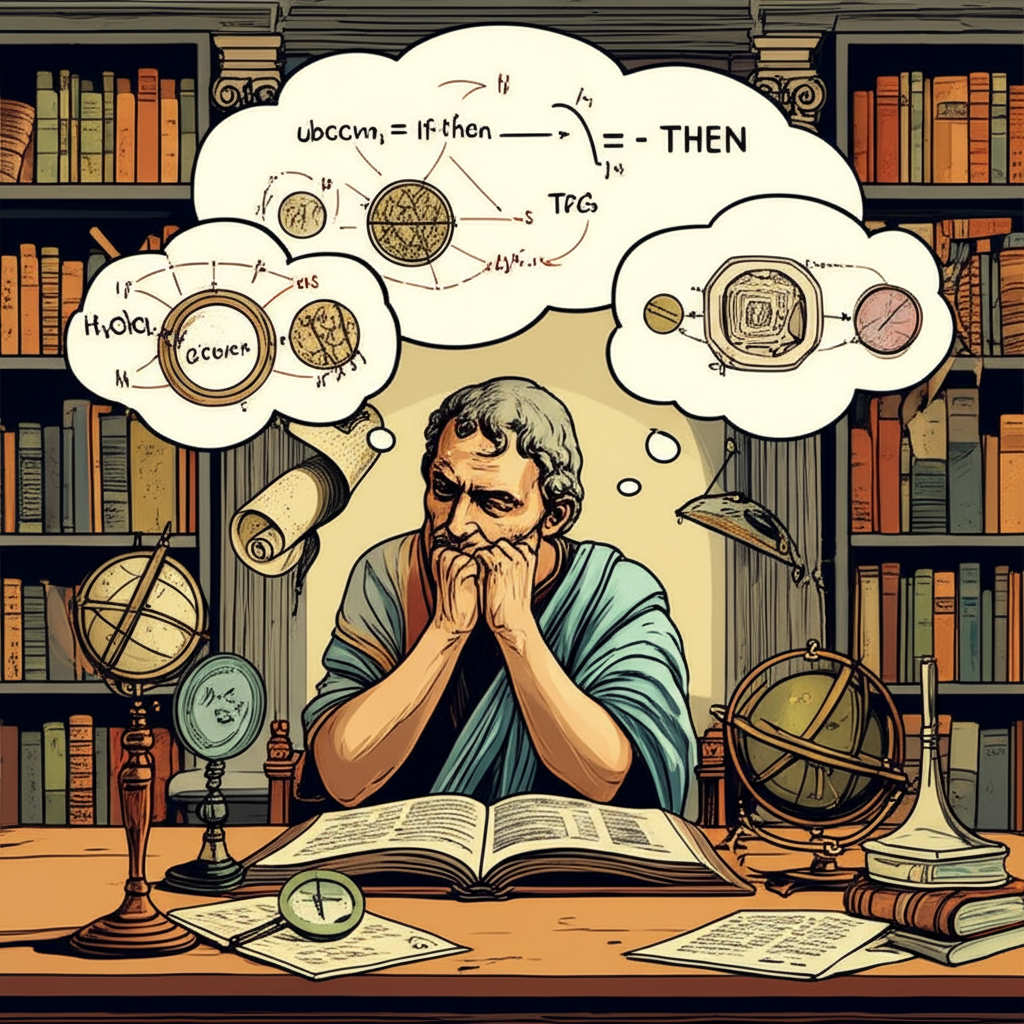
The Continuous Cycle of Inquiry
Scientific progress is not a linear march but a continuous cycle:
- Observation: Noticing a phenomenon.
- Question: Asking why or how.
- Hypothesis Formation: Proposing a testable explanation using Inductive or Abductive Reasoning.
- Prediction: Deducing what should happen if the hypothesis is true.
- Experiment/Observation: Testing the prediction.
- Analysis: Evaluating results against the prediction.
- Refinement/Rejection: Modifying the hypothesis, forming a new one, or accepting it as provisionally confirmed.
This cycle, driven by Logic at every turn, ensures that Science is a self-correcting enterprise, constantly refining its understanding of the natural world through the rigorous examination of hypotheses.
Conclusion: The Enduring Power of Structured Thought
The scientific Hypothesis is far more than an educated guess; it is a testament to the power of structured thought and the application of Logic in understanding our universe. From the initial spark of Inductive Reasoning to the rigorous tests of Deductive Logic and the crucial insights of Abductive Reasoning, every step in the scientific process relies on a deep appreciation for logical coherence. As Daniel Sanderson, I contend that embracing the Logical architecture of hypotheses is not just a technical requirement for Science, but a philosophical imperative for anyone seeking genuine knowledge. It is the framework that allows us to move beyond mere belief to justified understanding, continually building upon the intellectual heritage found within the "Great Books" and pushing the boundaries of what we know.
YouTube Video Suggestions:
-
📹 Related Video: ARISTOTLE ON: The Nicomachean Ethics
Video by: The School of Life
💡 Want different videos? Search YouTube for: "Karl Popper Falsifiability Explained"
-
📹 Related Video: What is Philosophy?
Video by: The School of Life
💡 Want different videos? Search YouTube for: "Inductive vs Deductive Reasoning Philosophy Science"