

The Architecture of Understanding: Unpacking the Logical Structure of Definition
In the grand tapestry of philosophical inquiry, few threads are as fundamental and enduring as the logical structure of definition. It is the very scaffold upon which coherent thought is built, the precise articulation that allows us to distinguish, categorize, and ultimately, comprehend the world around us. Without a rigorous approach to definition, our reasoning becomes a house of cards, susceptible to ambiguity, equivocation, and outright fallacy. This article delves into the classical understanding of how we define, drawing deeply from the Logic found within the Great Books of the Western World, revealing why this seemingly simple act is, in fact, an intricate art essential for any serious pursuit of knowledge.
The Cornerstone of Clarity: Genus and Differentia
At the heart of a robust definition lies the elegant interplay of two fundamental concepts: genus and differentia. This Aristotelian framework, foundational to Western Logic, provides a powerful method for dissecting and articulating the essence of a thing.
- Genus (The Universal): The genus refers to the broader class or category to which the thing being defined belongs. It answers the question, "What kind of thing is it?" The genus represents the universal aspect, shared by many different things. For instance, if we are defining "human," its genus might be "animal."
- Differentia (The Particular): The differentia, on the other hand, specifies the unique characteristic or quality that distinguishes the defined thing from all other members of its genus. It answers the question, "What makes this particular thing distinct within its kind?" This is the particular aspect that carves out a unique identity. For "human," the differentia might be "rational" or "tool-making."
Thus, a classic definition emerges: "A human is a rational animal." Here, "animal" is the genus, and "rational" is the differentia. This structure ensures that the definition is neither too broad (like just "animal") nor too narrow (like "a bipedal, featherless animal" which, while true, misses a more fundamental distinction).
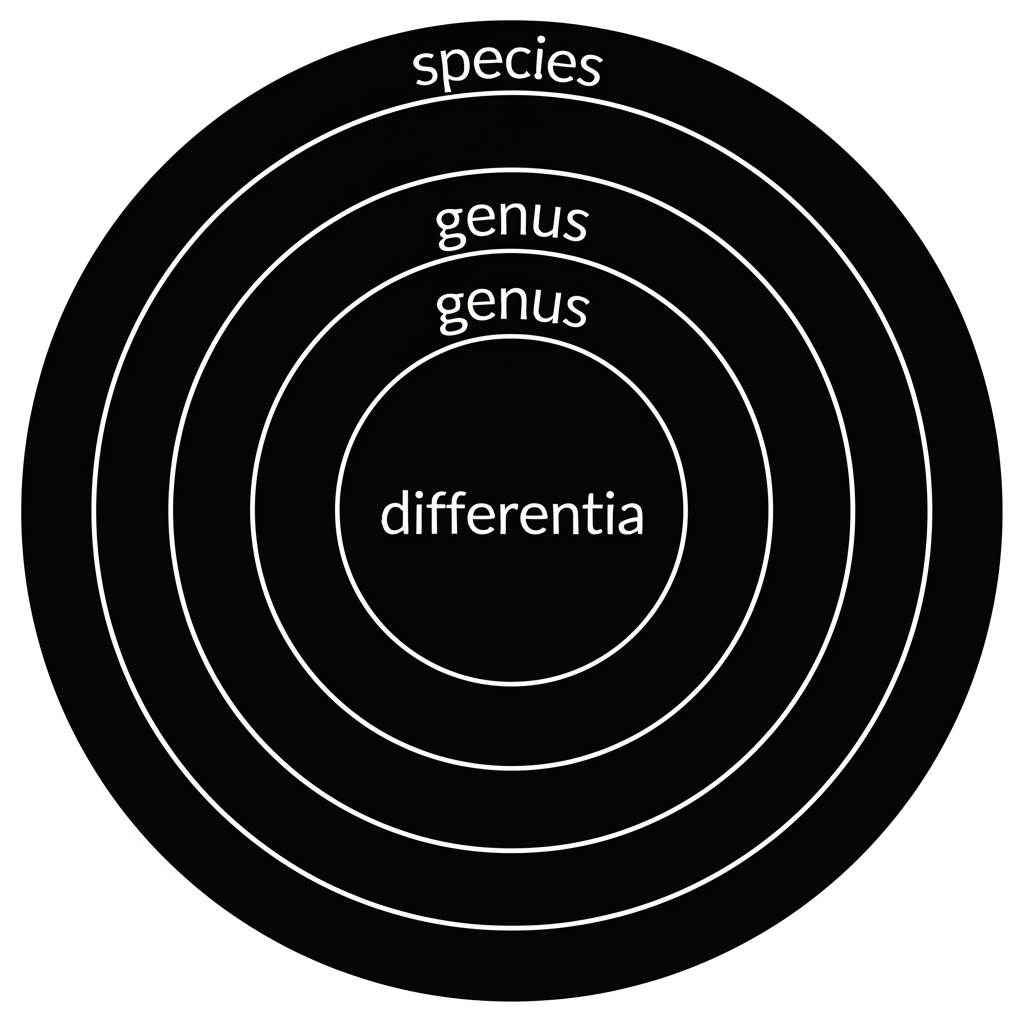 , visually depicting how differentia narrows down a genus to a specific species.)
Why Logical Definition Powers Sound Reasoning
The meticulous construction of definitions is not merely an academic exercise; it is indispensable for sound reasoning. When terms are ill-defined or used inconsistently, communication breaks down, and arguments lose their persuasive force.
- Eliminating Ambiguity: Precise definitions act as a bulwark against ambiguity. When we define our terms clearly, we ensure that everyone involved in a discussion or argument is operating with the same understanding of the concepts at hand. This is crucial in philosophy, where subtle shifts in meaning can derail an entire line of thought.
- Facilitating Deductive Logic: In deductive logic, premises must be clear and unambiguous for conclusions to follow necessarily. A well-defined term within a premise strengthens the entire logical chain, allowing for rigorous inference and valid arguments.
- Guiding Philosophical Inquiry: Many philosophical debates hinge on the definition of key terms: What is justice? What is truth? What is consciousness? The attempt to define these concepts rigorously often is the philosophical inquiry itself, pushing us to examine their universal and particular facets.
- Preventing Fallacies: Many informal fallacies, such as equivocation, arise directly from a failure to maintain a consistent definition of a term throughout an argument. A strong logical structure of definition inoculates against such errors, fostering intellectual honesty and clarity.
The Rules of Engagement: Crafting Effective Definitions
Drawing from the classical tradition, particularly as outlined by thinkers like Aristotle and later logicians, certain rules emerge for constructing good definitions. These aren't arbitrary guidelines but principles derived from the very nature of effective communication and reasoning.
Key Principles for Logical Definition:
- State the Genus and Differentia: As discussed, this is the foundational rule. It ensures precision by placing the term within a broader category and then distinguishing it.
- Be Coextensive with the Thing Defined: The definition should be neither too broad (including things that aren't the term) nor too narrow (excluding things that are). It should perfectly match the extension of the term.
- Example of too broad: Defining "human" as "an animal" (includes all animals).
- Example of too narrow: Defining "human" as "a philosopher" (excludes most humans).
- Avoid Circularity: The term being defined should not appear in its own definition, nor should any synonym of it that itself requires definition.
- Poor: "A circle is a circular figure."
- Better: "A circle is a plane figure all points of which are equidistant from a given point."
- Be Clear, Not Obscure: The definition should be expressed in terms that are more familiar and understandable than the term being defined. Avoid jargon, metaphors, or ambiguous language that obscures rather than illuminates.
- Be Affirmative Where Possible: Definitions should, wherever possible, state what something is rather than what it is not. While negative definitions are sometimes necessary (e.g., "darkness is the absence of light"), positive definitions are generally more informative.
The Enduring Legacy for Planksip's Pursuits
The logical structure of definition is not a relic of ancient philosophy but a living, breathing tool essential for navigating the complexities of modern thought. From dissecting scientific concepts to clarifying ethical dilemmas, the ability to precisely define our terms is the bedrock of intellectual progress. As we engage with the profound ideas contained within the Great Books of the Western World, we are continually reminded of the masters' commitment to this very precision. Their legacy challenges us, Daniel Sanderson, to wield Logic not as a blunt instrument, but as a finely honed scalpel, enabling us to cut through confusion and illuminate truth, one carefully constructed definition at a time.
📹 Related Video: ARISTOTLE ON: The Nicomachean Ethics
Video by: The School of Life
💡 Want different videos? Search YouTube for: "Aristotle Logic Definition"
📹 Related Video: What is Philosophy?
Video by: The School of Life
💡 Want different videos? Search YouTube for: "Philosophy of Language Definition"